Lesson Overview
Paying for a full degree abroad is different from paying for college in the US. In this lesson, you’ll learn:
- Which types of US financial aid can (and can’t) be used for degrees abroad
- How FAFSA and the CSS Profile fit in when studying outside the US
- How scholarships and grants work for international programs
- How private student loans work for degrees abroad
- How to use our partner Juno to shop for competitive private student loans for overseas degrees
By the end, you’ll have a clear funding plan and a checklist of actionable next steps.
Big Picture: How Paying for a Degree Abroad Works
Before diving into forms and loans, it helps to understand a few key differences between studying in the US and abroad.
1. Tuition and Cost Structure
- Tuition is often lower in many European countries compared to US universities.
- Fee structures differ: some universities charge flat annual fees, others per-credit, and some have administrative or residence permit fees.
- Living costs can vary widely depending on location.
- Currency exchange risk: your costs may be in euros or another currency while your savings are in USD.

Full article here: https://beyondthestates.com/guide-to-college-tuition-in-europe-for-international-students/
2. Types of Funding You Might Use
Most students combine several sources:
- Personal/family savings
- US federal aid (only if the foreign university participates in US federal aid programs)
- University scholarships from the foreign institution
- External scholarships (US or international)
- Work income (part-time work where allowed by visa rules)
- Private student loans (US-based or international lenders)
US Federal Aid: FAFSA & Studying Abroad
FAFSA (Free Application for Federal Student Aid) is the main form for US federal aid. For international degrees, the rules are specific.
1. When Federal Aid Can Be Used Abroad
You may qualify for US federal student loans if:
- You are a US citizen or eligible non-citizen
- You enroll in a Title IV–approved foreign institution
- You enroll in an eligible degree program at that institution
If eligible, you can access:
- Direct Subsidized/Unsubsidized Loans
- Direct PLUS Loans (for parents or graduate students)
- Limited Pell Grants for certain programs
Important: If your university does not participate in US federal aid, federal loans cannot be used.
2. FAFSA for Study Abroad vs Full Degree Abroad
- Semester abroad through US school: Aid flows through your US university.
- Full degree abroad:
- Apply to foreign institution’s financial aid
- Use FAFSA/federal loans only if the school participates in US federal programs
3. Why File FAFSA Anyway
- Confirms eligibility for any federal loans available
- Required by some scholarships
- Circumstances may change during your degree
Call-to-Action:
Take 20–30 minutes to complete your FAFSA now.
FAFSA Official Site
CSS Profile: Need-Based Aid for Certain Programs

The CSS Profile is a separate application for many US private universities and some public institutions to award need-based aid.
For degrees abroad:
- Less commonly used but can matter if applying to US and non-US schools simultaneously
- Useful for dual-degree programs
- Helps you compare full financial aid picture across countries
Submit the CSS Profile if any of your target schools list it as required or recommended.
Private Student Loans for Degrees Abroad
1. When Private Loans Make Sense
- Your university doesn’t participate in federal aid
- Federal loans don’t cover full costs
- You want flexible loan features
2. Key Loan Concepts
- Interest rate (fixed vs variable)
- APR with fees included
- Repayment options (interest-only, deferment)
- Cosigner rules & release
- Fees and penalties
3. Marketplace Advantage
- Compare lenders in one place
- Pre-screened for international degrees
- Potentially better terms via group negotiation
Using Juno for Private Loans
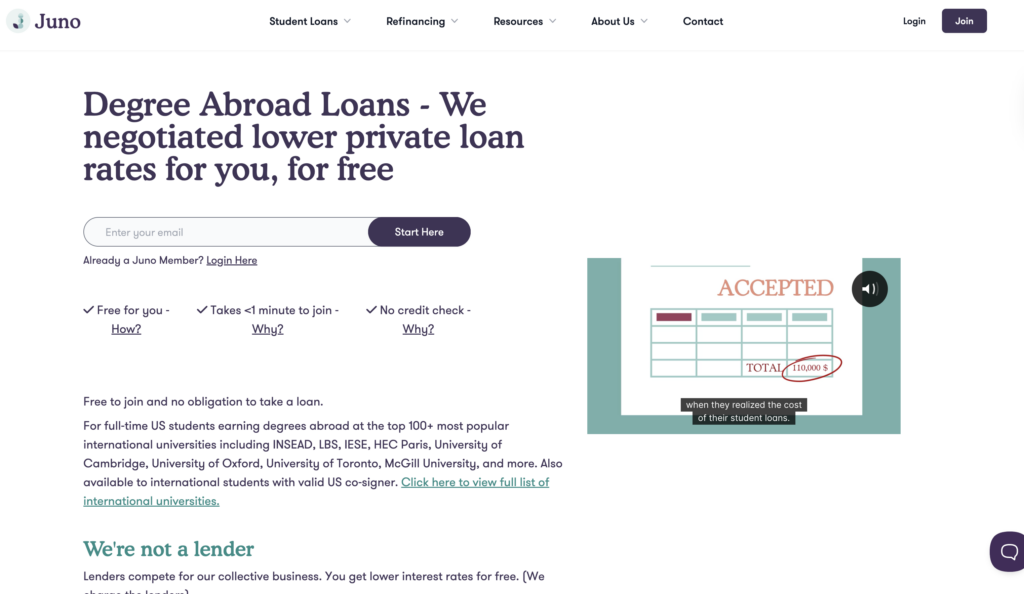
What Juno Does:
- Negotiates group discounts & terms with lenders
- Connects you with lenders supporting degrees abroad
- Provides transparent loan comparisons
Why It Helps:
- Ensures enrollment verification is accepted
- Streamlines loan applications for international universities
- Helps avoid guesswork on rates and repayment
Putting It All Together: Your Funding Plan
- Confirm Eligibility & Costs
- Check Title IV participation
- Request official tuition & fees
- Draft full budget (local currency & USD)
- Maximize Free Money
- List all scholarships & grants
- Track deadlines
- Apply early
- Complete Core US Forms
- FAFSA, CSS Profile if applicable
- Determine Your Funding Gap
- Total cost – scholarships/family/federal aid = funding gap
- Explore Private Loan Options
- Visit Juno
- Discuss responsibilities with family/cosigner
- Re-evaluate & Optimize
- Consider lower-cost programs
- Part-time work (visa rules)
- Update budget annually
Lesson Checklist
✅ Verified foreign university participates in US federal aid
✅ Filed/planned FAFSA
✅ Submitted CSS Profile if needed
✅ Created full degree budget
✅ Identified 5–10 scholarship opportunities
✅ Calculated funding gap
✅ Reviewed private loans through Juno
Financing an international degree can feel overwhelming. But once you:
- Understand federal aid abroad
- Maximize scholarships
- Build a realistic budget
- Compare responsible loan options
…you’ll have a clear funding roadmap.
Your degree abroad isn’t just academic—it’s financial planning in action. Investing the time now saves thousands later and gives you freedom after graduation.