What Is Nostrification?
Sixty-three percent of U.S. students applying to European universities don’t realize that their degree may need formal recognition after graduation.
You complete your degree. You receive your diploma. Everything seems finished. But in some countries, having the diploma itself doesn’t automatically mean you can work, continue your studies, or practice certain professions. In those cases, your degree may need to be officially recognized by the government.
Here’s what many families don’t know: this process is called nostrification. It’s the formal recognition of a foreign degree, and it’s a completely separate step from actually earning the degree.
And this is where it becomes important. If you’re planning to earn a full accredited degree abroad, understanding nostrification can save you a lot of confusion later on. It can affect your career opportunities, your ability to apply to graduate programs, and even your post-graduation timeline. Some countries require it. Others don’t. Knowing which is which can make a big difference in how you plan your education abroad.
Summary
What Is Nostrification?

Nostrification is the legal recognition of foreign educational credentials by another country.
Put simply, it answers one question:
“Is your U.S. diploma considered academically equivalent to a diploma issued in this country?”
The process can apply to:
- High school diplomas
- Bachelor’s degrees
- Master’s degrees
- Professional qualifications
Once approved, your credential receives official recognition within that country’s education system.
Why does this matter?
Some universities legally cannot admit students into certain programs until they confirm that prior qualifications meet national education standards.
This tends to be more common in countries with centralized education systems.
On the other hand, many European universities especially in places like the Netherlands, Ireland, Sweden, Denmark, and Finland often evaluate credentials themselves and don’t require formal nostrification.
This distinction matters.
A lot of students assume every international degree requires government approval. In reality, the rules can vary not only by country but sometimes by university.
Why Is Nostrification Required?
The main goal of nostrification is quality control.
Governments want to make sure incoming students have an academic background comparable to domestic applicants.
Reasons nostrification may be required:
- To confirm diploma authenticity
- To determine educational equivalency
- To verify prerequisite coursework
- To comply with national education regulations
- To qualify graduates for regulated professions
For example, a U.S. high school diploma may not automatically match the structure of another country’s secondary education system.
Similarly, some professional master’s programs need confirmation that an applicant’s bachelor’s degree meets specific national requirements.
| Situation | Nostrification May Be Needed? |
|---|---|
| Applying for a bachelor’s degree abroad | Sometimes |
| Applying for a master’s degree | Occasionally |
| Medical or healthcare professions | Frequently |
| Teaching licenses | Frequently |
| Employment in regulated professions | Often |
| Semester study abroad programs | Rarely |
Need Help With Nostrification?
Nostrification requirements can vary widely by country and university, making the process confusing for many families.
Beyond The States created a Nostrification Course to help students understand requirements, prepare documents, avoid common mistakes, and navigate the process with confidence.
The course covers:
- Which countries require nostrification and which often do not
- Step-by-step guidance on the recognition process
- Documents commonly requested by universities and government offices
- Translation and apostille requirements
- Common mistakes that delay applications
- Practical timelines so students can plan ahead
For families pursuing a full degree in Europe, understanding credential recognition early can save both time and unnecessary stress.
Recommended products
-
How to Nostrify Your Degree – Step-by-Step Course
Original price was: $499.00.$249.00Current price is: $249.00.

How Does Nostrification Work?
The exact process depends on the country, but the general steps are fairly similar.
Step 1: Submit Academic Documents
Applicants provide educational records from their home country.
Step 2: Credential Evaluation
Educational authorities compare the foreign qualification with domestic standards.
Step 3: Additional Requirements
Some countries may request:
- Certified translations
- Apostilles
- Supplemental coursework
- Entrance examinations
Step 4: Official Recognition Decision
Authorities may:
- Fully recognize the credential
- Grant conditional recognition
- Deny recognition if equivalency standards are not met
Here’s the interesting part: in many cases, universities handle all of this internally, and students never have to go through formal nostrification at all.
That’s one reason why understanding country-specific requirements early on is so helpful.
Documents Needed for Nostrification
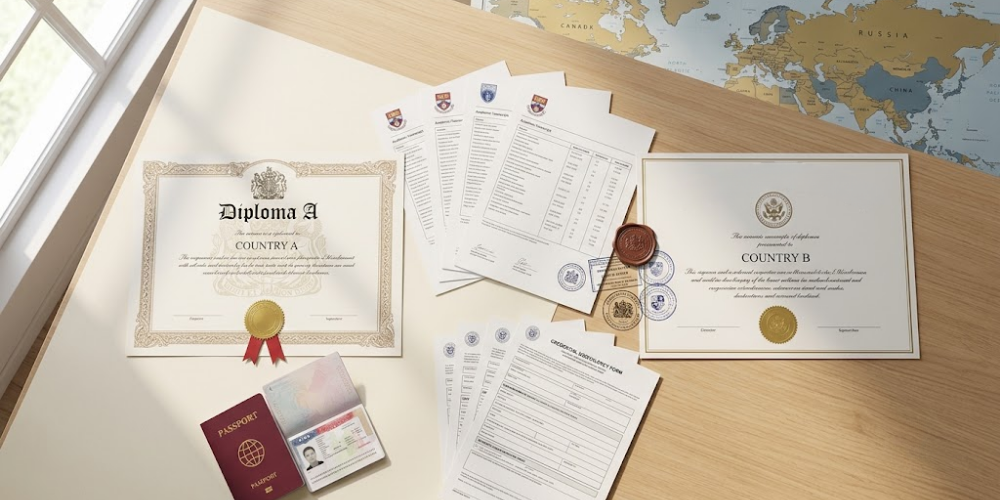
One of the most common questions students ask is:
What documents are needed for nostrification?
The answer varies, but most applications include:
Typical Documents Needed for Nostrification
- Passport copy
- High school diploma or university degree
- Official transcripts
- Course descriptions or syllabi
- Proof of accreditation of the previous institution
- Certified translations
- Apostille certification (in some countries)
- Application forms
- Administrative fees
Some countries may also request:
- Birth certificate
- Proof of name changes
- University acceptance letter
Because requirements differ so much, it’s always a good idea to confirm the exact process directly with the university or national education authority.
How Long Does the Nostrification Process Take?
One of the biggest frustrations for international students is simply not knowing how long things will take.
| Country Type | Estimated Timeline |
|---|---|
| University-administered evaluations | 2–8 weeks |
| Government recognition offices | 1–6 months |
| Professional licensing recognition | 3–12 months |
Several factors can affect processing speed:
- Country regulations
- Translation requirements
- Completeness of documents
- Time of year
- Complexity of the evaluation
How long does the nostrification process take?
For most students, expect anywhere from one month to six months.
Planning ahead is important here.
Applying too late can delay enrollment, visa processing, and sometimes even scholarship opportunities.
Cost of Nostrification for International Students
Costs vary widely across Europe.
| Expense | Estimated Cost |
|---|---|
| Government application fee | $50–$300 |
| Certified translations | $20–$100 per page |
| Apostille services | $20–$150 |
| Document shipping | $20–$75 |
| Additional evaluations | $50–$200 |
Most students spend between:
$100 and $600
Professional fields like medicine, nursing, or law may involve additional expenses.
The good news is that, compared with the costs often associated with U.S. university applications, testing, and admissions, nostrification is usually a relatively manageable expense.

Join the conversation.
Get real answers.
Beyond the States is a student community for those building their future in Europe.
Can You Study Abroad Without Nostrification?
Yes, quite often.
This is one of the biggest misconceptions families have.
Many students who earn full degrees abroad never complete a formal nostrification process.
Countries that frequently rely more on university credential evaluations include:
- Netherlands
- Ireland
- Sweden
- Denmark
- Finland
- Many universities in Germany
In these systems, universities often assess your qualifications directly.
Countries where formal recognition may be more common:
- Czech Republic
- Slovakia
- Certain programs in Italy
- Some professional degrees across Europe
The answer depends entirely on:
- The country
- The institution
- The degree level
- The field of study
That’s why researching requirements early can make the application process much smoother.
Which European Countries Commonly Require Nostrification?
Higher Likelihood of Formal Recognition Requirements
- Czech Republic
- Slovakia
- Certain regulated professions in Southern Europe
Lower Likelihood
- Netherlands
- Sweden
- Denmark
- Finland
- Ireland
Policies can change, though, and individual universities may have their own procedures.
At Beyond The States, we focus specifically on vetted, English-taught degree programs and help students understand these country-specific differences before they apply.

Common Myths About Nostrification
Myth #1: Every European university requires it.
False.
Many universities conduct their own internal evaluations.
Myth #2: Nostrification means your degree isn’t legitimate.
False.
It’s simply an administrative recognition process.
Myth #3: It only applies to international students.
False.
Recognition procedures also apply to professionals moving between countries.
Myth #4: It takes years.
Usually false.
Most cases are resolved within a few months.
Myth #5: U.S. diplomas are automatically accepted everywhere.
False.
Even highly respected credentials may still require formal recognition depending on local regulations.
Who Is This a Good Fit For?
Understanding nostrification is especially important for students applying to:
- Medicine programs
- Dentistry programs
- Nursing degrees
- Teacher education programs
- Government-regulated professions
- Countries with centralized admissions systems
Families looking for affordable and transparent pathways to internationally recognized degrees should understand these requirements early.
That said, many students pursuing business, engineering, computer science, economics, psychology, or liberal arts degrees in Northern Europe may never need to deal with nostrification at all.
Nostrification vs Credential Evaluation
These terms are often used interchangeably, but they’re not the same thing.
| Feature | Nostrification | Credential Evaluation |
|---|---|---|
| Government involvement | Usually | Sometimes |
| Legal recognition | Yes | Not always |
| Required for admissions | Sometimes | Frequently |
| Used for employment licensing | Often | Occasionally |
| Processing time | Longer | Usually shorter |
A credential evaluation simply assesses equivalency.
Nostrification goes a step further by providing official legal recognition.
Does Nostrification Affect Degree Recognition in the United States?
Generally, no.
Degrees earned from properly accredited universities abroad are commonly recognized for graduate school admissions and employment in the United States.
Recognition typically depends on:
- Institutional accreditation
- National recognition status
- Credential evaluation agencies
This is one reason accreditation matters so much when choosing a university abroad.
At Beyond The States, we focus on accredited programs taught entirely in English and help families understand degree legitimacy before applications begin.
Discover all the English-taught European college programs in one place.
Beyond the States provides easy access to 12,600+ European bachelor’s and master’s programs across 870 universities, 550 cities, and 212 areas of study, plus all the resources you need to get there.
3400+
English-taught bachelor’s programs in our database.
550
Beautiful European cities to choose from.
$360,170
Typical savings against a private university in the US.
8200+
English-taught master’s programs in our database.
870
Top-tier universities accepting international students.
$65,038
Typical savings against in-state tuition in the US.
Frequently Asked Questions
We’re here to help answer your questions about
Nostrification is the official recognition of a foreign educational qualification as equivalent to domestic academic standards.
It helps ensure educational quality, verifies diploma authenticity, and confirms academic equivalency.
Students submit educational documents, which are then evaluated by universities or government authorities before official recognition is granted.
Most cases take between one and six months, depending on the country and complexity of the situation.
Typical requirements include diplomas, transcripts, translations, passports, and sometimes apostilles.
Most students spend between $100 and $600, although costs vary by country.
Yes. Many European universities admit students through internal credential evaluations and do not require formal nostrification.
No. Requirements depend on the country, institution, and field of study.
Final Thoughts
Nostrification may sound intimidating, but for many students it’s simply an administrative step, not a major obstacle.
The bigger takeaway is this:
European higher education systems are incredibly diverse.
Some countries require formal government recognition. Others leave credential evaluations entirely to universities. Understanding those differences early can save a lot of time, money, and frustration.
For American families considering a full accredited degree abroad, having clear information makes all the difference.
At Beyond The States, we research English-taught degree programs across Europe and help students identify universities with transparent admissions processes, realistic costs, and internationally recognized credentials.
If you’re exploring your options, we encourage you to compare countries, review program requirements, and take our Beyond The States quiz to discover which pathways may be the best fit for your academic goals. We also offer free strategy calls and guidance for families who want more personalized support as they navigate the process.