Best MCAT Prep Course
Finding the right MCAT prep course can be challenging due to the wide range of options available. Each course offers unique features such as varying video lessons, live class hours, and practice materials. Some courses provide more than 500 video lessons, while others focus on delivering live class hours, reaching up to 146 hours. Prices can range significantly, with value options starting around $400 and more comprehensive courses reaching up to $5,000.
Also, many of these courses include thousands of practice questions and several practice tests to help students prepare thoroughly. The flexibility of course access periods also plays an important role, often ranging from a few months to unlimited access depending on the program. Money-back guarantees are commonly offered, providing peace of mind for students investing in their futures.
Summary
Top Rated MCAT Prep Courses of 2026
Explore a selection of top MCAT prep options available in 2026, each offering unique strengths. Blueprint stands out as the best overall choice and has great video lessons, while Kaplan offers excellent MCQ’s with explanations. Magoosh is recognized for its value, Prep101 for its comprehensive approach, and Altius for personalized learning experiences.
Blueprint MCAT
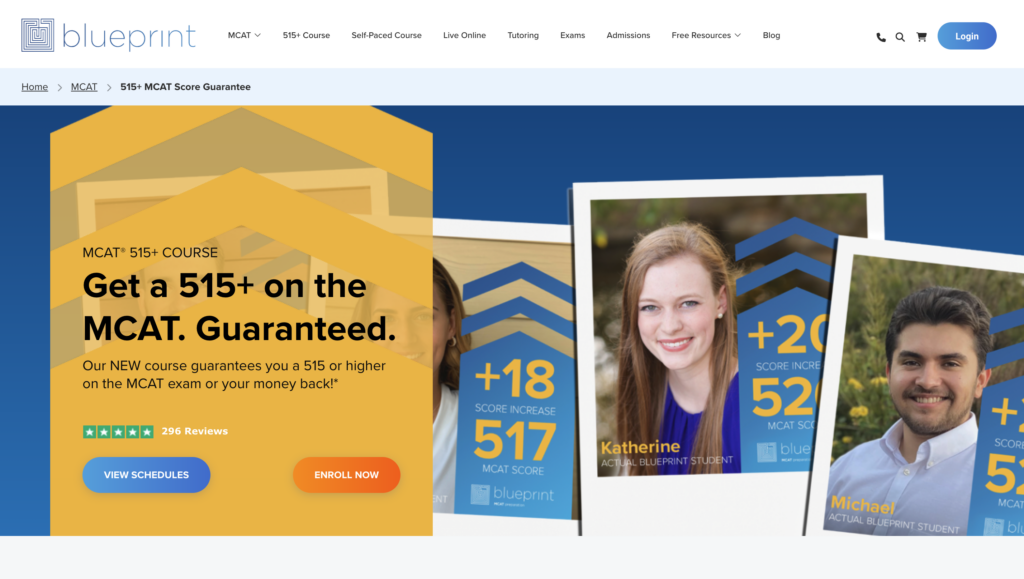
Review Score: 9.7
Outstanding Video Lessons
Blueprint excels in creating engaging video content that greatly benefits visual learners. Their approach involves instructors teaching in front of a green screen, with text, graphics, and animations augmenting the spoken material. This presentation style makes complex topics easier to grasp and more memorable. The vibrant visuals, combined with insightful commentary, make these lessons both informative and enjoyable.
Cleverly Designed Learning Modules
Blueprint organizes their learning material into easily digestible modules. Each module combines video lessons, quizzes, and assessments to offer a well-rounded approach to understanding concepts. This setup allows students to explore topics from different angles, reinforcing their knowledge and aiding retention. With over 160 modules focusing on content review and more for test strategies, students receive comprehensive guidance tailored to mastering the MCAT.
Blueprint Course Structure
Blueprint refers to another aspect where Kaplan excels. Their course offers two main styles: self-paced and live online formats. This allows students to pick the study approach best suited to their learning style. The course ensures flexibility while maintaining structure and accountability through live classes.
Other benefits may include a money-back guarantee, which shows the confidence Kaplan has in their curriculum. These factors contribute to their effective learning modules.
Pros:
- Detailed curriculum for extensive knowledge
- High-quality problem explanations enhance learning
- Efficiently structured class plans
- Comprehensive curriculum loaded with content for thorough preparation
- Accompanied by 11 superior prep books for text-focused learners
- Excellent live online classes led by a versatile group of instructors
- Strong problem explanations that surpass basic solutions
- Streamlined class structure for effective learning sessions
Cons:
- Video lessons lack advanced production
- Mobile app usability is limited
Kaplan MCAT

Review Score: 9.2
Kaplan offers MCAT prep with options for self-paced online courses or live classes. It often provides discounts to make their courses more accessible. Kaplan’s course includes high-quality video lessons filled with graphics that enhance the learning experience. Students can choose from a flexible schedule for live classes led by knowledgeable instructors. They also have access to a question bank with over 3,000 practice problems that can be filtered using advanced options.
Additional resources include more than 700 hours of study materials, nightly MCAT workshops, and various office hours to support learning. The MCAT prep books are insightful and well-structured. While Kaplan’s offerings are robust, the explanations for practice problems tend to be short and the mobile app could be improved.
Why Kaplan’s MCAT Course Stands Out
Exceptional Live Sessions
Kaplan’s live sessions provide an effective, engaging approach to MCAT prep. The recent improvements in their class structure have elevated the course experience. The flexible schedule option stands out, letting students choose classes that suit their weekly schedule. This system provides a convenient way to balance study time.
The dual-instructor model is another strong feature of their live sessions. One instructor leads the class, while another manages the chat. This ensures smooth delivery and offers students immediate answers to questions. The instructors themselves are highly experienced, bringing a deep understanding of the MCAT material to each session.
Impressive Video Instruction
Kaplan offers a comprehensive series of video lessons as part of their prep course. Although they may not surpass Blueprint’s videos, Kaplan’s content-rich video lessons are impressive. They use modern technology including digital whiteboards and high-quality production to maintain student attention and aid learning.
Each video covers essential MCAT concepts in a concise format, ranging from 10-15 minutes. These lessons are perfect for visual learners as they include formulas, graphics, and animations. With over 130 engaging video lessons available, students gain substantial value addition from these resources.
Custom-Made Qbank Questions
The customizable Qbank feature gives Kaplan’s MCAT prep an edge. Students access more than 3,000 practice questions, with options to filter by topic, question type, and difficulty level. The adaptive nature of these questions helps target areas where students need the most focus and gradually increases difficulty as their skills improve.
After tackling practice questions, students receive detailed performance reports. These analytics offer insights into strengths and weaknesses, making study sessions focused and effective. The Qbank makes sure that practice is personalized to each learner’s needs.
Kaplan’s MCAT prep course receives high praise across multiple areas. The video lessons are packed with visual content, ensuring students grasp complex concepts. The course structure effectively combines different learning methods. Kaplan integrates over 5,000 practice problems with thorough explanations.
Although having fewer tests and live hours compared to competitors, Kaplan’s resources are well-rounded. While explanations for some questions might be improved, the course delivery remains superior.
Pros:
- Comprehensive curriculum covering all MCAT topics in depth
- High-quality practice questions with well-explained solutions
- Structured class plans that keep students on track
- Comes with 11 in-depth prep books for thorough content review
- Live online classes led by experienced instructors
- Strong analytics to track progress and identify weaknesses
- Access to AAMC practice materials for realistic test prep
- Well-organized study schedules for different timelines
Cons:
- Video lessons are less engaging and have lower production quality compared to competitors
- Limited mobile app functionality for on-the-go studying
- Higher price point, especially for live courses
- Less personalized learning compared to adaptive platforms like Blueprint
Princeton Review MCAT Prep
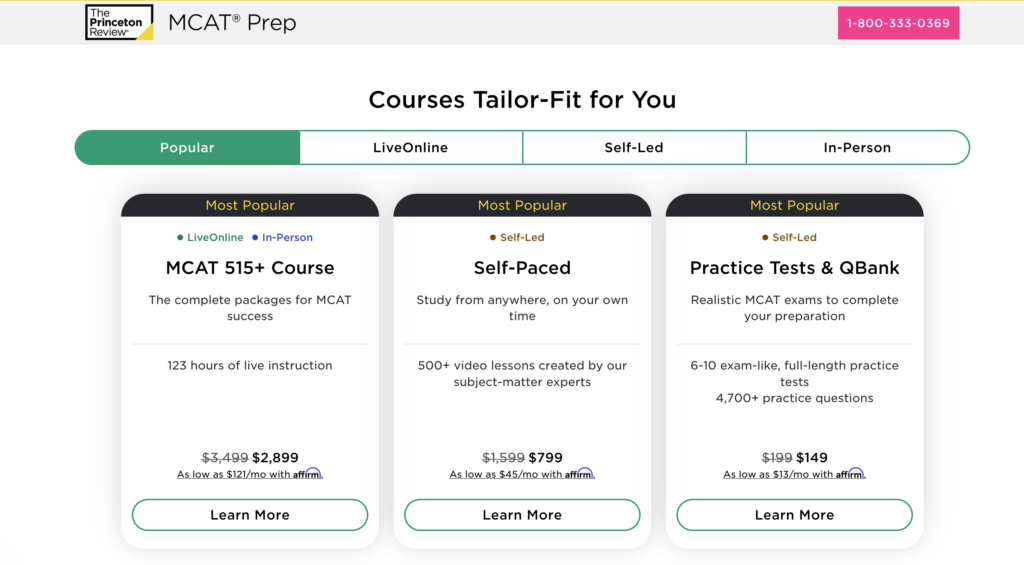
8.1 Score
Strong Live Class Sessions
Princeton Review offers an impressive total of 40 live class hours, available either online or in person. Each session is conducted by a rotating team of 4 to 6 expert instructors, each specialized in a different subject area. This approach allows students to gain in-depth knowledge from specialists rather than generalists, enhancing the learning experience significantly. This specialized method helps ensure that students receive quality instruction across various subjects covered in the MCAT.
Excellent MCAT Preparation Books
Princeton Review provides a set of 11 comprehensive prep books as part of their course materials. Seven of these focus on specific MCAT subjects like biology, chemistry, and more, while the remaining four are course-based workbooks. These books contain detailed explanations, well-crafted graphics, and are considered among the best available for MCAT preparation. They serve as an outstanding resource for students aiming to bolster their study efforts alongside the live classes.
Comparative Review: Princeton Study Options
- Flexible Learning Formats: Princeton offers self-paced, live online, and in-person formats.
- Score Improvement Promises: They provide substantial guarantees on score improvements.
- In-depth Curriculum: The program includes content-rich materials ideal for thorough content review.
- Quality Books: Comes with a set of 11 excellent MCAT prep books, aiding those who prefer text-based learning.
- Experienced Instructors: Online classes are conducted by a team of adept experts.
Pros
- Great value for money, saving thousands compared to other options.
- Extensive collection of helpful video solutions.
- Customizable practice questions for focused study.
- Score improvement guarantee for the price.
Cons
- Fewer practice tests and study materials compared to some other courses.
- Curriculum may not be as comprehensive as higher-priced options.
Magoosh MCAT Prep
Rating: 7.0
Magoosh stands out for its fantastic value in MCAT preparation. It offers a full course package for roughly $400, which is not a monthly fee but a one-time cost. This makes it much more affordable compared to other prep courses, often costing about five times more. Despite the lower price, Magoosh still provides a wealth of study materials, making it a smart choice for cost-conscious students.
The course includes over 380 video lessons covering a wide range of scientific topics. Although the production quality of these videos might be basic, the content is thorough and informative. The materials also include more than 740 practice problems and three full-length practice exams. This makes the course price not just affordable, but a considerable bargain for what students receive.
Personalized MCAT Practice Options
One of the standout features of Magoosh is its customizable practice session tool. This allows users to create personalized sets of practice questions tailored to individual study needs. The tool offers advanced filtering options, enabling students to focus their practice on specific MCAT subjects, question types, and difficulty levels. This targeted approach helps students concentrate on improving weaker areas, providing an effective and adaptive study experience.
Magoosh Features
- Self-Paced Online Access
- Affordable Pricing
- Library of 380 Content Review Videos
Magoosh is known for offering a budget-friendly option for MCAT preparation. The self-paced online course is suitable for those looking for more flexibility and a lower price point. Despite being more affordable than some competitors, it includes hundreds of helpful video solutions and allows students to customize their practice question sets. This adaptability makes it a valuable tool for students who prefer visual learning and targeted practice.
Advantages:
- Extensive coverage with over 130 hours of lectures
- Utilizes Examkrackers guides for robust study support
- Thorough structure combining various learning stages
- Competent instructors with effective communication
Drawbacks:
- The course demands a significant workload
- Video solutions for problems can be slow
Magoosh offers great prep value, balancing affordability with quality content and effective learning tools. Students looking for budget-friendly yet comprehensive MCAT preparation can greatly benefit from what it has to offer.
| Feature | Magoosh MCAT Prep | Prep101 |
|---|---|---|
| Cost | ~$400 | Variable |
| Video Lessons | 380+ | 130 hours of live |
| Practice Questions | 740+ | Examkrackers guided |
| Full-Length Tests | 3 | Included |
| Personalization Tool | Available | MCAT Coaching |
For those considering different MCAT prep options, Magoosh represents a blend of quality and economy, making it a top contender in accessible test preparation.
Prep101 MCAT
Rating: 6.5
Adaptable Live Class Options
Prep101’s MCAT prep course offers an adaptable approach to scheduling, making it easier to fit learning into a busy day. They provide four opportunities to attend the same class daily—morning, midday, afternoon, and nighttime. This allows students to choose times that align with their personal schedule. Although the overall workload remains challenging, this flexibility supports a more balanced daily study routine.
Preparation with Prep101
Prep101 is known for its detailed and extensive curriculum. It provides students with live online classes and personalized MCAT coaching, which are vital for those seeking a more guided preparation experience. The course also uses Examkrackers study guides and practice tasks, known for their quality and depth.
Prep101’s learning framework involves pre-class preparation, engaging live classes, and post-class assignments. This approach ensures a comprehensive understanding of the material, enhancing students’ preparation. The instructors are skilled communicators, helping students grasp complex concepts more effectively.
Live Instruction Methods and Organization
Another strength of Prep101 lies in its structured live instruction format. Each session typically involves pre-class readings and questions, followed by dynamic group lessons, and concludes with homework assignments for reinforcement. This traditional educational method is familiar and proven effective, echoing many college experiences. Spreading these tasks across several days, as recommended by Prep101, enhances information retention.
With its rigorous yet flexible approach, Prep101 provides a serious and comprehensive preparation package for those aiming for high scores on the MCAT.
Altius for MCAT Preparation
Rating: 6.0
The Advantage of Personal Mentorship
Altius stands out by focusing on one-on-one mentorship, which is at the core of their program. Each student is paired with a knowledgeable mentor, not just a typical tutor. These mentors provide more than just answers to questions—they create customized study plans and guide students through the challenging exam preparation process.
The approach helps identify areas where students need the most improvement. This tailored guidance ensures that each study session is focused and effective. Sessions with Altius mentors offer students a supportive path toward achieving their best possible scores.
Based on the chosen package, students receive between 15 to 45 hours of exclusive one-on-one time. Even the basic package provides valuable mentorship that many feel outshines traditional video lessons offered by other companies. The personal attention given by Altius mentors means students can maximize their study efficiency.
Intimate Group Learning
Altius also emphasizes learning in small groups, complementing their mentorship approach. These sessions focus on reviewing content and developing test strategies collectively. Small group classes are often led by one or two experts, who guide students through problems and review exercises together.
Each session goes into significant detail, allowing students to continually learn new material. With Zoom as the platform, these sessions maintain a close-knit environment, with groups limited to 6-8 participants. This setup allows students to build connections with their peers and benefit from mutual support and collaboration.
Enrolled students can expect to participate in between 120 and 200 hours of live online group sessions, depending on the package they choose. The dynamic and interactive nature of these classes makes them as effective as the one-on-one mentoring, providing a comprehensive learning experience.
The blend of mentorship and group learning makes Altius a strong choice for those aiming for top scores on the MCAT.
Altius Features
Individual Guidance: Students have the advantage of weekly one-on-one mentoring sessions with experienced mentors, providing focused support throughout their MCAT preparation.
Small-Group Learning: Classes with only 6-8 students foster a personalized and inclusive environment, greatly enriching the learning process.
Realistic Practice Exams: The practice tests available through Prep101 are among the most authentic, closely resembling the actual MCAT experience.
Comprehensive Course Material: A large, detailed workbook that covers the entire course acts as an essential resource for students.
Advantages:
Weekly individualized sessions with an expert mentor.
Intimate classroom settings significantly enhance the learning experience.
Premium quality practice tests simulate real MCAT conditions.
Extensive workbook offers comprehensive course coverage.
Challenges:
Students who need more day-to-day flexibility might find some aspects of the course rigid.
Compared to other options, the self-study materials might seem limited.
Basic Info About the MCAT
Overview of the MCAT
The Medical College Admission Test (MCAT) is an exam used by numerous medical schools in the United States and Canada as part of their admission process. Managed by the Association of American Medical Colleges (AAMC), this exam evaluates essential skills for medical students, like problem-solving and critical thinking, along with knowledge in sciences. Typically, medical schools require that the MCAT scores are not older than three years.
MCAT Exam Format
The MCAT is a computer-based test that extends over seven and a half hours and consists of multiple-choice questions. Since its update in 2015, the exam includes four key parts:
Chemical and Physical Foundations of Biological Systems: Contains 44 questions related to passages and 15 independent questions. Candidates have 95 minutes for this segment. It assesses knowledge in areas such as General Chemistry (30%), Physics (25%), Organic Chemistry (15%), Biochemistry (25%), and Introductory Biology (5%).
Critical Analysis and Reasoning Skills (CARS): Comprised of 53 passage-related questions to be completed in 90 minutes. This section tests the student’s ability to interpret arguments and synthesize text, without needing prior specific knowledge
Biological and Biochemical Foundations of Living Systems: Similar in structure and timing to the Chemical and Physical Foundations section. It tests biology and biochemistry knowledge, also including elements of organic and general chemistry. Key areas include Biology (65%), Biochemistry (25%), General Chemistry (5%), and Organic Chemistry (5%).
Psychological, Social, and Biological Foundations of Behavior: Also contains 44 passage-related questions and 15 standalone questions, spanning 95 minutes. This section covers psychology and sociology in relation to biology, useful for students familiar with these subjects.
MCAT Exam Dates and Locations
The MCAT is available about 25 times annually at various testing centers worldwide. It is usually held between January and September, offering flexibility in choosing dates and locations. Test results are generally posted online within a month after taking the exam. Early registration is advisable as popular slots can fill up quickly.
Getting Ready for the MCAT
Aspiring candidates should ideally begin their preparation at least three to six months in advance. Consistent and early studying can lead to better exam performance. The MCAT demands not just rote learning but a deep engagement with scientific and social concepts.
Some useful study strategies include:
Create a Study Plan: Developing a timeline and setting targets can guide effective preparation. Incorporate practice tests to ensure readiness.
Practice Regularly: Gain familiarity with the exam format by solving practice questions and taking full-length tests under exam conditions.
Strengthen Weak Areas: Identify and work consciously on weaker subjects. Redirect time from strong areas to improve them.
Quality over Quantity: Focus on thorough understanding rather than mere memorization. Spend time on areas that need better comprehension.
Ensure Preparedness: There’s no harm in rescheduling if necessary. The goal is to be fully prepared and confident. The MCAT offers multiple opportunities to take the exam within a year, and taking it only when ready is advisable.
Quick Reference List with Links
• Kaplan MCAT Prep
Website: kaptest.com/mcat
• Princeton Review MCAT Prep
Website: princetonreview.com/medical/mcat-test-prep
• Blueprint MCAT Prep
Website: blueprintprep.com/mcat
• Altius Test Prep
Website: altiustestprep.com
• Examkrackers MCAT Prep
Website: examkrackers.com
Steps to Become A Doctor
Becoming a doctor is a long and challenging journey that involves several key steps. While the exact path can vary by country and specialty, here’s a general roadmap for becoming a doctor in the United States:
1. Complete a Bachelor’s Degree
- Pre-Med Coursework: Most aspiring doctors major in a science field (such as biology or chemistry), but what’s essential is completing the required pre-med courses (e.g., biology, chemistry, physics, math, and sometimes humanities or social sciences).
- Extracurricular Activities: Gain clinical experience (volunteering, shadowing physicians), engage in research, and participate in community service to strengthen your medical school application.
2. Take the Medical College Admission Test (MCAT)
- Preparation: Invest time in studying for the MCAT, a standardized exam that tests your knowledge in scientific disciplines as well as your critical thinking and problem-solving skills.
- Timing: Most students take the MCAT in the spring of their junior year or early in their senior year.
3. Apply to Medical School
- Application Process: Use a centralized application service like AMCAS (American Medical College Application Service) for MD programs or AACOMAS for DO programs.
- Essays & Interviews: Prepare your personal statement, secure strong letters of recommendation, and get ready for interviews.
4. Complete Medical School
- Curriculum: Medical school typically lasts four years. The first two years focus on classroom-based learning and foundational medical sciences, while the last two years emphasize clinical rotations in various specialties.
- Licensing Exams: During medical school, you’ll begin taking parts of the United States Medical Licensing Examination (USMLE) or Comprehensive Osteopathic Medical Licensing Examination (COMLEX) in stages.
5. Enter Residency Training
- Match Process: After graduating, you apply for residency programs in your chosen specialty through the National Resident Matching Program (NRMP) or other matching services.
- Duration: Residency can last anywhere from three to seven years, depending on the specialty. During this period, you work as a doctor under supervision to gain hands-on experience.
6. Obtain Licensure
- Examinations: Successfully pass the final steps of your licensing examinations (such as USMLE Step 3 for MDs) during residency.
- State Licensure: Apply for and secure a medical license in the state where you plan to practice.
8. Board Certification and Continuing Education
- Board Exams: After residency (and fellowship, if applicable), you can sit for specialty board certification exams to validate your expertise.
- Lifelong Learning: Medicine is an ever-evolving field, so doctors must participate in continuing medical education (CME) to keep their knowledge up-to-date and maintain licensure.
Each of these steps requires careful planning, commitment, and resilience. It’s a long process—from undergraduate studies to independent practice—but each phase is designed to ensure that you acquire the knowledge, skills, and experience needed to provide high-quality patient care.
Frequently Asked Questions
We’re here to help answer your questions about finding the right MCAT prep course!