Degrees That Are NOT Worth It Anymore
A college degree can cost more than a house down payment.
In the U.S., many families borrow tens of thousands of dollars assuming any bachelor’s degree will “pay off.” That assumption is getting riskier every year.
Here’s what most families don’t realize.
Sometimes the issue isn’t college itself it’s choosing a degree with weak return on investment. And in many cases, students are paying premium U.S. tuition prices for programs with low salary ceilings.
There’s another option worth considering: earning a full, accredited bachelor’s degree abroad, not just a semester of study abroad. Many European universities offer English-taught degrees at a fraction of U.S. costs, often with clearer admissions and stronger financial outcomes.
Summary
Degrees That Are Not Worth It Anymore
Not every degree is a bad degree.
But some degrees are much harder to justify financially especially when students are taking on major debt to earn them.
When people search for Degrees That Are Not Worth It Anymore, they are usually asking a better question:
Will this degree create enough career opportunity to justify the cost?
That is the right question.
A degree with low tuition and moderate income potential may still be a smart choice. A degree with high tuition and weak job prospects may not be.
This is where return on investment (ROI) matters most.
Let’s break this down.
Why Some Degrees Have Low ROI
Why Some Degrees Have Low ROI Comes Down to Math
ROI means return on investment.
If a student borrows $150,000 for a degree that leads to a $40,000 starting salary, the financial pressure becomes obvious.
Here’s what drives low ROI:
1. High Tuition + Low Salary Potential
Private U.S. universities can charge $50,000+ per year in tuition alone. Some majors simply do not support that cost.
2. Graduate School Is Often Required
Some undergraduate degrees are stepping stones, not final career credentials.
Psychology is a common example. A bachelor’s alone often has limited direct career value.
3. Oversaturated Job Markets
Fields like journalism, communications, and fine arts often have far more graduates than available high-paying jobs.
4. Unclear Career Pathways
Some majors provide broad academic knowledge but weak direct employment pathways.
That doesn’t mean they lack value. It means students need a stronger strategy.
Discover all the English-taught European college programs in one place.
Beyond the States provides easy access to 12,600+ European bachelor’s and master’s programs across 870 universities, 550 cities, and 212 areas of study, plus all the resources you need to get there.
3400+
English-taught bachelor’s programs in our database.
550
Beautiful European cities to choose from.
$360,170
Typical savings against a private university in the US.
8200+
English-taught master’s programs in our database.
870
Top-tier universities accepting international students.
$65,038
Typical savings against in-state tuition in the US.
Top Degrees With Low Salary Potential
Below are some of the most commonly discussed Top Degrees With Low Salary Potential.
This is important: these degrees can still be right for some students. The question is whether the cost matches the outcome.
Comparison Table: Degrees With Lower ROI Risk
| Degree | Common Career Path | Common Challenge | Higher ROI Alternative |
|---|---|---|---|
| Fine Arts Degree | Artist, designer, educator | Competitive field, inconsistent income | UX Design, Graphic Design, Digital Media |
| General Psychology Degree | Entry-level human services | Often requires graduate school | Business Psychology, HR, Behavioral Analytics |
| Communications Degree | Marketing, PR, media | Broad but unclear specialization | Digital Marketing, Data-Driven Marketing |
| Journalism Degree | Reporter, editor, media | Industry contraction | Content Strategy, Media Production |
| Philosophy Degree | Academia, law prep | Indirect job path | Public Policy, Economics |
| Anthropology Degree | Research, nonprofit work | Limited direct hiring demand | International Relations, Public Health |
| Sociology Degree | Social services, research | Low salary ceiling | Data Analytics, Social Research |
| Fashion Design Degree | Apparel design | Highly competitive market | Product Design, Supply Chain |
| Criminal Justice Degree | Law enforcement, admin | Salary limitations in many roles | Cybersecurity, Public Administration |
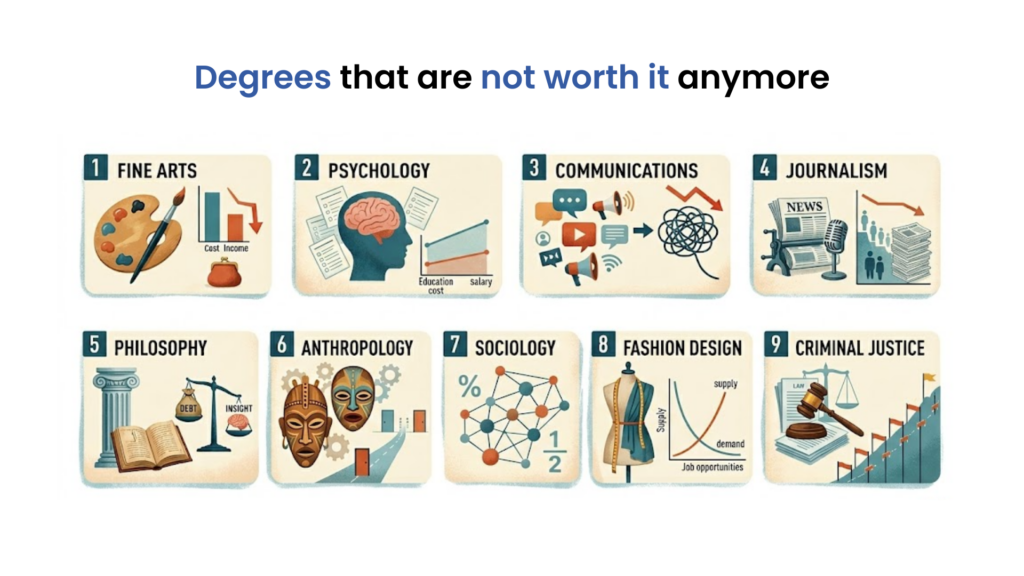
Fine Arts Degree
A Fine Arts Degree can be valuable for students pursuing visual arts, performance, or design.
But employers in these industries often care more about:
- your portfolio
- internships
- client work
- professional network
Not the diploma itself.
If tuition is high, ROI becomes difficult.
A student paying premium U.S. tuition for a fine arts degree may struggle financially for years, while a student earning the same accredited degree in Europe for far less may reduce that pressure significantly.
This is important.
Sometimes the degree is fine. The price is the problem.
General Psychology Degree
A General Psychology Degree is one of the most common majors and one of the most misunderstood.
Many students assume psychology leads directly to clinical work.
Usually, it does not.
Most psychology careers with strong salaries require:
- a master’s degree
- a doctorate
- professional licensure
Without graduate school, many graduates end up in lower-paying general support roles.
That makes undergraduate cost especially important.
Communications Degree
A Communications Degree can absolutely lead to strong careers in:
- marketing
- public relations
- media
- corporate communications
- brand strategy
The challenge is that it is broad.
Students need strong internships and practical experience to stand out.
Without that, it can become a very expensive “general degree” without a clear job target.
Journalism Degree
A Journalism Degree faces a structural problem: the industry changed faster than universities did.
Traditional newsroom jobs have declined while digital content, newsletters, and creator-led media have expanded.
Employers often prioritize:
- writing samples
- published work
- digital skills
- audience growth experience
More than the degree title.
That makes ROI harder to predict.
Philosophy Degree
A Philosophy Degree builds strong critical thinking and writing skills.
It can be excellent preparation for:
- law school
- graduate school
- policy work
But as a direct employment degree, it is less obvious.
Students need a clear plan.
Without one, philosophy can become expensive intellectual enrichment rather than a strong career investment.
Anthropology Degree
An Anthropology Degree is fascinating academically.
Career outcomes are narrower.
Many roles are concentrated in:
- research
- museums
- academia
- nonprofits
These paths often require graduate education and may not offer strong salary growth early on.
Sociology Degree
A Sociology Degree helps students understand systems, communities, and institutions.
That can support careers in:
- social services
- public policy
- nonprofit work
- HR
- research
But many higher-paying roles require additional credentials.
The degree alone may not create strong salary momentum.
Fashion Design Degree
A Fashion Design Degree is another portfolio-first field.
Hiring managers care about:
- design quality
- technical skill
- internships
- industry relationships
Students paying luxury-school tuition for fashion often discover that prestige does not guarantee placement.
Lower-cost international options can dramatically improve ROI here
Criminal Justice Degree
A Criminal Justice Degree is not automatically low value.
But many students assume it is required for law enforcement careers when it often is not.
In some cases, employers value:
- practical training
- certifications
- military service
- public administration experience
as much as, or more than the degree itself.
Students should verify job requirements before committing.
Find the Perfect Degree Program in Europe
Explore accredited bachelor’s and master’s programs with clear admissions and lower costs. Join thousands of students already studying across Europe.

How to Evaluate Degree Value
Instead of asking “Is this a good major?”
Ask:
What does this degree lead to?
Use this checklist:
Ask These Questions
- What jobs does this degree qualify me for immediately?
- What is the average starting salary?
- Will I need graduate school?
- How much debt will I graduate with?
- Are employers hiring in this field?
- Does location affect job access?
- Could I earn the same degree for less abroad?
That last question matters more than most families expect.
Cost Breakdown: U.S. vs Europe
Here’s a realistic example.
| Option | Annual Tuition | 4-Year Estimated Tuition |
|---|---|---|
| Private U.S. University | $35,000–$60,000+ | $140,000–$240,000+ |
| Public Out-of-State U.S. | $20,000–$35,000 | $80,000–$140,000 |
| Accredited European Degree Program | Often $0–$15,000 | Often far lower overall |
Many fully accredited European universities offer bachelor’s programs taught entirely in English.
Not exchange programs. Full degrees.
This often allows students to choose a passion-driven major with far less financial risk.
That’s where Beyond The States helps. We focus on vetted, affordable international degree options with transparent admissions not semester abroad programs.



Tips for Choosing a High-Value Degree
Choosing a degree should start with outcomes, not assumptions.
A high-value degree does not always mean the highest salary. It means the degree creates strong opportunities, manageable costs, and long-term flexibility.
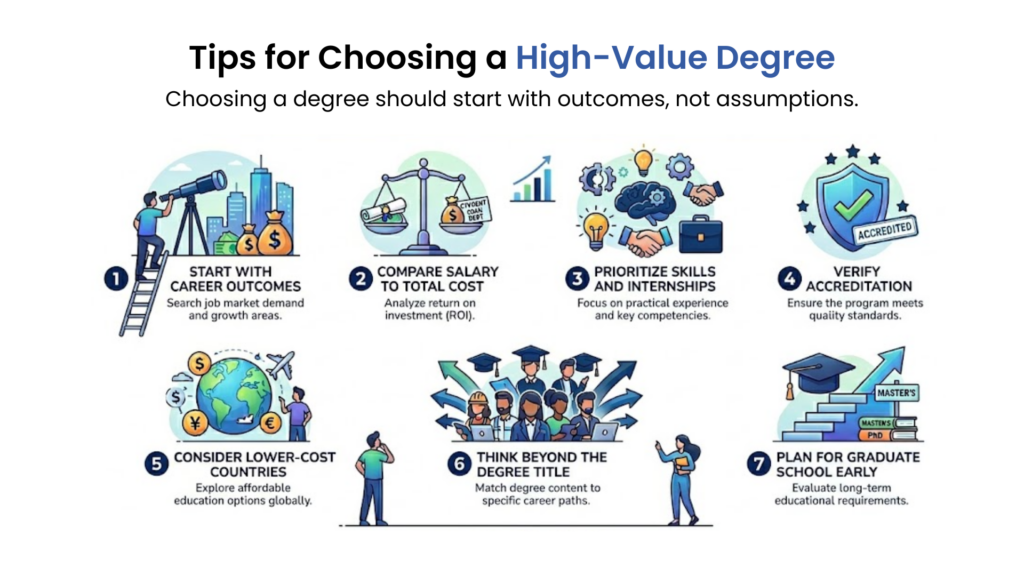
1. Start With Career Outcomes
Before choosing a university, ask:
- What jobs do graduates get?
- What is the average starting salary?
- Are internships included?
- Do employers recruit from this program?
A well-connected university with strong career outcomes is often a better choice than a famous name alone.
2. Compare Salary to Total Cost
Look beyond annual tuition.
Consider:
- Tuition for all years
- Housing and living expenses
- Health insurance
- Travel and visa costs
- Graduate school, if required
If a degree costs $150,000 but leads to a $40,000 starting salary, the ROI may be weak.
This is why many families consider full degrees abroad, where tuition can be significantly lower.
3. Prioritize Skills and Internships
Employers hire experience, not just majors.
Programs with internships, employer partnerships, and practical training often lead to better outcomes than broad academic programs without clear job pathways.
4. Verify Accreditation
If studying abroad, make sure the university is fully accredited and internationally recognized.
This matters for graduate school, professional licensing, and future job opportunities in the U.S.
5. Consider Lower-Cost Countries
Sometimes the best decision is changing the location, not the major.
Many universities in Europe offer full English-taught degrees with lower tuition and strong academic quality.
Countries like Netherlands, Germany, Ireland, Spain, and Italy are popular options for U.S. students seeking better value.
6. Think Beyond the Degree Title
A broad major like Communications may be less valuable than a specialized program like Digital Marketing.
Focus on the skills you graduate with, not just the name of the degree.
7. Plan for Graduate School Early
Some degrees, like psychology, often require a master’s or doctorate for strong career outcomes.
Families should factor that into the total cost from the beginning.
Who Is This a Good Fit For?
Studying for a full degree abroad may be a strong fit for:
- Students frustrated by high U.S. tuition
- Families seeking lower debt options
- Students with clear academic interests
- Applicants who want straightforward admissions
- Students open to international career pathways
Especially for lower-ROI majors, reducing tuition costs can dramatically improve long-term outcomes.
Common Myths About “Bad Degrees”
Myth 1: Passion Should Be Ignored
False.
Passion matters. Financial planning matters too.
The goal is balance.
Myth 2: Studying Abroad Means a Semester Exchange
Not here.
We’re talking about full accredited bachelor’s degrees completed abroad.
Myth 3: International Degrees Aren’t Legitimate
Also false.
Many European universities are globally recognized and fully accredited. Graduate schools and employers regularly accept these credentials.
Frequently Asked Questions
We’re here to help answer your questions about degrees that are not worth it anymore
Yes, especially when tuition is very high and salary outcomes are consistently low. The degree itself may still have value, but the financial return may not justify the cost.
Degrees with low salary ceilings and expensive tuition often create the weakest ROI. Common examples include fine arts, general psychology, journalism, and some broad liberal arts majors without clear career pathways.
Not necessarily. A psychology degree can be excellent if paired with graduate school or a specialized plan. A general psychology bachelor’s without a clear next step is where students often struggle.
Often, yes. Many English-taught universities in Europe offer tuition far below U.S. private colleges, and some countries offer very low or even no tuition for international students.
Yes, if the university is properly accredited and recognized. Many international graduates continue to U.S. graduate schools or work for global employers.
Conclusion
The question is not whether a degree is “worth it.”
The question is whether the investment makes sense for your goals.
Some degrees that are not worth it anymore become excellent choices when tuition is lower, debt is manageable, and the career path is clear.
That is why smart families compare more than rankings.
They compare outcomes.
If you are exploring degree options, country choices, or lower-cost accredited programs abroad, Beyond The States can help you evaluate what actually makes sense.
Start by exploring programs, comparing countries, or taking the quiz to find universities that match both your goals and your budget.