How to Stand Out on College Applications
U.S. college admissions have become more competitive, less predictable, and significantly more expensive over the past decade. Many strong students with solid grades and test scores still get rejected from selective schools.
What’s often overlooked is this.
Admissions isn’t just about achievement. It’s about how clearly a student’s story comes together.
And this is where things shift:
More students are now exploring full, accredited degree programs in Europe taught entirely in English, where admissions are typically more transparent and based more directly on academic performance.
At the core, whether applying in the U.S. or Europe, standing out still depends on the same essentials: academic strength, direction, and coherence.
Summary
What Makes a Strong College Application?
Before you can stand out, you need to understand what admissions officers are actually evaluating.
A strong college application typically shows four things:
- Academic readiness (grades, rigor, progression)
- Intellectual direction (what you’re interested in and why)
- Personal character (through essays and recommendations)
- Impact (what you’ve done outside the classroom)
The hidden truth
Many students assume “perfect stats = acceptance.” In reality, once you meet academic thresholds, differentiation becomes narrative-driven.
Admissions readers are asking:
- Why this student?
- Why this field of study?
- Why now?
- What will they contribute?
That’s the framework behind how to increase your chances of college acceptance.
How to Stand Out on College Applications
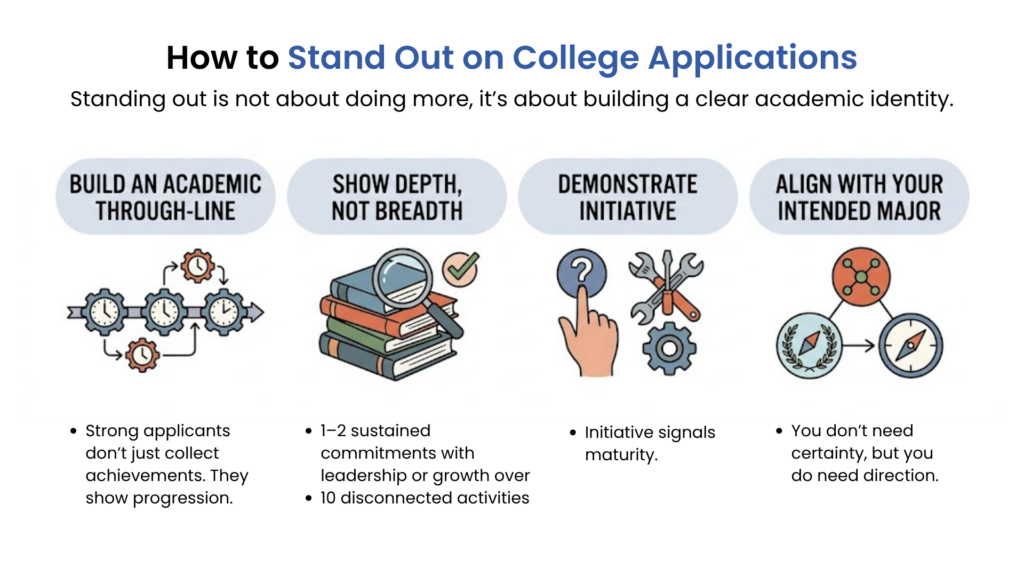
If there’s one misconception to correct, it’s this: standing out does not mean doing the most activities.
It means building a coherent academic identity.
1. Build an academic “through-line”
Strong applicants don’t just collect achievements. They show progression.
Example:
- Interest in environmental science → internship at local conservation group → AP Biology → independent research project → summer university program
This creates a narrative arc. That matters more than volume.
2. Show depth, not breadth
Admissions officers prefer:
- 1–2 sustained commitments with leadership or growth
over - 10 disconnected activities
3. Demonstrate initiative
Initiative signals maturity. Examples:
- Starting a small research project
- Creating a club with a clear purpose
- Launching a community program
- Pursuing independent study or mentorship
4. Align activities with intended major (when possible)
You don’t need certainty, but you do need direction.
Extracurricular Activities That Impress Colleges
Not all extracurriculars are equal in admissions review. What matters is impact and responsibility, not prestige.
High-impact categories:
- Leadership roles in school or community organizations
- Research or academic projects
- Paid work or family business responsibility
- Competitions (science fairs, debate, coding, writing)
- Community-based service with measurable outcomes
What does NOT impress on its own:
- Passive membership in multiple clubs
- Short-term volunteering without consistency
- Resume padding activities with no depth
A simple test:
If you removed the student from the activity, would it noticeably change or improve?
If yes, it likely has impact.
How to Write a Standout Personal Statement

Your personal statement is not a summary of your resume. It is the only place in the application where your voice leads.
What strong essays do well:
- Focus on a single central idea or moment
- Show reflection, not just experience
- Reveal how thinking has changed over time
- Connect personal experience to academic direction
What weak essays do:
- List accomplishments
- Try to impress instead of reflect
- Cover too many topics
- Sound generic or overly polished
A simple structure that works:
- Specific moment or story
- What you noticed or questioned
- How your thinking changed
- What that means for your academic direction
Let’s break this down.
The strongest essays often feel small in topic but large in insight.
How to Get Strong Letters of Recommendation
A strong recommendation letter does not come from status. It comes from specific observation over time.
Who to ask:
- Teachers who have seen your writing, thinking, or problem-solving
- Preferably in subjects related to your intended field
- Someone who can describe growth, not just performance
How to earn a strong letter:
- Participate actively in class discussions
- Ask thoughtful questions
- Show consistency over time
- Share your academic interests with your teacher
What weak letters sound like:
- “This student got an A in my class”
- Generic praise without examples
- Lack of differentiation from other students
Common College Application Mistakes to Avoid
Many qualified students weaken their applications in predictable ways.
1. Overloading activities
Quantity replaces depth, and depth is what admissions values.
2. Generic essays
If your essay could apply to 10,000 other students, it won’t stand out.
3. Ignoring academic alignment
Your coursework and interests should tell a consistent story.
4. Last-minute planning
Strong applications are built over 2–3 years, not months.
5. Misunderstanding “holistic admissions”
Holistic does not mean random. It means multi-dimensional evaluation.
U.S. vs European College Applications
For students also exploring accredited degrees abroad, admissions systems can look very different.
| Factor | U.S. Colleges | European Bachelor’s Programs |
|---|---|---|
| Admissions style | Holistic, unpredictable | More academic + transparent |
| Essays | Required and heavily weighted | Often minimal or not required |
| Extracurriculars | Very important | Less emphasized |
| Cost | High (often $30K–$90K/year) | Often €0–€15K/year |
| Decision clarity | Variable | More criteria-based |
This difference is why many students now explore full degree options in Europe especially when they want affordability and clearer admissions expectations.

Cost and Strategy Considerations

Understanding application strategy also means understanding financial reality.
In the U.S.:
- Average cost of attendance: $25,000–$90,000/year
- Merit aid is competitive
- Admissions uncertainty can increase financial planning risk
In Europe (English-taught degrees):
- Many public universities charge low tuition for international students
- Clear academic entry requirements
- More predictable cost structure
This is not about replacing one system with another it’s about understanding all viable pathways.
Discover all the English-taught European college programs in one place.
Beyond the States provides easy access to 12,600+ European bachelor’s and master’s programs across 870 universities, 550 cities, and 212 areas of study, plus all the resources you need to get there.
3400+
English-taught bachelor’s programs in our database.
550
Beautiful European cities to choose from.
$360,170
Typical savings against a private university in the US.
8200+
English-taught master’s programs in our database.
870
Top-tier universities accepting international students.
$65,038
Typical savings against in-state tuition in the US.
Who Is This a Good Fit For?
This approach to strengthening applications (and exploring alternatives) is especially relevant for:
- Students who feel uncertain about U.S. admissions outcomes
- Families concerned about rising tuition costs
- Students with strong academics but limited extracurricular “brand-name” achievements
- Students who want a more structured, transparent admissions process
- Students open to earning a full degree abroad in English
Misconceptions About Standing Out on Applications
Myth 1: You need perfect test scores
Not true. Many competitive applicants are admitted with imperfect scores.
Myth 2: You must be extraordinary
Admissions is not about being the “best.” It’s about being a strong fit.
Myth 3: More activities equal better chances
Depth consistently beats volume.
Myth 4: Only elite schools matter
Outcomes depend more on field of study, internships, and direction than prestige alone.
Frequently Asked Questions
We’re here to help answer your questions about How to Stand Out on College Applications
Once academic thresholds are met, the essay and extracurricular depth often become the most differentiating factors.
Ideally by 9th or 10th grade, focusing on consistency rather than last-minute achievements.
Much less than U.S. institutions. Academic performance is usually the primary factor.
A clear academic direction, strong grades, meaningful involvement, and a well-written personal narrative.
Focus on academic consistency, deepen a few key activities, and write a personal statement that shows reflection and growth.
Final Thoughts
Standing out on college applications is not about competing in every available category. It’s about clarity academic clarity, narrative clarity, and direction.
Students who understand this early tend to build stronger applications with less stress and more intention.
And for some students, this is also the moment to expand the map. Full degree programs in Europe, taught in English, can offer a structured, transparent alternative with globally recognized outcomes.
Find the Perfect Degree Program in Europe
Explore accredited bachelor’s and master’s programs with clear admissions and lower costs. Join thousands of students already studying across Europe.

If you want help understanding which path fits your academic goals, you can explore options with Beyond The States.
You can also:
- Book a strategy session
- Explore the Platinum Admissions package
The right application strategy is not about doing more. It’s about doing what actually matters with clarity.