Best Universities in Germany for International Students
Looking for a world-class degree without the crushing student debt?
Germany is leading the way for American students who want top-tier education, global career prospects, and an unbeatable value. With renowned universities, cutting-edge research, and programs taught in English, Germany combines academic excellence with real-world opportunity—and often, no tuition fees at all.
Some of our favorite universities in Germany for international students include Technical University of Munich, Ludwig Maximilian University of Munich, Heidelberg University, and RWTH Aachen University, which consistently rank among the world’s top institutions.
Summary
German Higher Education Details
Types of Higher Education Institutions
Germany operates three distinct types of higher education institutions. Each type serves different academic goals and career paths.
Universities (Universitäten) focus on research and theoretical studies. They offer bachelor’s, master’s, and doctoral degrees across many subjects. These institutions emphasize academic research and prepare students for scholarly careers.
Universities of Applied Sciences (Fachhochschulen) provide practical, career-focused education. Students gain hands-on experience through internships and industry partnerships. These schools teach business, engineering, and technical subjects.
Colleges of Art, Film and Music specialize in creative fields. They train students in fine arts, performing arts, and media production. Admission requires talent demonstrations or portfolio submissions.
Public universities in Germany charge minimal fees to all students, including Americans or international ones. Private institutions exist but represent a much smaller portion of the higher education system.

Reputation and Rankings
German universities perform very well in global rankings. Multiple appear in the QS World University Rankings and other international unbiased assessments.
The Technical University of Munich consistently ranks among the top universities in Germany. Heidelberg University and Ludwig Maximilian University of Munich also receive high marks. These schools excel in research output and academic reputation.
The World University Rankings recognize German strengths in engineering, medicine, and natural sciences. German universities produce significant research in these fields. International employers value degrees from top German institutions.
Rankings consider factors like research quality, teaching standards, and international outlook. German universities score particularly well in research citations and industry partnerships.

Popular Study Destinations in Germany
Several German cities attract large numbers of international students. These locations offer quality education and vibrant student communities.
Berlin hosts multiple universities and research institutes. The city provides diverse cultural experiences and lower living costs than other European capitals.
Munich combines traditional Bavarian culture with modern technology industries. Students access both academic excellence and career opportunities in this southern German hub.
Hamburg offers maritime studies and media programs. This northern port city attracts students interested in logistics, journalism, and international trade.
Other popular study destinations include Cologne, Frankfurt, and Dresden. Each city provides unique advantages in terms of specializations, costs, and lifestyle options.



Top Universities in Germany for International Students
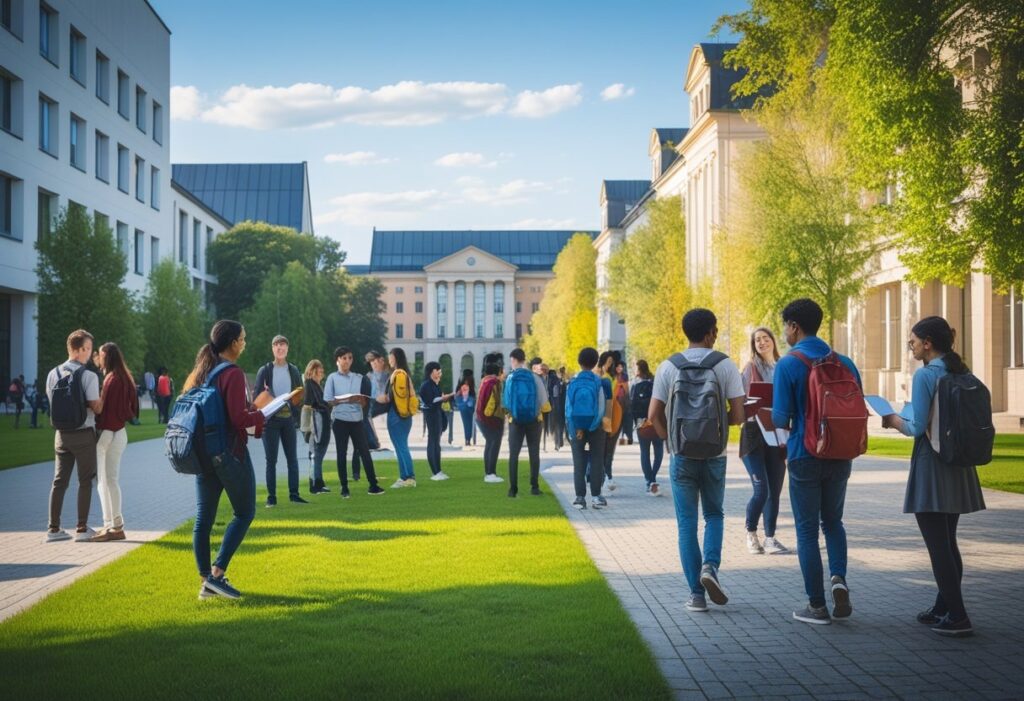
Germany hosts several world-class institutions that welcome students from around the globe. These universities offer strong academic programs, research opportunities, and support services specifically designed for international students.
Technical University of Munich (TUM)
TUM ranks as Germany’s top technical university and consistently appears in global university rankings. The university offers over 170 degree programs taught in English and German.
International students make up about 38% of TUM’s student body. The university provides dedicated support through its International Center, which helps with visa applications, housing, and academic planning.
Key programs include:
- Engineering and technology
- Natural sciences
- Medicine
- Management and economics
TUM has produced 17 Nobel laureates and maintains strong industry connections. Students benefit from research partnerships with major companies like BMW, Siemens, and Google.
The university operates three campuses in Munich, Garching, and Freising. Housing options include student dormitories and private accommodations, with monthly costs ranging from €300-600.
Ludwig Maximilian University of Munich (LMU Munich)
Ludwig Maximilian University of Munich stands as one of Germany’s oldest and most prestigious institutions. Founded in 1472, LMU Munich consistently ranks among Europe’s top universities.
The university enrolls over 50,000 students, with international students representing 15% of the total enrollment. LMU Munich offers more than 200 degree programs across 18 faculties.
Notable strengths include:
- Medicine and life sciences
- Physics and mathematics
- Philosophy and literature
- Law and economics
LMU Munich has awarded degrees to 42 Nobel Prize winners, more than any other German university. The university’s research output ranks among the highest globally.
International students receive support through the International Office. Services include orientation programs, German language courses, and academic counseling.
Heidelberg University
Heidelberg University, officially known as Universität Heidelberg, holds the distinction of being Germany’s oldest university. Established in 1386, it maintains a strong reputation for research and teaching excellence.
The university enrolls approximately 30,000 students, with 20% coming from international backgrounds. University of Heidelberg offers degree programs in German and English across multiple disciplines.
Top academic areas include:
- Medicine and health sciences
- Natural sciences
- Humanities
- Law
Heidelberg University has connections to 33 Nobel laureates as alumni, faculty, or researchers. The university’s medical school ranks among the best in Europe.
The historic city of Heidelberg provides an ideal setting for international students. Living costs average €700-900 per month, including accommodation and daily expenses.
Humboldt University of Berlin
Humboldt University of Berlin operates as one of Berlin’s premier research institutions. Founded in 1810, the university has shaped modern higher education through its research-focused approach.
The university serves over 35,000 students, including significant numbers of international students. Humboldt University offers programs in humanities, social sciences, natural sciences, and medicine.
Academic highlights include:
- Philosophy and social sciences
- Mathematics and natural sciences
- Medicine
- Theology
The university counts 29 Nobel Prize winners among its alumni and faculty. Notable figures include Albert Einstein, Max Planck, and Georg Wilhelm Friedrich Hegel.
Berlin’s vibrant international atmosphere makes it attractive to students worldwide. The city offers affordable living costs compared to Munich or Frankfurt, with monthly expenses around €600-800.
Specializations of Top German Universities
Engineering and Applied Sciences
Germany’s engineering programs rank among the world’s best. Technical University of Munich (TUM) leads in mechanical and automotive engineering. Students work directly with BMW, Audi, and Siemens on real projects.
RWTH Aachen University specializes in chemical and electrical engineering. The university operates Europe’s largest technical research center. Over 200 companies have research partnerships there.
Karlsruhe Institute of Technology focuses on applied sciences and energy research. They developed key technologies for renewable energy systems. You’d be surprised to know their nuclear engineering program attracts students from 50 countries!
These schools offer strong industry connections. Students complete internships at major German manufacturers. Job placement rates exceed 95% for engineering graduates.
Life Sciences and Medicine
Heidelberg University operates one of Europe’s top medical schools. The university hospital treats over 65,000 patients yearly. Students train in 43 specialized medical departments.
Charité Berlin combines three major hospitals into one teaching system. It produces more research publications than any other European medical school. The anatomy program uses advanced 3D modeling technology.
University of Munich (LMU) excels in life sciences research. Their biology department discovered new cancer treatment methods. The veterinary school ranks second in Europe.
Medical students complete six years of study. Clinical rotations begin in year three. International students must pass German language tests for patient interaction.
Humanities and Social Sciences
Humboldt University Berlin shaped modern university education worldwide. Famous philosophers and social scientists taught there. The law faculty trains judges for German courts.
University of Heidelberg offers Germany’s oldest humanities programs. Their philosophy department influences European thought. Students access manuscripts dating back 600 years.
Goethe University Frankfurt specializes in social sciences and economics. The business school ranks in Europe’s top 10. Political science graduates work in the European Parliament.
These programs require strong German language skills. Most courses use German as the primary language. International students take preparatory language courses.
Computer Science and Mathematics
Technical University of Munich leads in artificial intelligence research. Google and Microsoft fund research projects there. The robotics lab develops autonomous vehicle technology.
University of Saarland pioneered European computer science education. The campus hosts the German Research Center for AI. Students work on machine learning and cybersecurity projects.
TU Berlin combines mathematics with practical applications. Their algorithms influence internet search technology. The cryptography program trains government security experts.
German universities emphasize both theory and practice. Students complete coding projects for real companies. Mathematics programs connect to engineering and physics departments.
How Much Does it Cost To Study in Germany?
Tuition Fees and Tuition-Free Education
Public universities in Germany charge no tuition fees for most degree programs. This applies to both German and American or international students from all countries.
Students only pay a small semester contribution that ranges from €150 to €350 per semester. This fee covers student services and often includes public transportation.
Some German states charge tuition fees for non-EU students. Baden-Württemberg requires international students from outside the EU to pay €1,500 per semester at public universities.
Private universities in Germany charge tuition fees between €10,000 and €40,000 per year. These costs vary greatly depending on the program and school.
Most international students choose public universities to avoid high tuition costs. The tuition-free education system makes Germany very attractive for students worldwide.
Semester Contribution and Living Expenses
The semester contribution is mandatory at all German universities. This fee typically costs between €150 and €350 every six months.
The contribution covers student union services, cafeteria subsidies, and sports facilities. Many universities include a public transportation pass in this fee.
Living expenses in Germany cost between €800 and €1,200 per month for most students. Large cities like Munich and Hamburg have higher costs than smaller towns.
Monthly living costs include:
- Rent: €300-€700
- Food: €200-€300
- Health insurance: €110
- Books and supplies: €50-€100
- Personal expenses: €100-€200
Students can work part-time to help cover living expenses. Non-EU students can work 120 full days or 240 half days per year without special permits.
FREE INSIDER’S GUIDE
Top 5 English-Taught Colleges in Europe
Kickstart you education abroad with a powerful degree taught entirely in English, all without taking on any student loans!
Admission Process for International Students
Most German universities require international students to apply through uni-assist or directly to the institution. Students must provide academic transcripts, language certificates, and other supporting documents based on their chosen program.
Application Procedures
International students can apply to German universities through two main channels. Many universities use uni-assist, a centralized application service that evaluates foreign credentials. Other institutions accept direct applications through their own systems.
Students should start their applications 6-12 months before their intended start date. Most programs begin in October (winter semester) or April (summer semester).
The uni-assist process involves creating an online account and uploading required documents. The service charges €75 for the first application and €30 for each additional application to different universities.
Direct applications require students to submit materials directly to university admissions offices. Each university sets its own deadlines and requirements for direct applications.
Required Qualifications and Documents
International students need specific academic qualifications to study in Germany. A secondary school certificate equivalent to the German Abitur is required for undergraduate programs. Graduate programs require a recognized bachelor’s degree.
Students from some countries must complete a foundation year (Studienkolleg) before starting their degree. This applies to students whose secondary education doesn’t meet German university entrance requirements.
Essential documents include:
- Certified copies of academic transcripts
- Secondary school diploma or university degree
- Language proficiency certificates
- Passport copy
- Motivation letter
- CV/resume
All foreign documents must be officially translated into German or English. Many universities also require documents to be authenticated or apostilled by official authorities.
German and English Language Proficiency
Language requirements depend on the program’s language of instruction. German-taught programs require proof of German proficiency through accepted tests.
German language certificates accepted:
- TestDaF: Minimum level 4 in all sections
- DSH: Level 2 or 3 required
- Goethe Certificate: C1 or C2 level
English-taught programs accept international English proficiency tests. Universities typically require minimum scores that vary by institution and program level.
English language requirements:
- TOEFL: Usually 80-100 iBT
- IELTS: Generally 6.0-7.0 overall score
Some universities waive language requirements for native speakers or students who completed previous education in German or English. Students should verify specific score requirements with their chosen universities before applying.
Scholarships, Grants, and Financial Aid
There are several funding options to study in Germany. The DAAD provides major scholarships, while universities offer their own grants and the Deutschlandstipendium supports high-achieving students.
DAAD Scholarships and Deutschlandstipendium
The German Academic Exchange Service (DAAD) offers the largest scholarship program for international students in Germany. DAAD scholarships cover tuition fees, living expenses, and travel costs for various degree levels.
Students can apply for DAAD scholarships through their home country’s DAAD office or directly online. The application requires academic transcripts, letters of recommendation, and a study plan.
The Deutschlandstipendium provides €300 per month to talented students regardless of nationality. This merit-based scholarship supports students for at least two semesters.
Half of the Deutschlandstipendium funding comes from private sponsors and half from the federal government. Students apply directly through their chosen university’s application process.
University Scholarships and Foundation Grants
German universities offer their own scholarship programs for international students. These range from partial tuition waivers to full funding packages that include living expenses.
The Heinrich Böll Foundation provides scholarships to international students who demonstrate academic excellence and social engagement. Recipients receive up to €861 per month plus additional benefits.
Other major foundations include the Konrad Adenauer Foundation and Friedrich Ebert Foundation. Each foundation has specific criteria based on academic merit, financial need, or field of study.
Students should check individual university websites for available scholarships. Many universities automatically consider admitted students for merit-based awards.
Erasmus+ Program and Other Opportunities
The Erasmus+ program supports exchange students from European Union countries studying in Germany. Participants receive monthly grants ranging from €330 to €370 depending on the cost of living.
Erasmus+ students apply through their home university’s international office. The program covers one or two semesters of study abroad.
Students from developing countries can access scholarships through organizations like the World Bank or their home government programs. Many German states also offer regional funding for international students.
Research assistantships and part-time work opportunities help students earn money while studying. International students can work up to 120 full days or 240 half days per year.
Student Visa and Residence Permit
Non-EU students must obtain a student visa before arriving in Germany, including Americans. Students apply at German consulates in their home countries with acceptance letters from German universities.
The student visa allows entry into Germany for studies. After arrival, students must convert this to a residence permit within 90 days.
Required documents include:
- University acceptance letter
- Proof of financial resources (€11,208 per year)
- Health insurance coverage
- Academic transcripts
- Passport photos
Students visit local immigration offices to apply for residence permits. The permit covers the duration of studies plus additional time for job searching.
EU students do not need student visas. They register with local authorities after arrival and receive residence certificates.
Work Opportunities During and After Studies
International students can work 120 full days or 240 half days per year without additional permits. Students from non-EU countries need approval for jobs exceeding these limits.
Student jobs include research assistant positions, tutoring, and part-time work in restaurants or retail. Universities often post job opportunities on campus bulletin boards.
Post-study work visas allow graduates to stay 18 months after graduation to find employment. This applies to all international students who complete degrees at German universities.
After finding jobs, students apply for work visas or EU Blue Cards. The EU Blue Card suits graduates with job offers paying above €43,992 annually.
Graduate employment in Germany offers strong career prospects, especially in engineering, IT, and healthcare sectors.
Student Life and Support Services
German universities provide international offices that help with visa questions, housing, and academic guidance. These offices organize orientation programs for new students.
Student accommodation includes dormitories, shared apartments, and private housing. University housing costs €200-400 monthly and fills quickly.
Support services cover academic tutoring, mental health counseling, and career guidance. Many universities offer German language courses for international students.
Student organizations help international students connect with peers and German culture. These groups organize social events, trips, and cultural exchanges.
Health insurance is mandatory for all students. International students under 30 can join public insurance plans for approximately €110 monthly.
Frequently Asked Questions
International students often ask about Germany’s top universities, English programs, and costs. Many want to know about free tuition options and the best programs for their field of study.
What are the top-ranked universities in Germany for international students?
Technical University of Munich ranks first globally among German universities. It offers strong programs in engineering, natural sciences, and medicine.
Ludwig Maximilian University of Munich holds the second position. This university excels in humanities, social sciences, and life sciences.
Heidelberg University ranks third and is Germany’s oldest university. It provides excellent research opportunities in medicine, physics, and chemistry.
RWTH Aachen University specializes in engineering and technology. It maintains strong industry connections and research facilities.
Which universities in Germany offer the best English-taught programs for international students?
Technical University of Munich offers over 40 English master’s programs. These include aerospace engineering, data engineering, and management.
University of Mannheim provides English business programs. Students can study international management, economics, and finance.
RWTH Aachen University has English programs in engineering fields. Options include automotive engineering, computer science, and materials science.
Jacobs University Bremen teaches all courses in English. This private university focuses on engineering, natural sciences, and social sciences.
What are the most reputable engineering programs in Germany for international students?
RWTH Aachen University leads in mechanical and automotive engineering. The university works closely with major car manufacturers like BMW and Mercedes.
Technical University of Munich excels in aerospace and electrical engineering. Students access modern labs and research projects.
Karlsruhe Institute of Technology specializes in computer science and civil engineering. It offers strong connections to tech companies.
Technical University of Berlin provides urban engineering and environmental programs. The university focuses on sustainable technology solutions.
Are there any universities in Germany that offer free tuition to international students?
Most public universities in Germany offer free tuition to international students. This applies to both undergraduate and graduate programs.