How to Study Abroad as an American
Ready to swap your campus for castles, cafés, and cobblestone streets?
Studying abroad as an American isn’t just a dream—it’s an epic adventure that starts with the right plan. Whether you’re drawn to the rich history of Europe, the vibrant cultures of Latin America, or the fast-paced cities of Asia, navigating the process with an open mind and confidence makes all the difference.
Going abroad to study means you’ll be choosing a program, applying through a home or host university, and preparing all the important travel documents like a passport and visa. But it’s not all candy and roses. If you’re interested in studying abroad you’ll need to research your options, meet application deadlines, and understand costs and requirements before leaving.
Europe is a popular choice (that’s where most our students go), with countries like Italy, the UK, and Spain attracting many U.S. students each year. Other students choose programs in Latin America or Asia, seeking different experiences and cultures.
Planning ahead and knowing the steps makes it easier to succeed. Learning the basics early helps students have a smooth process and enjoy their time abroad.
Summary
Understanding Study Abroad Opportunities for Americans
Americans have many ways to study abroad, ranging from full academic years to short-term summer courses. Choosing the right option depends on what you’re looking for.
Types of Study Abroad Programs
There are several main types of programs available for American students interested in international education:
- Faculty-Led Programs: These are short group trips led by a professor from your home university. The group often travels together and takes classes focused on one subject.
- Third-Party Providers: Private organizations offer a variety of programs in different countries. They handle logistics like housing, travel, and some academic arrangements.
- Direct Enrollment: This allows students to enroll in a foreign university as a regular student. It offers independence and a full immersion in another academic system.
- Exchange Programs: American universities partner with foreign institutions abroad. Students typically swap places, meaning one American attends a partner school while a student from that school studies in the U.S.
Each program has varying levels of support and structure. You should consider your comfort with independence, language skills, and academic needs when deciding.
Short-Term vs. Long-Term Options
Short-term study abroad options usually last from a few weeks to a summer session. These appeal to students with tight schedules, limited budgets, or those wishing to get a taste of international education without a year-long commitment. Faculty-led and summer programs are the most popular short-term choices.
Long-term options include semester or year-long programs. These allow deeper cultural immersion and often lead to greater language skills and academic connections abroad. Students in long-term programs usually earn more credits, and these experiences can be key for career development or graduate school applications. We help thousands of students each year get their entire degree abroad, and we might be a bit biased but we think it’s the best way to go.
Both choices have pros and cons. The best length depends on personal and academic requirements. Financial aid rules and transfer credit policies can also influence the decision.
Exchange Programs vs. Direct Enrollment
Exchange programs are based on agreements between a U.S. institution and schools in other countries. These often cost about the same as in-state tuition, making them affordable. Exchange students receive support from both home and host universities, and credits usually transfer easily.
Direct enrollment means applying directly to a foreign university as an international or visiting student. This is common for students who want a specific program not available through their home university. Direct enrollment requires more independence and may have different tuition rates, but it provides a true immersion in the local education system.
Students should research each option carefully. Consider academic fit, support services, cost, and ease of transferring credits before choosing.

Benefits of Studying Abroad as an American
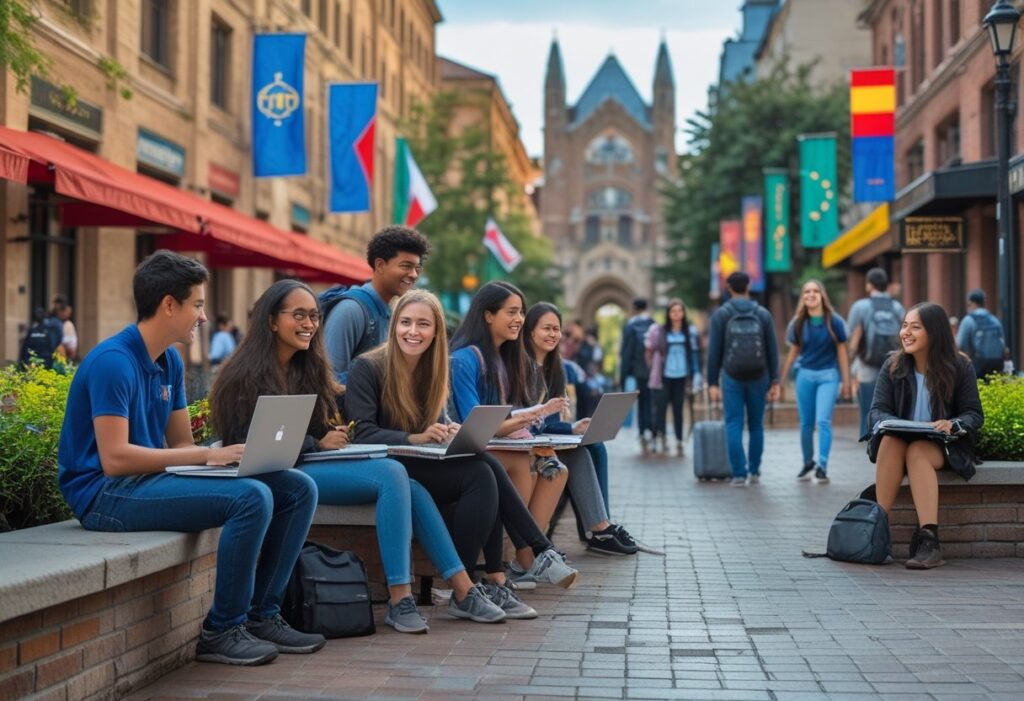
Going abroad gives American students the chance to earn academic credit while exploring new countries. It also offers unique opportunities for personal growth and new career possibilities that may not be available at home.
Academic Advantages
Studying abroad allows students to take classes not offered at their home college. Many find specialized programs, such as language immersion or unique research opportunities, especially valuable. Courses can also count toward their degree and sometimes fulfill major or general education requirements.
International education exposes students to new teaching styles. Professors often encourage independent thinking, group work, or problem-solving. This variety can make learning more engaging and help students develop skills that are useful across multiple disciplines.
American students studying abroad also improve their language skills. Though keep in mind that’s not necessarily required. We have more than 12,000 degree programs taught entirely in English in our database to pick from. Taking classes or living daily life in another language helps build fluency faster than classroom study at home. Access to campus resources and libraries in a foreign country broadens students’ academic knowledge.
Career and Professional Growth
Study abroad experience is a huge green flag on résumés and job applications. Employers value candidates who have learned to adapt to new settings, handle challenges, and communicate across cultures. This experience shows strong problem-solving and decision-making abilities.
While abroad, you will also build professional networks. You may intern with local businesses, join academic clubs, or form connections with teachers and classmates. These contacts can lead to future job opportunities both in the U.S. and internationally.
International education can also help you as an American understand global job markets. You’ll often learn about new careers or industries, such as international law, global health, or technology, that they may not have considered before. This broadens your career options after graduation.
Personal Development and Global Perspectives
Living and studying in a different country helps students become more independent. You must handle daily life, travel, and sometimes medical matters on their own. This increases confidence and teaches self-reliance.
Exposure to new cultures helps Americans better understand people from different backgrounds. It encourages open-mindedness and empathy, both of which are important in today’s interconnected world. Students also gain a deeper appreciation for their own culture by seeing it from a new perspective.
Personal growth reached through international education goes beyond academics. Many students return with greater maturity, stronger communication skills, and a willingness to engage with the world around them in meaningful ways.
Researching and Choosing the Right Program
Finding the right study abroad program involves more than just picking a country or university. Students should focus on key factors like academic quality, safety, daily life, and how well they can adapt to a new environment.
Selecting a Destination Country
The first step is to research possible countries and match them to personal and academic goals. Students should consider language, cost of living, and distance from the United States. Luckily we have a database that includes all the best with details on the cost of living and top programs you can attend at each.
Countries with strong education systems that welcome international students can make the transition smoother. It’s important to learn about climate, culture, and visa rules. Immigration policies can also affect how easy it is to study abroad.
Reading reviews, speaking with past participants, and using resources from American universities can offer real insights. A table like the one below can help compare options:
| Country | Language | Visa Difficulty | Cost of Living | Safety Rating |
|---|---|---|---|---|
| UK | English | Medium | High | High |
| Germany | German | Easy | Low | High |
| Australia | English | Easy | Medium | High |
| Japan | Japanese | Medium | Medium | High |
Finding Accredited Institutions
Choosing an accredited school is essential for academic and career benefits. U.S. students should check if credits will transfer back home and if degrees are recognized in their field.
Official accreditation bodies or government education websites list approved schools. Study abroad offices at American universities often recommend trusted partner programs.
It’s best to avoid diploma mills or unknown schools. Look for institutions that offer strong student support, clear course lists, and help with admissions and visas. Ask about teaching quality and international rankings if that matters to the student.

Evaluating Programs
It’s important to select a program that fits academic needs and career goals. Review the course list, specializations, and teaching methods. Some programs in the United States and abroad offer hands-on research or internships, which can add to the experience.
Students should make sure core classes are available and meet degree requirements back home. Meeting with an academic advisor at their home university helps avoid problems with credit transfer.
Some programs offer flexibility or unique classes not found in the U.S. It’s useful to compare details such as class size, language of instruction, and schedules.
Considering Safety and Cultural Fit
Personal safety is a top concern when studying abroad. Research the safety of the city and campus using government travel sites and student forums. Students can ask about health care, emergency support, and campus security measures.
It’s also helpful to think about cultural fit. Consider factors like local attitudes toward foreigners, language barriers, and daily customs. Some destinations are more welcoming to international students from the United States than others.
Talking to alumni or current students can give an honest view of what daily life is like. Taking the time to prepare for cultural differences can help students adapt quickly and enjoy their stay.
Application Process for American Students
Meeting Eligibility Requirements
Before starting an application, students need to make sure they meet each program’s eligibility criteria. This usually includes being enrolled at a college or university in the United States, or having graduated from high school with the right credits.
Specific requirements depend on the country and institution. Some schools want a certain GPA or specific academic background. Many require proof of language ability, like passing the IELTS or TOEFL for programs taught in English, or another test for non-English courses.
Visa eligibility is also important. Most countries need students to have an acceptance letter before they can apply for a student visa. Some programs are open only to students with a U.S. passport, while others welcome international applicants. Checking the official website of the host university is the best way to confirm all requirements.
Preparing Application Materials
Applicants must collect several documents to complete their applications. Common materials include:
- Academic transcripts
- Standardized test scores (SAT, ACT, GRE, etc., if required)
- Proof of language proficiency
- Passport copy
- Letters of recommendation
A personal statement or essay is usually required. This essay should explain why the student wants to study abroad and how the program fits their goals.
Some schools may ask for a resume or a list of extracurricular activities. Certified translations are necessary for any documents not in the required language. It helps to keep everything organized in a checklist or table to stay on track.
| Document | Needed For | Notes |
|---|---|---|
| Transcripts | Most programs | Official, sealed copies |
| Test scores | Some programs | Send directly if needed |
| Passport | All programs | Must be valid |
| Recommendation letters | Most programs | Usually 1-3 |
Navigating Admissions Timelines
Deadlines and timelines vary widely across countries and universities. Some study abroad programs require applications six months to a year in advance. Others have rolling admissions and more flexible deadlines.
Key dates usually include the application deadline, document submission date, interview dates (if required), and notice of acceptance. Missing a step can delay the whole process or mean missing out completely.
Financing Your International Education
Paying for international education as an American can be challenging, but there are several practical routes students use to handle costs. Careful planning and research are key to making study abroad more affordable and realistic.
Estimating Tuition and Living Expenses
Tuition for study abroad depends on the country and university. Public universities in Europe often charge lower fees for international students than private American colleges. Some countries, such as Germany and Norway, offer free or very low-cost tuition to foreign students.
Living expenses can range from $600 to $2,000 per month based on city and lifestyle. Housing, food, transportation, and health insurance are the biggest factors. Popular cities like London or Paris typically cost more than smaller towns.
When planning a budget, students should include:
- Tuition and fees
- Housing (on- or off-campus)
- Meals or meal plans
- Local transportation
- Books and supplies
- Travel to and from the US
Using a table or spreadsheet can help students track estimated and actual costs.
Scholarships and Grants for Americans
Many scholarships and grants are designed for US students studying abroad. The Benjamin A. Gilman International Scholarship helps Pell Grant recipients pay for study abroad. Fulbright U.S. Student Program awards grants for research, teaching, or graduate study worldwide.
Some programs receive federal support, but recent funding freezes have paused or limited access in some cases. Private organizations and universities also offer scholarships based on academic achievement, financial need, or specific destinations.
Students should search for:
- University-specific study abroad grants
- Scholarships from foundations or cultural organizations
- Grants for fields like science, languages, or service projects
Applications often require essays and reference letters, so early preparation is important.
Financial Aid and Loan Options
Federal financial aid from the United States, like Pell Grants and federal loans, can sometimes be used for overseas study if the foreign program is approved by the home institution. Check with both the study abroad office and financial aid office to confirm what aid applies.
Some private student loans also allow funds for international education, but interest rates may be higher. It is important to compare terms and only borrow the needed amount.
Preparing for Life Abroad
Acquiring Student Visas and Documentation
Anyone studying abroad as an American student must secure the correct visa to enter and remain in the destination country. Visa requirements vary, but most countries require proof of university acceptance, financial support, and sometimes a personal interview. Common documents include a valid passport, visa application forms, recent photos, and acceptance letters.
Some countries, like the UK or Australia, also require medical exams or background checks. Students should start this process early, as visa approval can take several weeks or even months. Keeping copies of all important documents—both digital and printed—helps prevent delays if paperwork is lost. Staying updated with the nearest embassy’s requirements and deadlines is essential for a smooth application.
Finding Accommodation Abroad
Finding a place to live is a major aspect of international education. Many students choose on-campus housing because it is convenient and usually includes utilities and internet. Others look for private apartments or shared housing, which can offer more independence and often lower rent.
Cultural Adjustment and Language Prep
Adapting to a new culture is a key part of studying abroad. Students often face “culture shock,” which can include homesickness, confusion, or frustration when adjusting to new customs, food, and social rules. Learning basic local phrases, cultural norms, and daily routines before arrival eases the transition.
Practical prep tips:
- Attend predeparture orientations and cultural workshops.
- Practice the local language using mobile apps or language courses.
- Stay open-minded and respectful when encountering different traditions or lifestyles.
Joining clubs, talking with local students, and asking questions can make it easier to make friends and feel confident. Preparation helps students participate fully in their international education experience.
Frequently Asked Questions
Studying abroad as an American student involves meeting certain academic, financial, and legal requirements. Many programs offer options for scholarships and affordable alternatives.