College in Europe vs U.S.
It might feel a bit overwhelming deciding between college in Europe or the U.S., especially with so many differences in cost, programs, and life in general. That being said, the biggest difference we see on a regular bassi is that European colleges are often far less expensive and more focused, while U.S. colleges have broader programs and shockingly high tuition.
Everyone’s different, but you might actually prefer the structured and career-focused approach found in many European universities. Others like the flexible choices, social activities, and sports culture found in U.S. colleges. Understanding these differences can help you pick the right area for your goals and interests.
Summary
Overview of College in Europe vs US
College in Europe and the US have many differences in how they are structured, taught, and funded. Costs, admissions processes, and student life also vary widely between European universities and American universities.
Higher Education Systems
European colleges and universities often focus on specialized education from the start. Most students apply directly to a specific subject or degree such as engineering, law, or history. Classes are designed around that subject, and students have fewer electives.
In the US, colleges and universities usually use a “liberal arts” model. Students are often not required to pick a major until their second or third year. American colleges offer a wider range of courses, letting students explore different subjects.
European higher education systems often have national standards set by each country. In contrast, the US higher education system has both public and private schools, each with its own rules and requirements.

Key Differences Between European and American Colleges
| Factor | Europe | United States |
|---|---|---|
| Tuition Fees | Often low or free; some countries charge small amounts | Usually higher, especially for private colleges |
| Length of Study | Bachelor’s usually 3 years | Bachelor’s usually 4 years |
| Admissions | Based on grades/test scores for chosen subject | Holistic; includes essays, activities, and test scores |
| Campus Life | Less focus on sports or clubs | Many clubs, sports, and events |
| Housing | Students may live off-campus; less campus housing | Many live on campus, especially first year |
American universities often have a bigger focus on campus life and extracurricular activities. European universities put more focus on academics and independent study. Degrees in Europe tend to be more specialized and take less time to complete. US colleges offer more flexibility for students who want to change majors or explore different fields.
Academic Structure and Coursework
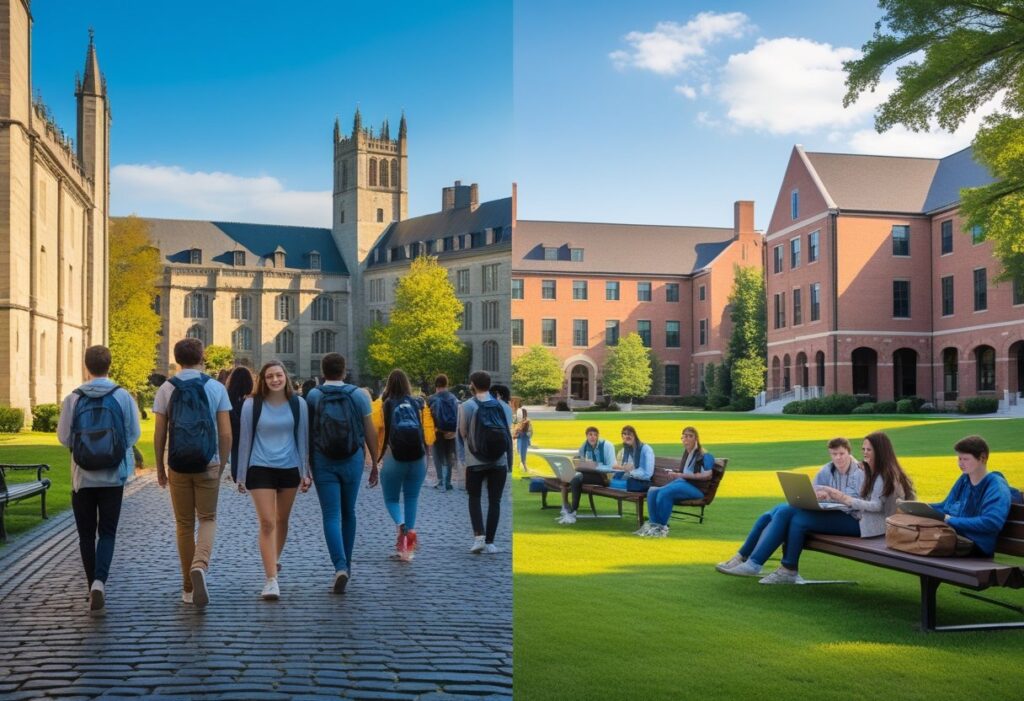
European and US colleges have different ways of organizing degrees, choosing majors, and teaching students. The type and number of classes, how students specialize, and the classroom environment vary between these regions.
Majors and Specialization
In Europe, students usually select their major or area of study before they start college. Most undergraduate programs ask students to specialize early, such as starting with law, engineering, or medicine right after high school. Changing majors is often hard because coursework is designed with a strict path in mind.
US colleges give students more time to decide. Most students take a range of classes in their first and second years before declaring a major, usually by the end of their sophomore year. Switching majors is common, and credits from earlier classes often count toward new requirements. This flexible system allows students to explore different interests before committing.
The difference in approach can impact how prepared students feel. Those in Europe often become experts in their chosen subject early, while those in the US get a broader experience before specializing.
General Education Requirements
Most US colleges have general education requirements. Students must take classes in several subjects such as math, science, writing, and the humanities. Here’s a simple example:
| Area | Typical Classes |
|---|---|
| Math/Science | Algebra, Biology |
| Humanities | History, Philosophy |
| Social Science | Psychology, Economics |
| Writing | English Composition |
European colleges focus on the main subject right away and have few, if any, required general education courses. Instead, students jump into classes directly related to their specialization. This means a chemistry major in Germany may not need to study literature or art as part of their degree.
The US system offers a more well-rounded education and gives students time to explore different academic fields. The European model lets students dive deeper into their chosen specialty from the start.
Teaching Methods
Teaching methods differ as well. In the US, classes often have a mix of lectures, small group discussions, projects, and continuous assessment through homework, midterms, and presentations. Participation and attendance usually count toward the final grade.
In European universities, large lectures are common, especially in the early years. Fewer small group classes or seminars are offered. Many European programs rely on one or two big exams at the end of the term to decide the final grade. Continuous assessment and participation often matter less in Europe than in the US.
This means US students may get more feedback during the semester, while European students face high-pressure exams at the end.
Student-Faculty Ratio
Student-faculty ratio is the number of students per teacher. US colleges, especially private ones, often have a lower student-faculty ratio. This makes it easier to meet with professors and get personal help.
Larger European universities may have bigger classes and higher ratios. It is normal for first-year lectures in Europe to have hundreds of students, with less contact between students and professors.
Smaller US liberal arts colleges sometimes offer classes with fewer than 20 students. This can lead to more discussion and individual attention. European students may need to be more independent in managing their studies and seeking help.
Admissions Process and Application Differences
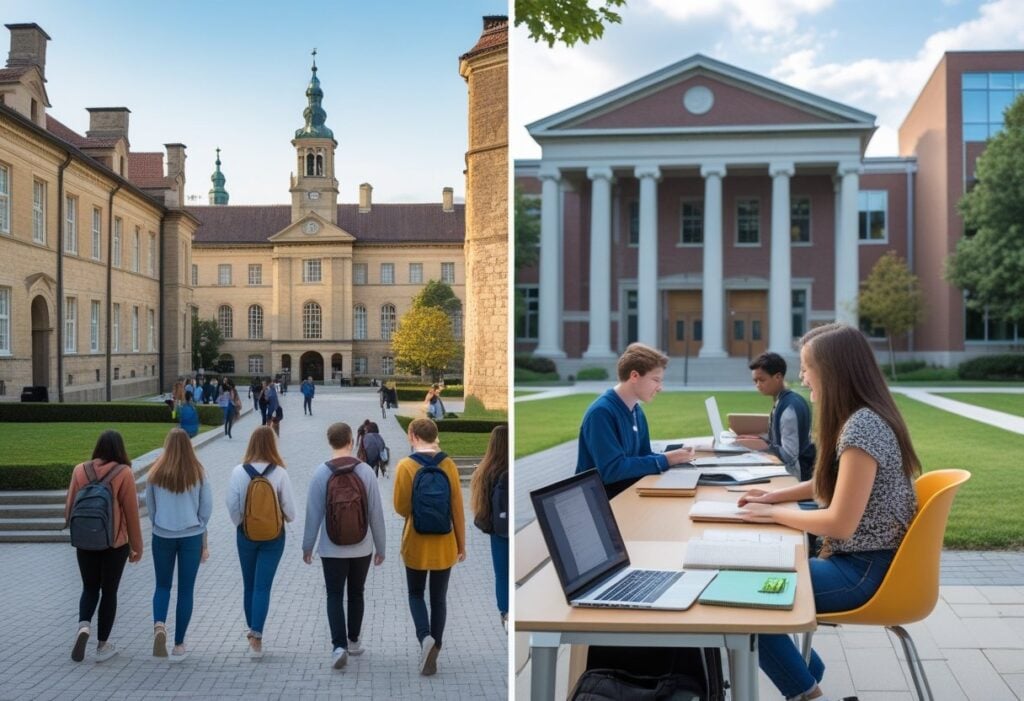
Colleges in Europe and the US have distinct paths for applying and getting accepted. Requirements, deadlines, and how students are evaluated differ between these regions.
Admissions Process and Acceptance Rates
In the US, students usually apply through a centralized system like the Common App or directly to colleges. Applications may open in the fall, with deadlines from November to January. Colleges in the US often consider grades, essays, activities, and sometimes interviews.
European schools, like those in the UK, often use centralized services such as UCAS. Other countries may require direct applications to each university. The European process tends to focus more on academic records and standardized test scores, with less emphasis on activities.
Acceptance rates are usually higher at most European universities compared to elite US schools. Many European schools admit students based mostly on set academic standards, while US colleges are more selective and holistic in their review process.
Application Requirements
US colleges usually require:
- High school transcripts
- Standardized test scores (SAT/ACT, though this is becoming optional)
- Personal essays
- Letters of recommendation
- Extracurricular activities and achievements
They may also ask for interviews or portfolios for special programs.
European universities often need:
- Final school exam results (such as A-levels, IB, Abitur, or Baccalauréat)
- Proof of language skills (like IELTS or TOEFL for English-taught programs)
- Sometimes a motivation letter or brief statement
- Few universities require essays or references
Deadlines in Europe can be much earlier, especially for competitive programs like medicine.
International Students Considerations
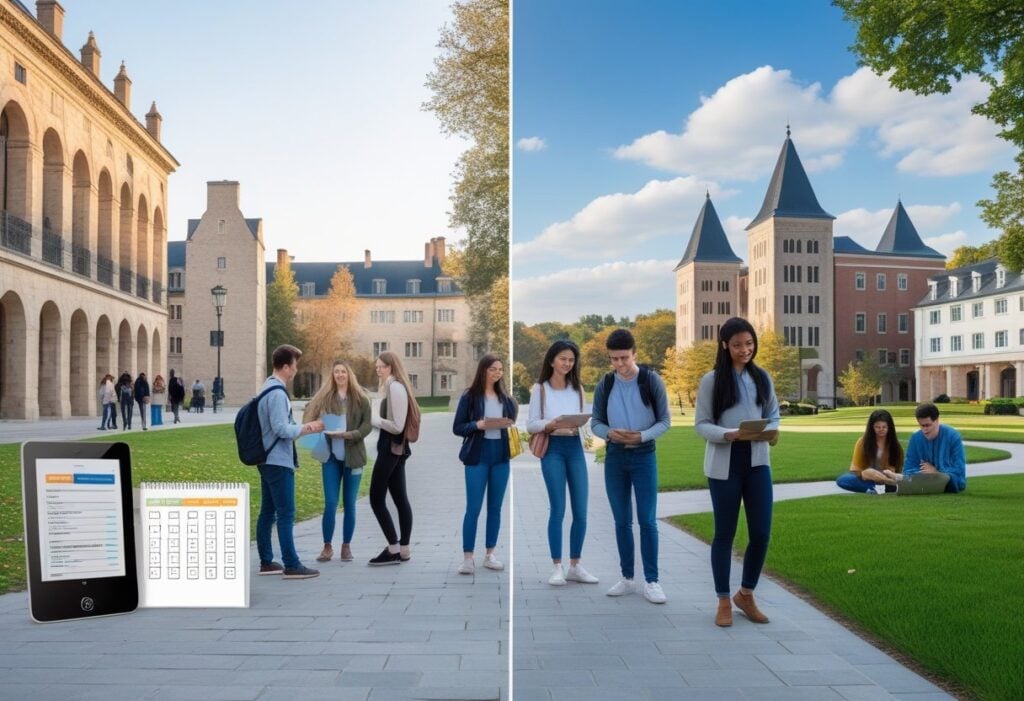
International students face special steps in both the US and Europe. In the US, proof of English skills, student visas, and financial documentation are needed. Admissions can be competitive, but many colleges provide support for international applicants.
In Europe, requirements vary by country. For example, some nations require national entrance exams, while others rely just on school records. Language proficiency is important, especially if the course isn’t in English.
Many European universities offer programs in English. Students must check visa steps, health insurance, and if their qualifications match entry standards. Housing and adjustment support services can differ between regions.
Cost of Attending and Financial Aid
College costs are very different between Europe and the US. Tuition fees, financial aid options, loans, and living expenses all play a big role in what students pay and how much debt they may have after graduation.
Tuition Fees and Free Education
Tuition fees at US colleges are usually much higher than in Europe. The average annual tuition in the US ranges from $10,000 to over $40,000 for public and private universities. In contrast, many European countries offer low-cost or even tuition-free education, especially for citizens of the European Union (EU). For example, public universities in Germany, Norway, Sweden, Finland, and Austria often have no tuition fees for EU students. Non-EU students may pay some fees, but these are usually lower than US rates.
Some countries charge small administrative fees, usually under $1,000 per year. In the UK, tuition for local and EU students is capped, while international students pay higher fees. Overall, Europe’s lower or free tuition makes college much more affordable for many students compared to the US.
Scholarships and Grants
Both the US and Europe provide scholarships and grants, but the sources and amounts can be different. In the US, need-based and merit-based aid are available through federal programs, states, colleges, and private organizations. The FAFSA form helps determine eligibility for many types of US aid.
In Europe, scholarships come from the government, universities, and the Erasmus+ program, which helps students study in other EU countries. Some scholarships in Europe are only for high-achieving students or specific fields. In some European countries, grants are not as common, partly because tuition is already low or free. International students can apply for scholarships in both Europe and the US, but there are often fewer options in Europe for students from outside the EU.
Student Loans and Debt
In the US, student loans are widely used to cover high tuition and living costs. Federal loans are the most common, but many students also need private loans. The average US college graduate leaves school with around $30,000 in student debt. Repayment can take many years after graduation.
European students often need smaller or no loans because of lower tuition costs. Some governments, such as in the UK and the Netherlands, provide student loans, but debt levels are typically lower than in the US. Many students in countries like Germany, France, and Nordic countries can finish college without taking on debt. This reduces the financial pressure after graduation.
Living Expenses
Living expenses are important when comparing costs. In the US, students can expect to pay $10,000 to $15,000 per year for housing, food, transportation, and other costs. These expenses vary by location, with cities generally costing more than rural areas.
In Europe, living costs also vary. Cities like London, Paris, and Amsterdam are expensive, with monthly costs for students ranging from €800 to €1,500. Smaller cities and towns are often cheaper. Some European universities offer affordable student housing, but in high-demand areas, finding low-cost accommodation can be difficult.
The total cost of college is not just about tuition—living expenses can be a major part of a student’s budget. European students may pay less for tuition, but they still need to budget carefully for daily living. Some students work part-time while studying to help cover these costs.
Campus Life and Culture
Campus settings, student activities, and community experiences differ between US and European colleges. From living arrangements to social gatherings, students adjust to new routines and traditions.
Student Housing and Residence Halls
In the US, many colleges require first-year students to live in on-campus dormitories, especially at private universities. Dorms usually have shared bedrooms, common bathrooms, and dining halls. Students often form close friendships with roommates and hallmates, creating a strong sense of community.
European student housing is more varied. Some students rent private apartments or shared flats instead of living in residence halls. In the UK and parts of Northern Europe, universities may offer student halls, but students often move off campus after the first year. Meal plans and on-campus dining are less common in many European countries.
Long-term friendships may form, but the housing experience can feel more independent in Europe. Living with family while attending a local university is more normal there than in the US.
| Feature | US Colleges | European Colleges |
|---|---|---|
| On-campus living | Very common, often required | Less common |
| Meal plans | Standard | Rare |
| Room type | Shared rooms common | Often single rooms |
Campus Life and Social Life
Social life on US campuses tends to be vibrant. Students often spend much of their free time on campus, meeting friends, attending events, and participating in group activities. Many socialize through university clubs, student unions, and residence hall gatherings.
In Europe, social life is often centered around the city or town rather than the campus itself. Many universities are located in city centers, and students meet friends in public places such as cafes, pubs, or cultural sites. Clubs and societies exist but may not be as closely connected to housing or campus buildings.
Friend circles can be more tightly linked to academic courses in European universities, especially since students sometimes commute from home. Weekend parties and on-campus social events are usually less central to student life outside the US.
Extracurricular Activities
US colleges generally offer a wide variety of extracurricular activities. Students can join dozens or even hundreds of recognized clubs, ranging from academic groups to music or special interest societies. Fraternities and sororities play a major role in social life at many US institutions, providing organized events, philanthropy, and housing.
In Europe, extracurricular choices may be smaller in number and less formal. Few European universities have Greek life organizations, and club membership may be linked to academic departments. Students still find opportunities to join sports, debate, theater, or music clubs, but campus-wide organizations tend to be less prominent.
Many European students seek activities off campus, in the local community or city, which leads to a different style of engagement compared to the US.
Sports and School Spirit
Sports are a huge part of US college culture. Large schools have varsity teams, and sporting events attract thousands of fans. Football and basketball games are considered major campus events. School spirit is strong, with mascots, marching bands, and homecoming traditions. Students often wear college gear and participate in pep rallies.
In Europe, sports are generally less tied to the university experience. Schools may offer intramural or club teams, but they rarely have the same scale or visibility as US college sports. Few sporting events attract large crowds or media coverage, and dedicated sports facilities are less common.
Students interested in competitive sports often join local or city clubs instead of college teams. Displays of school spirit, like chants or large rallies, are rare in most European universities.
Academic and Cultural Experience
The choice between studying in Europe or the US affects daily life, the way students interact, and the type of education they receive. Differences in city life, mobility, and campus culture shape student experiences in meaningful ways.
City Life and Mobility
European universities are often integrated into the city’s fabric. Students live in apartments or shared housing scattered throughout lively neighborhoods. They use public transportation—trams, buses, and trains—to commute to class and explore the city. Cities such as Paris, Berlin, and Amsterdam are designed for walking and biking, making it easy for students to get around without a car.
In contrast, many US colleges have sprawling campuses located outside city centers. Students might rely on campus buses or personal cars. On-campus housing is typical, especially for first-year students. It’s common to eat, study, and socialize on campus, which can create a close, contained community.
Daily life in Europe encourages independence and engagement with local culture. In the US, the campus acts as its own small town, focusing on student life and school spirit.
Cultural Experience and Global Outlook
Studying in Europe gives students easy access to multiple countries and cultures. Traveling between nations can be simple and cheap thanks to extensive rail and budget airline networks. Weekend trips to Italy, Spain, or Eastern Europe are common. Students are exposed to new languages, foods, and customs as part of daily life.
American colleges have a more centralized cultural setting. While there are international students from all over the world, most of campus life and classes are in English and shaped by American traditions.
Many European universities attract a diverse student body from around the world, making every day a chance to learn about different cultures and perspectives. This fosters a strong global outlook and can help prepare students for international careers. Students interested in college admissions abroad can turn to services offering admissions guidance to top European universities.
Cross-Cultural Communication
Moving between countries in Europe means students must navigate different customs, languages, and communication styles. Courses may be held in a foreign language, requiring extra flexibility and effort. Working on group projects with classmates from different backgrounds sharpens communication skills.
Students may learn to adapt how they speak or behave in classrooms and social settings depending on the country or school. This experience increases practical understanding of how culture changes the way people interact and solve problems.
In the US, most classes and daily life are centered around English. International and American students practice cross-cultural communication, but most cultural differences are less dramatic once students are used to US college culture.
Bilingual and International Focus
Many European universities offer courses taught in English, but students often pick up a second or third language while living or studying abroad. Learning new languages is seen as part of everyday life. That being said, we have a database of more than 12,000 programs taught entirely in English. You can check it out here.
Some programs require proof of language skills or offer classes mixing local and foreign students in both the local language and English. This can lead to better language skills and confidence in international settings.
US colleges usually teach entirely in English, though language courses are available as electives. The focus is more on American culture, but international experiences are increasing due to study abroad programs and global campus initiatives.
A bilingual or multilingual environment and an international class mix help students in Europe build strong resumes and prepare for careers that cross borders.
Career Prospects and Opportunities
Students deciding where to go to college often look closely at internships, networking, and job chances after finishing their degrees. The structure, connections, and opportunities available in Europe and the US may impact their careers in different ways.
Internships and Research
In the US, colleges often have strong connections with businesses. Many students get internships during summer or after their second year. These placements give real work experience and sometimes lead to job offers. Research opportunities in the US are common, and students can join projects early, especially in science or engineering.
In Europe, internships are also important, but their structure can differ by country. For example, in Germany, internships are often required for graduation. In France, some degrees include a final-year work placement. Research chances depend on the university. Students in the UK may find research options during their degree, but many programs focus more on coursework than lab work during the first years.
Some European countries offer paid internships more often than the US. However, placement services and organized career fairs are generally seen more often at American colleges.
Networking and Innovation
Networking events are frequent at US universities. Students can meet employers on-campus at career fairs or through alumni networks. Clubs and student groups also connect students with businesses and professionals.
Innovation is a focus in many US colleges. Schools like Stanford and MIT have programs encouraging students to launch startups or join technology projects. Incubators, business plan competitions, and pitch days are common.
European colleges offer networking, but the approach may be different. In some countries, universities work closely with local industries, especially for technical fields. Alumni networks are growing, but often not as developed as in the US. Some cities, like London and Berlin, are known for innovation hubs, though not all European schools have the same level of startup support.
Job Prospects After Graduation
Graduates from top US universities may find it easier to get jobs in the US or abroad. Employer networks and career offices are often larger and more active. In fields like business, engineering, and tech, a US college name can be an advantage.
In Europe, job prospects depend more on the country and subject studied. Graduates in engineering, health, or business from schools in Germany, the UK, or the Netherlands usually see strong job markets. Some countries offer special visas to help international students stay and work after graduation.
Language skills and local regulations are important in Europe. Someone who speaks only English may have more limited job choices in some countries. In the US, most jobs for new graduates do not require knowing another language.
The table below shows a simple comparison:
| Factor | US Colleges | European Colleges |
|---|---|---|
| Internships | Common, often organized | Varies, sometimes required |
| Research | Widely available | Depends on country and course |
| Networking | Strong alumni and employer ties | Growing, varies by country |
| Innovation | Many programs and incubators | Focused in tech hubs/cities |
| Job Prospects | Active career offices | Often linked to local industry |
Graduate Education Differences
Graduate education in Europe and the US differs in how students are admitted, the structure of degrees, and the types of international experiences available. These differences can have a significant impact on a student’s academic path, length of study, and career plans.
Graduate Admissions
Graduate admissions in the US often require a combination of standardized test scores (like the GRE), personal statements, recommendation letters, and undergraduate transcripts. Many US programs also look for work or research experience. The application process is holistic, and students usually apply to multiple programs at once.
In Europe, admission requirements are usually more focused on previous academic performance and related degrees. There are fewer standardized test requirements, and entrance exams are less common. Some countries and schools may require specific language tests, especially if the program is taught in English or another non-native language. Many master’s programs only accept students who have completed a relevant bachelor’s degree.
The application timelines may also differ. US graduate programs often have longer lead times between application deadlines and program start. European institutions may have later deadlines or offer rolling admissions.
Advanced Degree Structure
In the US, graduate degrees often follow a two-step process: first a master’s, then a PhD. A master’s program usually takes two years, while a PhD can take five to seven years, with time spent on coursework, research, and teaching.
In Europe, many countries use the Bologna Process, which standardizes degree levels (Bachelor’s, Master’s, Doctorate) across much of the continent. Most European master’s programs take one to two years. European PhDs usually take three to four years and are often focused mainly on research from the beginning, with less coursework than in the US.
European students often go directly into a PhD after a master’s. In some fields, programs combine master’s and PhD study. The table below shows the typical length for advanced degrees:
| Degree | US Duration | Europe Duration |
|---|---|---|
| Master’s | 2 years | 1–2 years |
| PhD | 5–7 years | 3–4 years |
International Studies Opportunities
Both Europe and the US offer international studies options, but the approach differs. Many European programs partner with universities across borders, allowing students to earn joint or double degrees. Programs like Erasmus+ encourage studying abroad within Europe and sometimes outside it.
US graduate schools often have formal exchange programs or offer the chance to conduct research abroad. However, these are typically selected individually rather than being built into the degree. US students may need to apply separately for funding or exchange spots.
Many European cities host large numbers of international students, and some courses are taught fully in English, making them accessible to students worldwide. In the US, international students are common, but immigration and visa processes may be more complex. Both regions have strong networks for supporting international studies, but Europe often integrates these opportunities into standard degree programs more fully.
Type of Institutions and Programs
Colleges and universities in Europe and the US differ in how they are organized and what types of programs they offer. Some focus on broad education, while others require students to pick a field early.
Public vs Private Institutions
In the US, both public and private colleges are common. Public universities usually get money from state governments and often charge less for students from that state. Private institutions are funded mostly by tuition, donations, and endowments. They tend to be more expensive, but they often offer more financial aid packages.
In Europe, most universities are public. These schools are funded by the government and usually charge much lower tuition, even for international students. Private institutions do exist, but they are less common and can be costly.
| Region | Public Universities | Private Institutions |
|---|---|---|
| US | Very common | Very common |
| Europe | Very common | Less common |
Because of these differences, students in Europe often pay less for college than those in the US. Most students in Europe attend public universities.
Liberal Arts Colleges vs Specialized Universities
Liberal arts colleges are a special feature of American higher education. These schools teach a broad range of subjects in the arts and sciences. Students often spend the first two years taking general courses before deciding on a major.
In Europe, universities usually expect students to choose a specific subject, such as law, medicine, or engineering, before they begin. Programs are often specialized from the start, and students do not have as much flexibility to change fields after enrolling.
Liberal arts education gives US students more time to explore interests. In contrast, European students start studying their chosen field in depth immediately. This structure affects how students plan their studies and future careers.
Conclusion
Choosing between college in Europe or the US depends on a student’s goals and preferences.
European colleges often have lower tuition fees and shorter degree programs. Many offer programs in English, especially for graduate studies.
US colleges, on the other hand, provide a wide variety of extracurricular activities and a strong focus on campus life. They often require general education classes in the first two years.
Key points to remember:
| Feature | Europe | US |
|---|---|---|
| Tuition fees | Lower | Higher |
| Program length | Shorter (3 years) | Longer (4 years) |
| Application process | Streamlined | More complex |
| Campus life | Less emphasis | Strong emphasis |
Students should think carefully about what matters most to them, such as cost, location, and learning style.
Both options can offer a quality education and different types of experiences.
Frequently Asked Questions
College in Europe and the US have key differences in cost, admissions, recognition, and student life. Some American students can study in Europe for low or no tuition, but certain conditions apply.