How Long to Study for the MCAT
Most students underestimate the MCAT by a wide margin. The average pre-med spends 300–350 hours preparing, yet many still feel underprepared on test day.
Here’s what most families don’t realize.
MCAT prep isn’t just about time it’s about structure, strategy, and consistency.
And this is where things shift.
For students considering medical school, especially those exploring full degree programs abroad (not study abroad), understanding how to prepare efficiently can open more flexible and often more affordable, pathways to becoming a physician.
Summary
How Long Should You Study for the MCAT?
Once students decide they want to attend medical school, the next question naturally becomes: when should I start studying for the MCAT, and how long will it take?
That question matters because it directly affects:
- When you can realistically take the exam
- When you can apply to medical school
- How much pressure you’ll feel during application season
The MCAT (Medical College Admission Test) is a standardized exam that assesses your knowledge in biology, chemistry, physics, psychology, and reasoning skills. It is widely considered one of the most demanding admissions exams in the United States.
So the concern is valid.
The Short Answer:
3 to 6 months of preparation is standard for most students.
The More Accurate Answer:
It depends on your:
- Academic background
- Study consistency
- Target score
- Outside obligations
In practice, most students need about 300–400 total study hours, distributed over a structured timeline.
Even the AAMC (the test maker) aligns with this range, suggesting roughly 300–350 hours of preparation as a baseline.
Some students compress this into 1–2 months, but those cases usually involve students without full-time academic or work commitments.
Recommended Study Hours for the MCAT
Most successful students fall into a relatively tight range:
300–400 total study hours
That range is not arbitrary. It reflects what is realistically needed to:
- Learn or re-learn foundational sciences
- Build MCAT-style reasoning skills
- Complete full-length practice exams
- Review mistakes deeply enough to improve
But the distribution of those hours depends heavily on your timeline.
MCAT Study Timeline Breakdown
| Timeline | Weekly Hours | Daily Average | Total Hours | What It Feels Like |
|---|---|---|---|---|
| 3 months | 25–35 hrs | 4–6 hrs | ~300–350 | Intensive, structured, high focus |
| 4 months | 20–25 hrs | 3–4 hrs | ~320–400 | Balanced, steady progress |
| 6 months | 10–20 hrs | 2–3 hrs | ~300–360 | Flexible, lower stress, longer runway |
This is important.
The MCAT is not designed to reward marathon study sessions, it rewards sustained cognitive training over time.
So while more time can help, it only helps if it’s structured properly. Otherwise, students often fall into passive studying, repetition without improvement, or burnout cycles that reduce retention.
MCAT Study Timeline Options
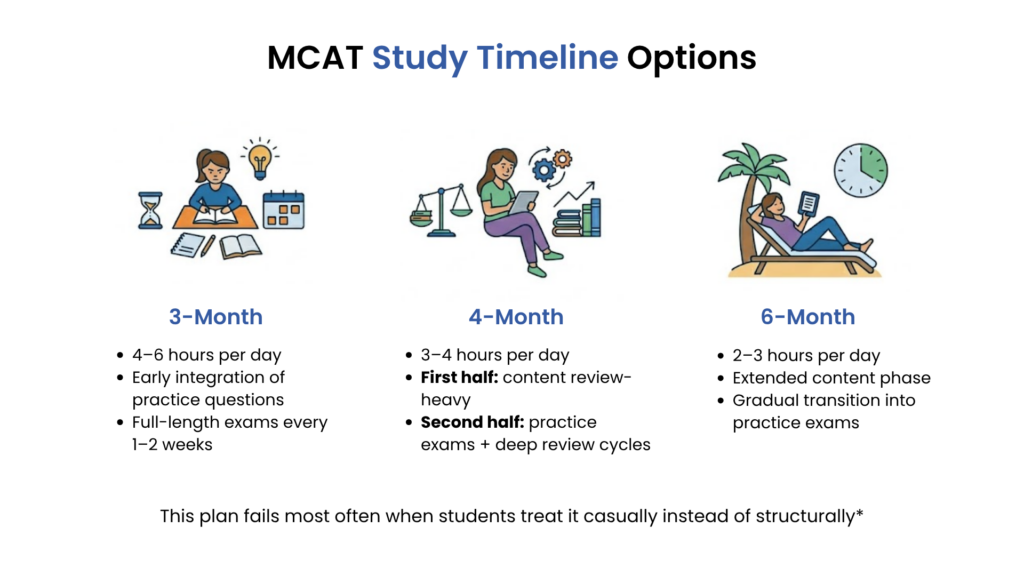
Let’s go deeper into what each timeline actually looks like in real life, not just on paper.
3-Month MCAT Study Plan
This is the most compressed and demanding timeline.
It works best for:
- Students with strong biology/chemistry/physics foundations
- Gap-year students studying full-time
- Students retaking the MCAT with targeted improvements
Structure Breakdown:
- 4–6 hours per day
- Early integration of practice questions (not just content review)
- Full-length exams every 1–2 weeks
- Very limited downtime
What this really means:
You are essentially training like an athlete in a short competitive season. There is no slow buildup phase. You move quickly from content review into application and testing.
Pros:
- Fastest path to exam readiness
- Keeps material fresh and top-of-mind
- Good for students with strong baseline knowledge
Cons:
- High cognitive load
- Limited time to correct foundational gaps
- Burnout risk increases significantly after week 6–8
This timeline only works if you already have discipline and strong academic preparation.
4-Month MCAT Study Plan
This is the most commonly recommended timeline.
It works well for:
- Most pre-med students
- Students balancing part-time jobs or lighter coursework
- Students who need both content review and practice integration
Structure Breakdown:
- 3–4 hours per day
- First half: content review-heavy
- Second half: practice exams + deep review cycles
What this really means:
You have enough time to build skills without rushing, but not so much time that you lose momentum.
You are constantly cycling:
- Learn → Apply → Review → Adjust
Pros:
- Sustainable for most students
- Strong balance of learning and testing
- Lower burnout risk than 3-month plan
Cons:
- Requires consistent daily discipline
- Less flexibility if you fall behind early
- Easy to drift without structure
This is often the “sweet spot” for students who want both performance and stability.
6-Month MCAT Study Plan
This timeline is often misunderstood.
It is not easier, it is simply more spaced out.
It works best for:
- Students with weaker science foundations
- Full-time students or working professionals
- Students who need more repetition to retain material
Structure Breakdown:
- 2–3 hours per day
- Extended content phase (first 8–10 weeks)
- Gradual transition into practice exams
- Long review cycles for weak areas
What this really means:
You are building knowledge slowly and reinforcing it repeatedly over time. This can be extremely effective, but only if you stay consistent.
Pros:
- Lower daily stress
- More time to build conceptual understanding
- Easier to maintain alongside life responsibilities
Cons:
- Easier to lose momentum over months
- Requires strong self-discipline
- Risk of “endless preparation” without exam commitment
This plan fails most often when students treat it casually instead of structurally.
Daily Study Hours for MCAT Prep
Your daily study time determines whether your plan is realistic.
Full-Time Study (Gap Year)
- 4–6 hours/day
Typical breakdown:
- 2–3 hours content review
- 1–2 hours practice questions
- 1 hour reviewing mistakes
This structure mirrors how MCAT thinking actually develops: repetition plus correction.
Part-Time Study (School or Work)
- 2–3 hours/day
Typical breakdown:
- 60–90 minutes content review
- 45–60 minutes practice questions
- 30 minutes review/flashcards
Here’s what that means:
You cannot “cover everything” daily. You must prioritize high-yield topics and consistency.
Key Insight
Consistency matters more than intensity.
A student studying 2 hours daily for 6 months often outperforms someone studying 10 hours once a week, because cognitive retention decays quickly without repetition.
MCAT Study Plan and Schedule: What Actually Drives Success

A strong MCAT plan is not just a calendar, it is a feedback loop.
You should be continuously adjusting based on performance data.
Key Factors That Affect Study Duration
Your timeline is shaped by five major variables:
- Science background
- Strong coursework reduces required prep time
- Target score
- Competitive med schools require higher consistency and more practice exams
- Diagnostic score
- Your baseline determines how much rebuilding is needed
- Schedule flexibility
- Work, school, and family obligations limit daily capacity
- Learning style
- Some students need repetition; others learn through application
Now here’s the twist.
Students exploring medical degrees abroad sometimes discover that admissions structures vary significantly by country. Some programs are more direct-entry and less test-heavy, while others still require MCAT performance.
This doesn’t eliminate the MCAT but it can change how strategically you approach it.
Full-Time vs Part-Time MCAT Study Plans
| Factor | Full-Time Study | Part-Time Study |
|---|---|---|
| Daily Hours | 4–6 hrs | 2–3 hrs |
| Timeline | 3–4 months | 4–6 months |
| Flexibility | Low | High |
| Burnout Risk | Higher | Moderate |
| Best For | Gap year students | Current students/workers |
Choose based on reality, not ideal conditions.
A realistic plan always outperforms an ambitious but unsustainable one.
How to Build an Effective Study Schedule
A strong MCAT schedule includes structure and adaptability.
Core components:
- Weekly performance goals
- Dedicated content and practice blocks
- Scheduled full-length exams (every 2–3 weeks)
- Built-in review time
- Buffer weeks for weak areas
But wait.
Most students make the same mistake: they over-plan and under-execute.
A better system is simple:
Learn → Practice → Review → Adjust
That loop is the foundation of MCAT improvement.
MCAT Preparation Strategy
Preparation is not about exposure it’s about precision.
Best Resources for MCAT Preparation
Most high-performing students use a focused set of tools:
- Blueprint MCAT Review
- AAMC official materials
- UWorld question bank
- Kaplan or Princeton Review books
- Anki flashcards
Read more: Best MCAT Prep Course
Key principle:
More resources do not equal better results. Depth matters more than variety.
Practice Exams and Review Strategy
Practice exams are where score improvement happens.
Recommended structure:
- 1 diagnostic exam before studying begins
- Full-length exam every 2–3 weeks during prep
- Weekly targeted section practice in later stages
Review process (critical step):
For every missed question, ask:
- Was this content gap or reasoning error?
- Why is the correct answer correct?
- What pattern caused the mistake?
This is important.
Students who review deeply improve significantly faster than those who only “check answers.”
Common Study Mistakes to Avoid

- Studying without a structured schedule
- Relying only on content review
- Ignoring full-length practice exams
- Not analyzing mistakes in detail
- Starting practice tests too late
- Burning out in early weeks
And this changes the equation.
The MCAT is not a memorization exam it is a reasoning and application test.
Tips to Stay Consistent During Preparation
Consistency is the highest predictor of success.
Practical strategies:
- Study at the same time daily
- Set weekly performance targets
- Track errors and patterns
- Use active recall instead of passive reading
- Schedule recovery days to prevent burnout
- Build accountability (study partners or mentors)
The goal is not perfection.
The goal is continuity.
Final Planning: When to Schedule Your MCAT Exam
Timing your exam is a strategic decision, not just a logistical one.
Best Timing Strategy
- Begin studying with a target exam date in mind
- Schedule your MCAT 3–4 months into preparation (minimum confidence baseline)
- Leave flexibility for a retake window if needed
Ideal testing windows:
- April–June: Best for early medical school applications
- July–August: Common secondary application timing
Here’s what that means.
Your MCAT date should reflect readiness not deadlines alone.
Cost Breakdown of MCAT Preparation
MCAT prep can get expensive but it doesn’t have to.
Typical Costs
| Item | Estimated Cost |
|---|---|
| MCAT Exam Fee | $335 |
| Prep Books | $150–$300 |
| Question Banks | $200–$400 |
| Prep Courses (optional) | $1,500–$3,000 |
Total range:
- Budget approach: $500–$800
- Full-service prep: $2,000–$4,000
Here’s what most families don’t realize.
Compared to the cost of medical education in the U.S., this is relatively small but it’s still worth optimizing.
Students considering medical school in Europe often find:
- Lower tuition
- Transparent admissions
- Flexible pathways (some without MCAT)
Who Is This a Good Fit For?
A structured MCAT study plan is ideal for:
- U.S. pre-med students applying domestically
- Students considering international medical schools
- Career changers entering medicine
- Gap year students focusing on applications
Especially relevant for:
Students exploring full degrees abroad, where admissions may be:
- More predictable
- Less reliant on subjective factors
- Focused on academic readiness
Common Misconceptions About MCAT Prep
“I need a year to prepare”
Usually unnecessary. Most students perform best with 3–6 months of structured study (300–400 hours). Longer timelines often reduce consistency and lead to forgetting earlier material.
“More hours = better score”
Not true. MCAT success depends on quality of study time, not total hours. Practice questions, full-length exams, and deep review matter far more than passive review or repetition.
“I need an expensive prep course”
Not required. Many students score highly using AAMC materials, UWorld, and self-study tools. Courses can help with structure, but they don’t replace consistent practice and review.
“If I don’t do well, I can’t become a doctor”
Incorrect.
This is where international options matter.
Some accredited medical programs abroad:
- Don’t require the MCAT
- Offer direct-entry pathways
- Are recognized globally
Frequently Asked Questions
We’re here to help answer your questions about How Long to Study for the MCAT
Most students study 300–400 hours total, depending on their starting point and target score.
Yes, if you study full-time (4–6 hours/day) and have a solid science background.
Yes. This is ideal for part-time study or students needing more foundational review.
• Full-time: 4–6 hours
• Part-time: 2–3 hours
Consistency matters more than intensity.
Not always.
Some accredited programs in Europe do not require the MCAT, offering alternative pathways into medicine.
Conclusion
Preparing for the MCAT is less about how long you study and more about how effectively you use your time.
Most students need:
- 3–6 months
- 300–400 hours
- A structured, consistent plan
But here’s the bigger picture.
If you’re exploring medical careers, the MCAT is just one pathway. Many students are now considering fully accredited medical degrees abroad, where admissions can be more transparent, costs are often lower, and timelines are clearer.
If you’re not sure which path makes the most sense, that’s exactly where guidance helps.
You can explore vetted international programs through Beyond The States, take the program match quiz, or schedule a strategy session to map out your options with clarity.