Gap Year Travel Programs
College costs in the U.S. keep rising faster than inflation. And despite that, a lot of students still graduate unsure about their direction, without much real-world experience or clear career skills.
Here’s something many families don’t fully see at first.
A gap year abroad isn’t just a break between high school and college anymore. For a lot of students, it’s becoming a planned step that builds academic strength, language ability, career clarity, and sometimes even opens the door to earning a full degree overseas not just short study abroad programs.
And that changes the picture quite a bit.
The strongest gap year programs in 2026 aren’t just about travel. They tend to mix structured learning, internships, volunteering, cultural immersion, and even university prep in a way that can genuinely shape a student’s next steps.
Summary
What Is a Gap Year Travel Program?
A gap year travel program is a structured experience where students spend time abroad before college, between academic stages, or during a transition period.
Most programs include a mix of:
- Language immersion
- Volunteer work
- Internships
- Cultural learning
- Outdoor or leadership activities
- University preparation
- Travel across one or more countries
Some last just a few weeks. Others run for a full academic year.
The stronger programs are built around actual outcomes, not just “seeing the world.”
That matters.
When done well, a gap year can help students return to school more focused, more independent, and clearer about what they want academically.
In some cases, it even leads students to rethink the traditional path entirely and consider earning a full accredited degree abroad at a lower cost than many U.S. universities.
At Beyond The States, that’s the focus helping students look at full degree options in Europe, not just short-term study abroad experiences.
Why Take a Gap Year Abroad?
Students choose gap years for a lot of different reasons, and the trend has been growing as families rethink the usual college timeline.
Common reasons students choose gap year programs
- Feeling burned out after high school
- Not being sure about a major or career path
- Wanting international experience
- Learning a new language
- Building independence before college
- Gaining work or volunteer experience
- Strengthening college applications
- Exploring more affordable degree options abroad
Research generally shows that structured gap years can boost confidence, motivation, and engagement once students return to academics.
But there’s a catch.
The outcome depends heavily on the program itself. A loosely planned year with no structure is very different from a guided, intentional program abroad.
Best Gap Year Travel Programs in 2026
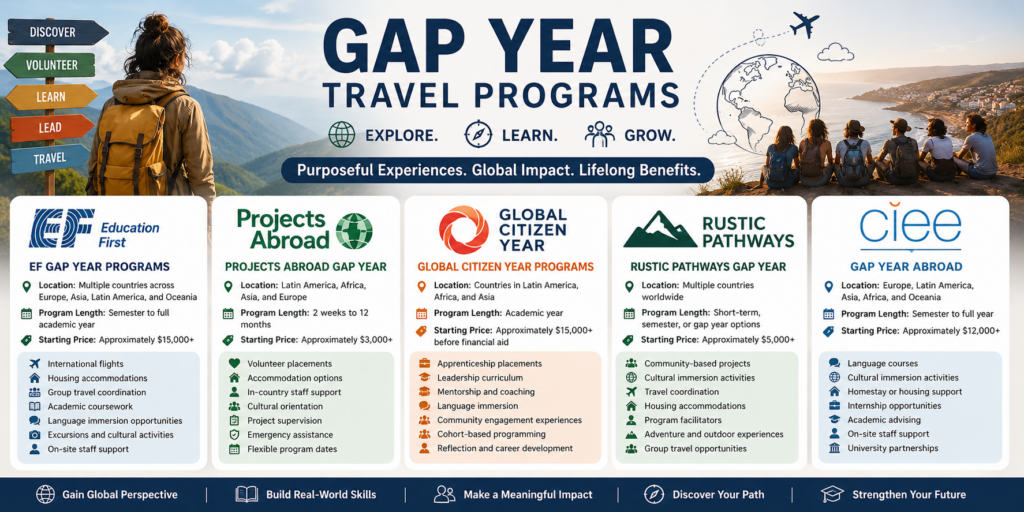
There isn’t really a single “best” option. It depends on what a student wants, how much structure they need, their budget, and their goals.
Here’s a simple breakdown of programs many U.S. families tend to look at.
| Program Provider | Best For | Typical Length | Focus Areas | Approximate Cost |
|---|---|---|---|---|
| EF Gap Year Programs | Structured travel + academics | Semester to year | Language, travel, culture | $15,000–$35,000 |
| Projects Abroad Gap Year | Volunteering and service | 2 weeks to 1 year | Healthcare, teaching, conservation | $3,000–$15,000+ |
| Global Citizen Year Programs | Leadership + global immersion | Academic year | Apprenticeships, leadership | $15,000–$40,000 |
| Rustic Pathways Gap Year | Adventure + service learning | Flexible | Community projects, travel | $5,000–$20,000 |
| CIEE Gap Year Abroad | Academic and cultural immersion | Semester to year | Language, internships, study | $12,000–$30,000 |
EF Gap Year Programs
Location: Multiple countries across Europe, Asia, Latin America, and Oceania
Length: Semester to full year
Starting cost: $15,000+
Includes:
- Flights
- Housing
- Group travel
- Coursework
- Language learning
- Cultural activities
- On-site staff support
EF Education First is a good fit for students who want a very structured experience. Everything is organized in advance, which makes it easier for families who prefer clear support and guidance while their student is abroad.
Projects Abroad Gap Year
Location: Latin America, Africa, Asia, Europe
Length: 2 weeks to 12 months
Starting cost: $3,000+
Includes:
- Volunteer placements
- Housing options
- Local support staff
- Orientation
- Project supervision
- Emergency support
Projects Abroad focuses heavily on service work. Students get more direct experience in fields like healthcare, education, and conservation, with supervision built into the program.
Global Citizen Year Programs
Location: Latin America, Africa, Asia
Length: Academic year
Starting cost: $15,000+ (before aid)
Includes:
- Apprenticeships
- Leadership training
- Mentorship
- Language learning
- Community engagement
- Cohort-based learning
Global Citizen Year is designed for students who want more structure around personal growth and leadership. It’s less about travel for its own sake and more about building direction and skills.
Rustic Pathways Gap Year
Location: Various countries worldwide
Length: Flexible options
Starting cost: $5,000+
Includes:
- Community service projects
- Cultural immersion
- Travel logistics
- Housing
- Group programs
- Outdoor activities
Rustic Pathways blends travel with service and adventure. It tends to appeal to students who want something active and less classroom-focused.
CIEE Gap Year Abroad
Location: Europe, Asia, Africa, Latin America, Oceania
Length: Semester to 1 year
Starting cost: $12,000+
Includes:
- Language courses
- Cultural immersion
- Housing support
- Internships
- Academic advising
- University partnerships
CIEE works well for students who want a mix of academics and cultural experience. It can also be a stepping stone toward longer international study.
Gap Year Abroad vs. Full Degree Abroad
This is where some families start thinking beyond gap years altogether.
A gap year is temporary.
A full degree abroad means earning an accredited bachelor’s degree entirely outside the United States.
| Gap Year Abroad | Full Degree Abroad |
|---|---|
| Temporary experience | Complete university degree |
| Usually 3–12 months | Usually 3–4 years |
| Often non-degree based | Fully accredited degree |
| Focus on exploration | Focus on academics + career |
| Can be expensive short-term | Often lower overall tuition |
| Limited academic credit | Full university qualification |
Many European universities teach entirely in English and can cost significantly less than comparable U.S. schools.
If families want to explore that route, Beyond The States helps students look at full degree options in Europe and understand how those programs actually work in practice.
Some public universities in Europe charge less than $5,000 per year for international students.
Admissions also tend to feel more straightforward and based on merit, especially when compared to the more unpredictable holistic admissions process in the U.S.
At Beyond The States, we help families sort through these options and figure out what actually makes sense for their goals.
Typical Cost Breakdown for Gap Year Travel Programs
Costs really depend on where you go and how the program is structured.
Here’s a realistic breakdown for a semester or full-year program:
| Expense | Estimated Cost |
|---|---|
| Program tuition | $5,000–$30,000 |
| Flights | $800–$2,500 |
| Insurance | $500–$1,500 |
| Visa fees | $100–$600 |
| Personal spending | $1,500–$5,000 |
| Vaccinations/prep | $200–$800 |
Ways families reduce costs
There are a few practical ways to bring expenses down:
- Picking regional programs instead of ones that jump across multiple countries
- Applying for scholarships
- Living in homestays instead of private apartments
- Choosing more affordable destinations
- Looking into direct enrollment at universities abroad
One thing to keep in mind: a higher price tag doesn’t automatically mean a better experience or better outcomes.
Who Is a Gap Year Abroad a Good Fit For?
Gap year travel programs tend to work well for students who:
- Want international experience before starting college
- Are feeling burned out academically
- Are still figuring out their direction
- Are interested in global or international careers
- Want to improve a foreign language
- Learn better through hands-on experiences
- Are considering studying abroad for their degree
- Want a bit more independence and maturity before college
They may not be the best fit for students who:
- Prefer very structured academic environments
- Struggle a lot with independence
- Need continuous academic momentum without a break
- Don’t have any real direction or goals for the year
Planning really matters here.
A good gap year usually has clear goals, some accountability, and a realistic budget from the start.
Common Myths About Gap Year Programs
Myth #1: Gap years delay academic success
In reality, many students come back more focused and motivated than before.
Myth #2: Gap years are only for wealthy families
Some programs are expensive, but there are scholarships, work options, and lower-cost destinations that make them more accessible than people think.
Myth #3: International experiences don’t help careers
Global exposure, communication skills, and language ability are all increasingly useful in many fields.
Myth #4: Degrees abroad aren’t recognized in the U.S.
Many international universities are fully accredited and recognized by U.S. employers and graduate schools.
That said, it’s still important to double-check accreditation and recognition before enrolling. But when you choose reputable universities, studying abroad can absolutely lead to strong career and graduate school outcomes.
How to Choose the Right Gap Year Travel Program
Before committing, it helps to slow down and look at a few key areas:
1. Academic structure
Does the program include actual coursework, internships, or something measurable?
2. Safety and support
What kind of housing oversight, emergency support, and on-the-ground staff are in place?
3. Cost transparency
Are things like flights, meals, insurance, and excursions clearly included or separate?
4. Accreditation or partnerships
Is the program tied to recognized institutions or universities?
5. Career relevance
Will this experience actually help with future applications or career direction?
6. Long-term value
Could this experience also help a student explore full degree options abroad later on?
And here’s the part that often gets overlooked:
The best gap year isn’t the one with the most destinations or the most “Instagram-worthy” itinerary. It’s the one that actually leads to growth and clarity.
Frequently Asked Questions
We’re here to help answer your questions about Gap Year Travel Programs
They can be, especially when they include real academic, cultural, or professional structure not just travel for its own sake.
Most structured programs fall somewhere between $5,000 and $30,000+, depending on length and location.
Yes. Colleges often value maturity, international experience, leadership, and intentional learning.
Reputable programs usually provide housing oversight, emergency procedures, and staff support. Still, families should research providers carefully.
Some programs offer credit, but it really depends on the provider and the receiving university.
Students might start college, apply for internships, continue studying abroad, or move into full degree programs internationally.
Final Thoughts
Gap year travel programs are changing.
For a lot of students, they’re not just a pause before college anymore. They’ve become a way to build clarity, gain international experience, and sometimes even open the door to more affordable degree pathways abroad.
The key is to approach them with intention.
Focus on what the student will actually learn. Think about long-term outcomes, not just the trip itself. Compare costs honestly. And choose programs that align with real academic or career goals not just short-term excitement.
If you’re also exploring full degree options outside the U.S., Beyond The States helps students compare accredited English-taught programs across Europe. It’s a useful way to see what’s actually possible in terms of cost, admissions, and academics.
You can explore programs, take our quiz to get started, book a free strategy call or check out our College Admissions Counseling.