MBA Recommendation Letter Sample
Applying to an MBA program can feel like a lot. Between standardized tests, personal statements, transcripts, and interviews, it’s easy to think recommendation letters are just another item to cross off your checklist.
They’re not.
A strong recommendation letter can reinforce your achievements, confirm your leadership potential, and highlight qualities that don’t always come across in a résumé. On the other hand, a vague or generic letter can weaken an otherwise strong application.
Here’s something many families don’t realize.
Whether you’re applying to a graduate business school in the United States or pursuing a fully accredited MBA degree in Europe, recommendation letters serve much the same purpose. They help admissions committees understand who you are beyond your grades and work history. At Beyond The States, we help students earn full degrees abroad—not semester study abroad programs—and many European MBA programs clearly explain what they expect to see in recommendation letters.
If you’re looking for an MBA recommendation letter sample, this guide explains what makes a recommendation effective, who should write it, and how to help your recommender create a letter that genuinely strengthens your application.
Summary
What Is an MBA Recommendation Letter?
An MBA recommendation letter is a document submitted as part of an MBA admissions application. It gives someone who knows your work the chance to highlight your strengths, leadership ability, work ethic, and potential for future success.
A great letter of recommendation goes beyond compliments. It backs up those positive claims with real examples that show your performance, character, and impact.
Admissions committees use recommendation letters to answer questions like:
- Can this applicant lead others?
- Do they work well with a team?
- Have they shown professional growth over time?
- Will they contribute meaningfully in the classroom?
- Are they ready for the challenges of graduate business school?
The strongest recommendation letters tell a story. They rely on specific examples instead of a long list of positive adjectives.
Sample Excerpt
I have supervised Sarah Johnson for the past four years as Senior Operations Manager at ABC Technologies. During that time, she consistently demonstrated exceptional leadership, strategic thinking, and a remarkable ability to unite cross-functional teams. When our company launched a new product line, Sarah led a team of twelve employees across three departments, completing the project two weeks ahead of schedule while reducing operational costs by 18%. Her combination of analytical thinking and collaborative leadership makes her exceptionally well prepared for graduate business education.
Notice what makes this example effective:
- It explains the relationship between the recommender and the applicant.
- It includes a measurable accomplishment.
- It provides evidence of leadership.
- It establishes the recommender’s credibility.
- It ends with a clear recommendation.
Why Do Business Schools Require an MBA Recommendation Letter?
MBA admissions go beyond grades and test scores.
Unlike many undergraduate programs, MBA admissions place a strong emphasis on professional experience and leadership potential. Recommendation letters help confirm qualities that transcripts and résumés simply can’t show.
Leadership Skills
Business schools are looking for future leaders.
A recommendation letter should explain how the applicant:
- Motivates colleagues
- Solves difficult problems
- Makes decisions under pressure
- Influences teams
Professional Achievements
Strong recommenders don’t just say an applicant is successful. They prove it with measurable results, such as:
- Revenue growth
- Cost savings
- Project completion
- Promotions
- Awards
- Process improvements
Teamwork
MBA programs rely heavily on group discussions and collaborative projects.
That’s why admissions committees look for applicants who:
- Listen to others
- Respect different perspectives
- Build consensus
- Support their teammates
Academic Potential
Many MBA applicants have been out of school for several years.
A recommendation letter can reassure admissions committees that the applicant still has the curiosity, discipline, and ability to succeed in an academic setting. This can be especially helpful for candidates with lower undergraduate GPAs.
Get an English-taught Master’s in Europe
Kick-start your education abroad with a powerful master’s degree taught entirely in English. Avoid taking on any student loans and take your 9 to 5 job… international!
Who Should Write Your MBA Recommendation Letter?
Choosing the right recommender is just as important as the letter itself.
The strongest recommendations come from people who know your work firsthand and can speak about it with confidence.
Direct Supervisor
For most applicants, a direct supervisor is the best choice.
They can speak directly about your:
- Leadership
- Performance
- Professional growth
- Communication skills
- Decision-making
In most cases, this is the strongest source for a recommendation.
Manager
If asking your direct supervisor isn’t appropriate—for example, if they don’t know you’re applying—another manager you’ve worked closely with can be an excellent alternative.
Choose someone who has seen your work consistently over time.
Professor
Applicants with limited work experience may benefit from a recommendation from a professor, especially if they’ve recently completed coursework or business-related research.
A professor can speak about your:
- Academic ability
- Critical thinking
- Classroom participation
- Research skills
Mentor
A professional mentor can also write a strong recommendation if they have a deep understanding of your career growth.
That said, a mentor’s letter is usually best used alongside a workplace recommendation rather than replacing one, unless your circumstances make that necessary.
What Should an MBA Recommendation Letter Include?
Every effective MBA recommendation follows a clear structure while still feeling personal and specific.
Introduction
The recommender should begin by explaining:
- Their role
- Their relationship with the applicant
- How long they’ve known or worked with the applicant
This immediately establishes credibility.
Accomplishments
The main body of the letter should focus on meaningful achievements instead of simply listing job responsibilities.
Strong examples might include:
- Leading organizational change
- Managing challenging projects
- Launching new initiatives
- Improving company performance
The more specific the examples, the stronger the letter.
Leadership Examples
Leadership isn’t limited to managing people.
Strong recommendation letters often highlight applicants who have:
- Influenced stakeholders
- Resolved conflicts
- Mentored junior employees
- Built effective teams
Communication Skills
MBA students spend a lot of time presenting ideas, leading discussions, and collaborating with classmates.
A recommendation letter should explain how the applicant communicates effectively with different audiences and works well with others.
Career Potential
Admissions committees also want to see future potential.
The recommender should explain why the applicant is ready for graduate business education and how earning an MBA fits into their long-term career goals.

Join the conversation.
Get real answers.
Beyond the States is a student community for those building their future in Europe.
How Do You Write a Strong MBA Recommendation Letter?
Whether you’re writing the recommendation yourself or helping someone prepare one, having a clear structure makes the process much easier.
Here’s a simple way to approach it.
Start With a Strong Introduction
Begin by explaining your relationship with the applicant.
For example:
I have supervised Michael for three years as Regional Sales Director at XYZ Corporation.
That single sentence immediately gives admissions committees the context they need.
Use Specific Examples
Avoid vague descriptions like:
- Excellent leader
- Hard worker
- Great communicator
Instead, show what the person actually did.
Example:
Michael redesigned our client onboarding process, reducing implementation time by 30% while improving customer satisfaction scores.
Real examples make your recommendation much more convincing.
Include Measurable Achievements
Whenever possible, include numbers. They add credibility and help admissions committees understand the applicant’s impact.
Examples include:
- Increased revenue by 22%
- Managed a team of 18 employees
- Reduced costs by $250,000
- Improved customer retention by 15%
Concrete results speak louder than general praise.
End With a Clear Endorsement
Finish your letter with a confident recommendation.
Example:
I recommend Jennifer without reservation for your MBA program. I am confident she will contribute meaningfully to your academic community while continuing her impressive professional growth.
What Is the Best MBA Recommendation Letter Format?
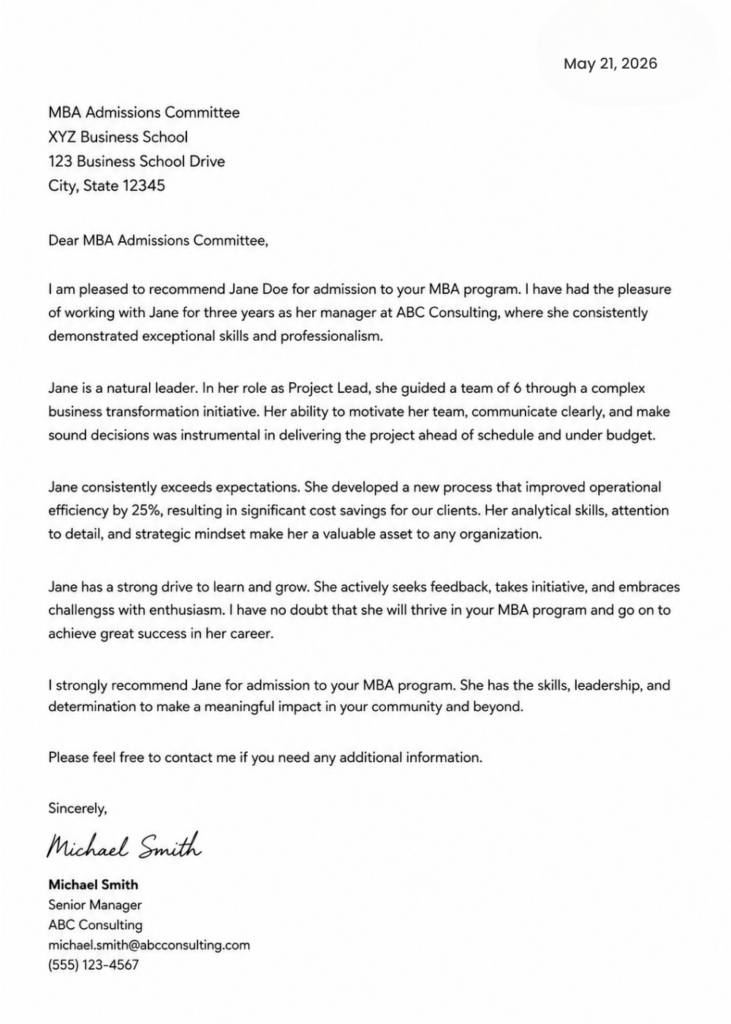
Business schools usually expect a professional, well-structured recommendation letter. A formal business letter format is still the standard.
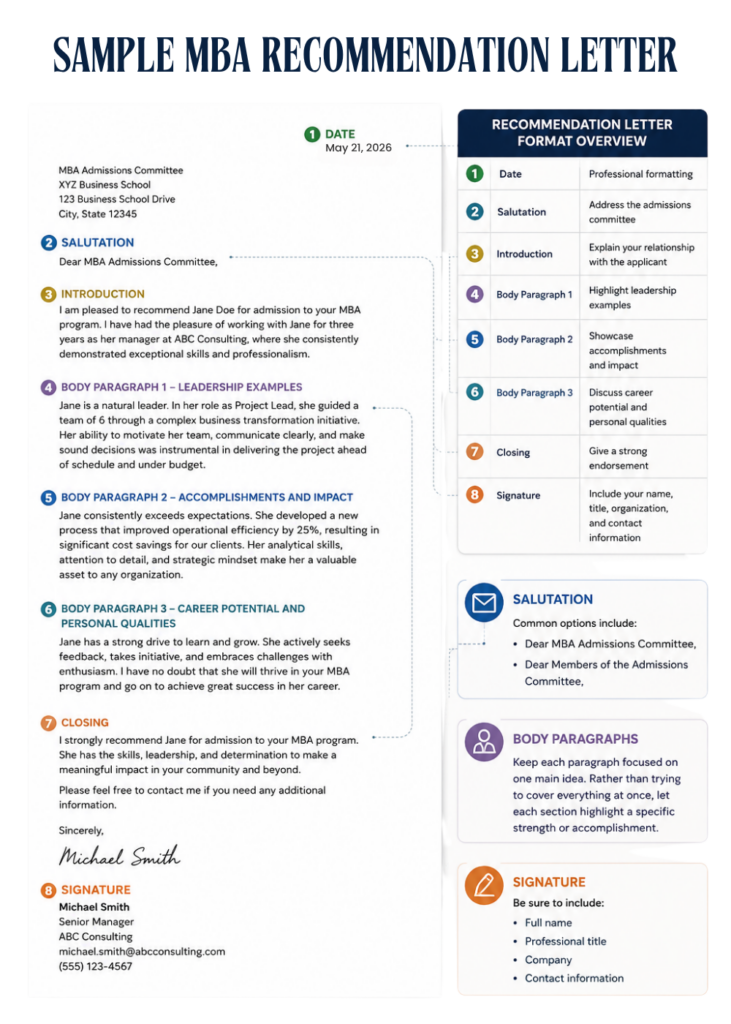
| Section | Purpose |
|---|---|
| Date | Professional formatting |
| Salutation | Address the admissions committee |
| Introduction | Explain your relationship with the applicant |
| Body Paragraph 1 | Highlight leadership examples |
| Body Paragraph 2 | Showcase accomplishments and impact |
| Body Paragraph 3 | Discuss career potential and personal qualities |
| Closing | Give a strong endorsement |
| Signature | Include your name, title, organization, and contact information |
Salutation
Common options include:
- Dear MBA Admissions Committee,
- Dear Members of the Admissions Committee,
Body Paragraphs
Keep each paragraph focused on one main idea. Rather than trying to cover everything at once, let each section highlight a specific strength or accomplishment.
Signature
Be sure to include:
- Full name
- Professional title
- Company
- Contact information
MBA Recommendation Letters for European Business Schools
Many European MBA programs ask for recommendation letters, much like business schools in the United States. The difference is that their admissions requirements are often more transparent.
Many universities clearly explain:
- Who should write the recommendation
- The questions recommenders need to answer
- How to submit the letter
- How applications are evaluated
- Important application deadlines
That transparency makes it easier to prepare a stronger application and reduces last-minute surprises.
If you’re applying for an MBA in Europe, it’s also worth checking:
- Institutional accreditation
- International recognition
- English-taught programs
- Career support services
- Employer reputation
At Beyond The States, we research and vet fully accredited, English-taught universities across Europe. We help you compare programs based on affordability, admissions requirements, and academic quality so you can find the best fit for your goals.

Cost Breakdown: Applying for an MBA
Recommendation letters are usually free, but they’re just one part of the overall cost of applying to an MBA program.
| Expense | Typical Cost |
|---|---|
| MBA application fee | $50–$300 per school |
| GMAT or GRE (if required) | $220–$275 |
| English proficiency test (if required) | $200–$300 |
| Transcript requests | $5–$25 each |
| Credential evaluation (sometimes required) | $100–$250 |
Many European MBA programs have lower tuition than similar programs in the U.S. Some also waive GMAT or GRE requirements for qualified applicants. Even so, it’s always a good idea to review each university’s admissions requirements before you apply.
Find the Perfect Degree Program in Europe
Explore accredited bachelor’s and master’s programs with clear admissions and lower costs. Join thousands of students already studying across Europe.
Who Is This a Good Fit For?
Learning how to get a strong MBA recommendation letter can be especially helpful if you are:
- An early-career professional applying to MBA programs
- A mid-career manager looking to move into leadership roles
- A U.S. student considering an accredited MBA in Europe
- A career changer planning to pursue graduate business education
- An applicant with strong work experience but older academic records
If you’re planning to study abroad, start researching admissions requirements early. That gives you plenty of time to choose the right recommenders before application deadlines arrive.
Common Myths About MBA Recommendation Letters
Myth: A CEO’s letter is always better.
Reality: Admissions committees care far more about detailed, personal recommendations than impressive job titles.
Myth: Every letter should sound formal and academic.
Reality: Authentic, professional writing is much more effective than language that feels overly polished or exaggerated.
Myth: Longer letters are stronger.
Reality: A concise, well-supported letter of one or two pages is often more persuasive than a long, repetitive one.
Myth: You should write the letter yourself.
Reality: Some recommenders may ask for talking points or a draft, but the final recommendation should reflect their own perspective and follow the school’s policies.
Frequently Asked Questions
We’re here to help answer your questions about MBA recommendation letters
Most recommendation letters are one to two pages long. Focus on providing specific examples and meaningful insights rather than trying to fill extra space.
Sometimes. However, admissions committees generally prefer a direct supervisor or manager who can speak to your leadership, performance, and professional growth.
Yes. Share your résumé, career goals, target schools, and examples of projects or accomplishments you’d like them to highlight.
Many do, but requirements vary by university. Some ask for one recommendation, while others require two. Always check the admissions guidelines for each school you’re applying to.
The strongest letters include specific examples, measurable achievements, honest observations, and a confident endorsement from someone who knows the applicant well.
A strong MBA recommendation letter isn’t built on impressive titles or generic compliments. It shows your leadership, achievements, and potential through specific examples that support the rest of your application.
If you’re exploring fully accredited, English-taught MBA programs in Europe, we can help you compare vetted universities, understand admissions requirements, and find programs that fit your goals and budget. Take our Beyond The States quiz, explore our country guides, or schedule a free strategy session with us to create a clear plan for earning your degree abroad with confidence.