University Open Days
College visits in the U.S. can feel rushed, expensive, and oddly unhelpful. You fly in, walk around campus, sit through a broad info session, and leave with more questions than you started with.
What a lot of families don’t realize is that university open days in Europe work very differently.
They’re usually more structured, more transparent, and much more focused on helping you figure out whether a program is actually the right fit before you commit. And if you’re thinking about earning a full, accredited degree abroad not just studying overseas for a semester open days can be one of the most useful parts of the decision process.
Summary
What is a University Open Day?
A lot of people assume a university visit means a quick walk around campus and a few brochures.
That’s not really what an open day is.
A university open day is a structured event designed to help you understand both the university and the specific program you’re considering. You’re not just looking at buildings. You’re trying to picture your next three or four years.
During an open day, you’ll usually have the chance to:
- Attend program-specific presentations
- Talk directly with professors and admissions staff
- Meet current students
- Explore classrooms, labs, and student spaces
- Learn how admissions actually work
One thing that stands out about European open days is how academically focused they are. Compared to what many U.S. families are used to, they tend to be more direct and transparent.
If you’re considering a full degree abroad, this is often the moment where programs start to feel real. You can see how the curriculum is structured, what you’ll actually study, and where the degree could lead.t to see how programs are structured, what you’ll study, and where it can lead.
When Do University Open Days Happen?
Most universities hold open days several times throughout the year, not just once.
You’ll usually see them scheduled:
- In the fall, for students starting their research
- In the winter, when students begin narrowing options
- In the spring, closer to final decisions
Some universities offer multiple in-person dates. Others include virtual options too.
That flexibility matters because many European universities have later or more flexible application deadlines than schools in the U.S. Even attending an open day later in the cycle can still be worthwhile.
If you’re planning ahead, it’s smart to check university websites early and register in advance. Popular sessions can fill up quickly.ister in advance. Popular sessions can fill up quickly.
Open Days vs Campus Tours: What’s the Difference?
This is where people often get confused.
Both involve visiting a university, but they’re designed for completely different purposes.
| Feature | Campus Tours | Open Days |
|---|---|---|
| Structure | Guided walk + general info session | Full-day event with multiple sessions |
| Focus | Campus and student life | Academic programs + admissions |
| Faculty Interaction | Rare | Common |
| Student Interaction | Limited | Extensive |
| Depth of Information | Surface-level | Detailed and program-specific |
| Best For | First impressions | Final decision-making |
Campus Tours
Campus tours are usually shorter and more general.
They’re often led by current students and focus on giving you a feel for the environment. You’ll see major buildings, hear about student life, and get a broad overview of the university.
They’re useful for getting a first impression.
But they rarely go very deep.
Open Days
Open days are much more detailed and interactive.
Most include multiple sessions throughout the day with a strong focus on academics, admissions, and career outcomes. Instead of just observing, you’re actively engaging with the program.
You’ll usually have access to:
- Program presentations
- Admissions briefings
- Faculty Q&A sessions
- Student panels
And this is the key difference:
A campus tour helps you decide whether you like the university. An open day helps you decide whether the degree actually makes sense for your goals.u decide if the degree makes sense for your goals.
What Happens During an Open Day?

Open days are meant to give you a full picture of the university experience.
The exact schedule varies, but most include a mix of academic sessions and student life activities.
You can usually expect:
- Presentations about specific degree programs
- Workshops explaining admissions requirements
- Opportunities to meet faculty and staff
- Student-led discussions about daily life
- Guided or self-paced campus tours
Some universities also offer sample lectures or subject-specific demonstrations. Those can be especially helpful because they give you a realistic sense of how classes are taught.
And honestly, that’s when things start to click for a lot of students.
Instead of vaguely imagining what your education might look like, you begin to see it more clearly course by course, year by year.ht look like, you start to see it clearly course by course, year by year.
What Should You Do at an Open Day?
It’s easy to show up, attend a few sessions, and leave without learning much.
The students who get the most value out of open days usually go in with a plan.
Start with the essentials, then dig deeper.
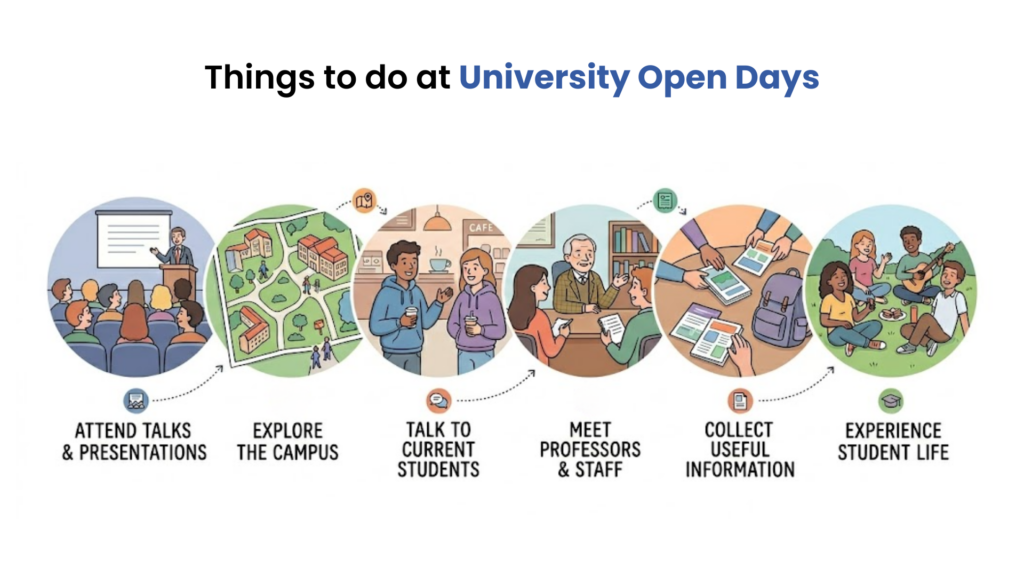
Attend Talks and Presentations
Most universities run multiple sessions throughout the day.
Focus first on the sessions connected to your intended field of study. Those will usually give you the clearest insight into:
- Course structure
- Teaching style
- Internship or research opportunities
General university presentations can still be useful, but understanding the program itself should be the priority.
Explore the Campus
Spend time beyond the official tour route.
Check out the spaces students actually use every day:
- Libraries
- Study areas
- Common spaces
- Nearby neighborhoods
You’re not just choosing a university. You’re choosing where you’ll live.
Talk to Current Students
This is probably one of the most valuable parts of any open day.
Students will usually tell you the things brochures leave out.
Ask about:
- Workload and academic expectations
- Social life and community
- Support for international students
Their answers tend to give you a much more realistic perspective.
Meet Professors and Staff
Open days often make faculty unusually accessible, which is rare at many universities.
Take advantage of it.
Ask questions like:
- What makes this program different?
- What do successful students usually do well?
- Where do graduates typically end up?
Those conversations can quickly help you figure out whether the program aligns with your goals.
Collect Useful Information
You’ll probably leave with brochures, handouts, and program guides.
Take them, but don’t rely on them alone.
Write down your own impressions while they’re fresh. Compare programs. Notice what stood out and what didn’t.
That’s usually where the real clarity comes from.
Experience Student Life
Don’t spend the entire day inside formal sessions.
Grab coffee nearby. Walk through the town or city. Watch how students interact with each other.
If you’re planning to earn a full degree abroad, With it, you leave with actual answers.
How to Prepare for an Open Day
A little preparation makes a huge difference.
Without it, open days can blur together pretty quickly. With it, you leave with actual answers.
Plan Your Schedule
Most universities publish a detailed agenda ahead of time.
Review it carefully:
- Register early for important sessions
- Map out your day
- Leave time between events so you’re not rushing
Trying to attend everything usually means missing the sessions that matter most.
Choose the Right Sessions
Not every presentation will be equally useful.
Prioritize sessions focused on:
- Your intended major
- Admissions requirements
- Career outcomes
General overviews are fine, but your attention should stay on the degree itself.
Ask Better Questions
Go in with a short list of questions you genuinely care about.
For example:
- What are the admission requirements for U.S. students?
- Is the degree recognized internationally?
- What do graduates typically do after this program?
- Are internships or practical experiences included?
The point isn’t just to collect information.
You’re trying to evaluate fit.
Network and Connect
Open days are one of the few times when professors, staff, and students are all accessible in the same place.
Introduce yourself. Ask follow-up questions. Exchange contact information when it feels useful.
Those connections can help later, especially during the application process.
Follow Up After Your Visit
Once the day is over, take time to reflect while everything is still fresh.
- Review your notes
- Compare the programs you visited
- Reach out with any remaining questions
A lot of students skip this step, but it’s usually where decisions start becoming clearer.
University open days aren’t just informational events. They’re decision-making tools.
And when used well, they can give you a level of clarity that’s hard to get any other way especially if you’re considering earning your degree abroad.s. They’re decision-making tools.
Cost Considerations: Are Open Days Worth It?
Traveling to Europe for an open day can feel expensive upfront.
Here’s a realistic estimate:
| Expense | Estimated Cost |
|---|---|
| Flights (U.S. to Europe) | $500–$1,200 |
| Accommodation (2–3 nights) | $200–$600 |
| Food & local transport | $100–$300 |
| Total | $800–$2,000 |
But wait.
Now compare that to the cost of a four-year degree in the U.S.
- U.S. private universities: $30,000–$80,000/year
- Many European programs: $3,000–$20,000/year
And this changes the equation.
Spending $1,000–$2,000 to make a well-informed decision about a degree that could save tens of thousands of dollars each year is, for many families, a reasonable investment.

Who Is This a Good Fit For?
University open days abroad can be especially helpful for:
- Students considering full degrees in Europe
- Families who want clear information about costs
- Students who prefer structured, merit-based admissions
- Those interested in specific career paths early on
- Students who are comfortable with independence and international environments
They’re probably less necessary if:
- You’re still casually exploring options
- You haven’t narrowed down a field of study yet
Common Misconceptions About University Open Days
“They’re just like U.S. campus tours”
Not really.
Most open days abroad are more academic and less focused on selling the school. You’ll usually spend more time learning about programs, admissions, and career paths than hearing polished marketing presentations.
“You need to attend one to apply”
False.
You can absolutely apply without attending an open day. That said, they can make your decision a lot easier because you get a clearer sense of the program and the university itself.
“International degrees aren’t recognized”
This concern comes up all the time, and it makes sense.
But here’s the reality:
- Many European universities are globally accredited
- Degrees are recognized by U.S. employers and graduate schools
- Some programs are actually more specialized and career-focused than comparable U.S. options
That part matters.
At Beyond The States, we only recommend fully accredited, English-taught programs that meet international standards.
Discover all the English-taught European college programs in one place.
Beyond the States provides easy access to 12,600+ European bachelor’s and master’s programs across 870 universities, 550 cities, and 212 areas of study, plus all the resources you need to get there.
3400+
English-taught bachelor’s programs in our database.
550
Beautiful European cities to choose from.
$360,170
Typical savings against a private university in the US.
8200+
English-taught master’s programs in our database.
870
Top-tier universities accepting international students.
$65,038
Typical savings against in-state tuition in the US.
“It’s too complicated to plan”
At first, it can seem overwhelming.
But with the right guidance, the process is often more straightforward than navigating U.S. college admissions. In many cases, it’s simpler.
Frequently Asked Questions
We’re here to help answer your questions about University Open Days
A university open day gives prospective students the chance to explore academic programs, meet faculty, and figure out whether a university feels like the right fit before applying or enrolling.
Yes, especially if you’re seriously considering a specific program. They usually offer much more academic insight than a standard campus tour.
Yes. Most European universities welcome international students and often include sessions specifically designed to answer their questions.
Usually, yes. Many universities require registration for certain sessions or activities.
Yes. A lot of universities now offer virtual options, although visiting in person tends to give you a fuller picture of the experience.
Final Thoughts
University open days are one of the best ways to evaluate your options, especially if you’re thinking about earning a full degree abroad.
What many students appreciate most is the clarity.
Clear programs. Clear admissions requirements. Clear outcomes.
If you’re exploring international universities, it helps to start with vetted programs and a realistic understanding of where you’d be a strong fit.
From there, you can decide whether attending an open day makes sense for your goals and timeline.
If you want help narrowing down your options, you can explore programs through Beyond The States,take the quiz, or book a free strategy call. We’ll help you focus on programs that are accredited, affordable, and aligned with your goals.