What Colleges Look for in Applicants
College admissions feels complicated because, in many systems, it is complicated by design. Students are told to be well-rounded, but also academically strong. They are told extracurriculars matter, but so do essays. Then decisions come out that don’t always follow a clear pattern.
Here’s what most families don’t realize. The criteria are not universal they change depending on whether you’re applying in the U.S. or to a European university.
And this is where things shift: in many European systems, especially when applying for a full accredited degree abroad (not study abroad), admissions are less about storytelling and more about academic readiness for a specific program.
Now here’s the part that matters.
Across most universities, the real question is simple:
Can this student succeed in this exact program with the preparation they already have?
Once you understand that, everything else becomes easier to interpret.
Summary
What Colleges Look for in Applicants

Before diving into specific requirements, it helps to understand the underlying logic of admissions decisions.
Colleges are not trying to find the “most impressive” student. They are trying to find students who:
- Meet academic thresholds
- Match the program structure
- Can complete the degree successfully without major gaps
This is especially true in Europe, where students apply directly into a subject rather than a general college experience.
That single difference explains most of what follows.
Academic Grades and GPA Requirements
If there is one consistent factor across almost all systems, it is academic performance.
Grades are not just one piece of the application, they are often the foundation.
Why grades matter so much
Grades reflect something extracurriculars cannot: sustained academic ability over time. Admissions officers use them to predict whether a student can handle the intensity of a university program.
In Europe, this becomes even more direct. Many universities set clear academic thresholds before they even consider other parts of the application.
For example:
- University of Amsterdam evaluates applicants primarily based on academic qualifications aligned with program requirements.
- Lund University uses merit-based ranking systems where academic performance plays a central role in selection.
What this means for students
If your grades do not meet the requirement, no amount of extracurricular involvement or strong essays will fully compensate.
This is not meant to discourage students, it’s meant to clarify where to focus energy.
Standardized Tests in Europe
In the U.S., standardized tests like the SAT or ACT can influence admissions decisions, especially at selective institutions.
In Europe, that is rarely the case.
Here’s the reality:
Most European universities do not require SAT or ACT scores for admission. Instead, they rely on:
- Final high school grades
- National exam results (depending on country)
- Subject-specific performance
Why this matters
This shifts pressure away from a single exam and places it on consistent academic performance over time.
However, it also means there is less opportunity to “balance out” weaker grades with a strong test score.
So the tradeoff is simple:
- Less testing pressure
- More emphasis on academic consistency
Language Requirements (IELTS, TOEFL, etc.)
Language requirements function as a gate, not a differentiator.
If you do not meet them, your application typically does not move forward.
Most English-taught programs require:
- IELTS (usually 6.0–7.0 minimum depending on program)
- TOEFL iBT (commonly 80–100 range)
Discover all the English-taught European college programs in one place.
Beyond the States provides easy access to 12,600+ European bachelor’s and master’s programs across 870 universities, 550 cities, and 212 areas of study, plus all the resources you need to get there.
3400+
English-taught bachelor’s programs in our database.
550
Beautiful European cities to choose from.
$360,170
Typical savings against a private university in the US.
8200+
English-taught master’s programs in our database.
870
Top-tier universities accepting international students.
$65,038
Typical savings against in-state tuition in the US.
Why this is strict
European universities assume that if you cannot operate in the language of instruction, academic success will be limited regardless of subject knowledge.
This is why language scores are treated as eligibility, not competition.
Once you meet the requirement, you are considered “ready” in this category. Above that threshold, higher scores rarely give additional advantage.
Personal Statement and Motivation Letter
Students often assume the personal statement is the deciding factor.
It is not.
But it still matters, just in a different way.
What admissions officers really use it for
In Europe, the motivation letter answers a very specific question:
Does this student understand what they are applying for?
That’s it.
What strong motivation letters include:
- A clear reason for choosing the subject
- Evidence of prior academic preparation
- A logical explanation of interest in the field
What weak motivation letters do:
- Focus on general passion without specifics
- Tell life stories unrelated to academics
- Sound identical to every other applicant
This is important: clarity matters more than creativity.
Admissions officers are not evaluating writing style, they are checking alignment.
Extracurricular Activities and Experience
This is where U.S. and European systems diverge most clearly.
In the U.S.
Extracurriculars help build a narrative. They show leadership, initiative, and personality.
In Europe
Extracurriculars are secondary unless they directly support academic readiness.
Here’s the key difference:
European universities ask:
Does this experience prove academic interest or preparation?
Not:
Does this student seem impressive overall?
When extracurriculars actually matter:
- Medicine: healthcare volunteering or exposure
- Design fields: creative projects or portfolio work
- Business: internships or relevant work experience
Outside of those contexts, extracurricular volume has limited impact.
Letters of Recommendation
Letters of recommendation are not universal in Europe, and when they are required, their role is narrower than in the U.S.
They are used to confirm:
- Academic performance
- Subject readiness
- Work habits in an academic setting
They do not typically function as narrative endorsements of personality or character depth.
This keeps them focused and consistent with the overall academic evaluation model.
Country-Specific Admission Differences
Admissions vary widely across Europe, but patterns exist:
Germany
- Strict subject requirements
- Strong academic thresholds
- Limited flexibility in admissions
Netherlands
- Competitive numerus fixus programs
- Academic ranking systems
- Clear cutoffs in many fields
Sweden
- Merit-based selection system
- Transparent scoring structure
France
- Highly structured public university system
- Competitive entry for selective programs
Why this matters
Understanding the country system helps eliminate guesswork. The “rules” are different, but they are usually explicit.
Application Portfolios (Arts & Design Programs)
Some fields do require additional evaluation, but only in specific disciplines.
Portfolios are typically required for:
What reviewers actually evaluate
They are not looking for perfection. They are looking for progression.
They assess:
- Technical skill development over time
- Creative thinking
- Ability to communicate ideas visually
- Depth of conceptual work
In these programs, the portfolio replaces some of the academic evaluation used in other fields, but it still operates within structured expectations.
Interview Requirements for European Universities
Interviews are not common, but when they exist, they are purposeful.
They are typically used for:
- Medicine
- Dentistry
- Highly competitive selective programs
What interviews assess
They are not personality interviews. They focus on:
- Academic reasoning
- Subject understanding
- Motivation consistency
- Problem-solving approach
The goal is to confirm that the applicant understands the demands of the field.
EU vs Non-EU Applicant Requirements
There is an important distinction between academic evaluation and administrative requirements.
Academically:
EU and non-EU students are usually held to the same standards.
Administratively:
Non-EU students (including U.S. applicants) must complete additional steps:
- Visa application
- Proof of financial resources
- Translated documents
- Language certification
Key insight:
The difficulty is not in admissions standards, it is in documentation and logistics.
How to Increase Your Chances of Getting Accepted
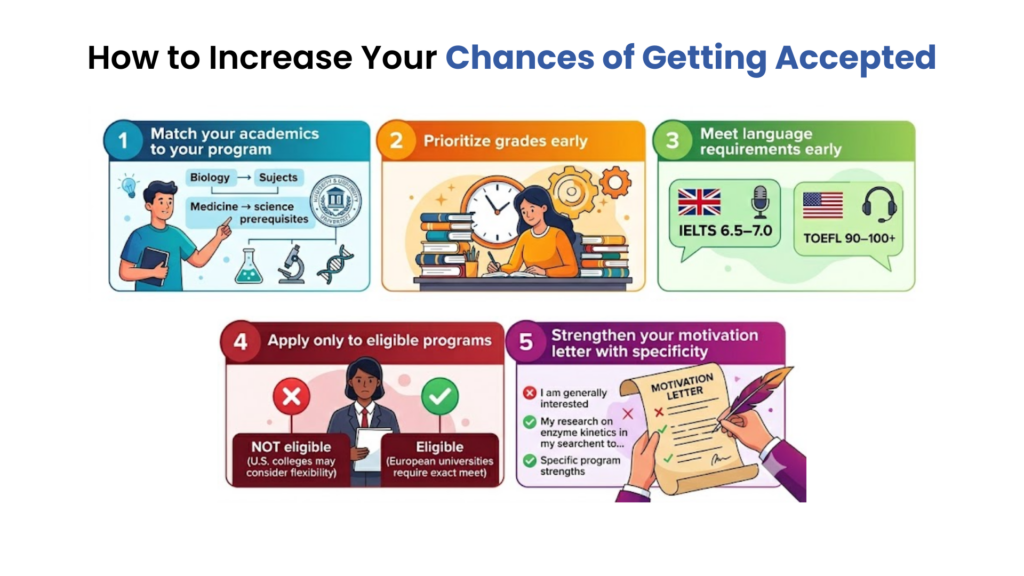
If you are wondering how to increase your chances of getting accepted, the answer is more strategic than performative.
1. Match your academics to your program
European universities expect subject alignment.
- Engineering → strong math and physics
- Economics → math-heavy coursework
- Medicine → science prerequisites
2. Prioritize grades early
Unlike systems that allow late “rescue narratives,” many European programs are heavily transcript-driven.
3. Meet language requirements early
Common benchmarks:
- IELTS 6.5–7.0
- TOEFL 90–100+
4. Apply only to eligible programs
Unlike U.S. colleges, many European universities will not “consider flexibility” if requirements are not met.
5. Strengthen your motivation letter with specificity
Avoid general interest statements. Focus on:
- Why this subject
- Why this program structure
- What academic preparation you already have
Recommended products
-
Motivation Letters and How to Write Them for European Universities
Original price was: $150.00.$79.00Current price is: $79.00. -
Motivation Letter Review
Original price was: $699.00.$499.00Current price is: $499.00.


Comparison: What Colleges Prioritize
| Factor | U.S. Admissions | European Admissions |
|---|---|---|
| Grades | High | Very High |
| Extracurriculars | High | Low–Medium |
| Personal Statement | High | Medium |
| Standardized Tests | Medium–High | Low |
| Subject Fit | Medium | Very High |
| Predictability | Low | Higher |
This is why many students exploring a full accredited degree abroad find European systems easier to interpret, even if the academic standards remain high.



Who This Admissions Model Is a Good Fit For
This system tends to favor students who:
- Perform consistently in academics
- Prefer clear requirements over subjective evaluation
- Want to specialize early in a subject
- Are comfortable with structured education systems
- Are exploring affordable accredited degrees abroad
It may be less ideal for students who rely heavily on extracurricular storytelling or undecided academic exploration.

Common Myths About What Colleges Look For
Myth 1: “You need perfect extracurriculars”
Not in most European systems. Academics matter more.
Myth 2: “Personal statements decide everything”
They rarely override academic eligibility.
Myth 3: “More activities = better chances”
Not necessarily. Relevance matters more than volume.
Myth 4: “International admissions are easier”
They are often more structured, not easier.
Frequently Asked Questions
We’re here to help answer your questions about What Colleges Look for in Applicants
Primarily academic readiness, subject fit, and eligibility for the program.
Important in the U.S., but secondary in most European systems.
It supports your application but rarely determines admission alone.
Strong academics aligned with the chosen program and clear motivation.
Match academic requirements early, meet language scores, and apply to programs aligned with your transcript.
Final Thoughts
Understanding what colleges look for in applicants removes a lot of uncertainty from the process. While U.S. admissions often blend academics with holistic storytelling, European universities tend to focus more directly on academic readiness and program fit.
For students considering a full accredited degree abroad, this clarity can be a major advantage. The key is not to “outperform the system,” but to understand exactly how it evaluates applicants.
Beyond The States helps students compare programs across Europe with transparency so you can focus less on guessing what admissions officers want, and more on choosing the right academic path for your future.