Best International Universities for American Students
Let’s be honest.
When Americans think about “top universities,” they usually think Harvard, Stanford, MIT basically schools that cost more than a house to attend and accept fewer people than win the lottery.
But here’s what your guidance counselor probably didn’t tell you….
Some of the world’s best universities aren’t in the United States. And many of them are easier to get into, significantly cheaper, and offer experiences that will fundamentally change who you are as a person.
Sounds like a win/win right?
We’re talking about internationally ranked institutions where you can get a world class education, graduate with little to no debt, travel across continents on weekends (for cheap), build a global network, and actually have money left over to enjoy your twenties instead of just surviving them.
Sound too good to be true?
It’s not.
Let’s dive into the best international universities for American students, places where quality, affordability, and life changing experiences come together.
Summary
Why American Students Should Consider International Universities
Before we get to the rankings, let’s talk about why getting your bachelors or masters abroad isn’t just a good backup plan, it’s often the smarter choice.
FREE INSIDER’S GUIDE
Top 5 English-Taught Colleges in Europe
Kickstart you education abroad with a powerful degree taught entirely in English, all without taking on any student loans!
The Cost Reality Check
Average cost of American universities:
- Private universities: $60,000-$80,000/year
- Public universities (out-of-state): $30,000-$50,000/year
- Public universities (in-state): $25,000-$35,000/year
- Four-year total: $100,000-$320,000
Cost of top international universities:
- Many European universities: $0-$20,000/year total (including living expenses)
- Three-year bachelor’s degrees mean one less year of costs
- Total degree cost: $20,000-$80,000
You could save $50,000-$250,000+ on your entire degree.
That’s not a typo. That’s real money you could use for:
- Graduate school
- Starting a business
- House down payment
- Actually enjoying your twenties
- Retiring years earlier
The Experience Factor
Studying internationally means:
- Living in a different country for years, not just a semester
- Weekend trips to multiple countries for less than a tank of gas
- Building a truly global network (classmates from 50+ countries)
- Learning or improving foreign language skills
- Experiencing different teaching styles and perspectives
- Developing cultural intelligence that employers value
- Becoming comfortable with ambiguity and adaptation
Try getting that from a dorm room in Wisconsin.

The Career Advantage
International education gives you a leg up plus a lot of benefits like:
- A degree that stands out on resumes
- Demonstrated independence and adaptability
- Cross-cultural communication skills
- Global perspective that domestic students lack
- Potential to work in Europe post-graduation (many countries offer 1-2 year work visas)
- Network spanning multiple continents
In an increasingly globalized economy, these aren’t nice-to-haves—they’re competitive advantages.
The Academic Benefits
Many international universities offer:
- Three-year bachelor’s degrees (who doesn’t want to graduate a year early?)
- Focus on your major from day one (no mandatory basket weaving class)
- More independent learning (treated like an adult)
- Research opportunities even at undergraduate level
- Smaller class sizes in many programs
- Professors who are leaders in their fields
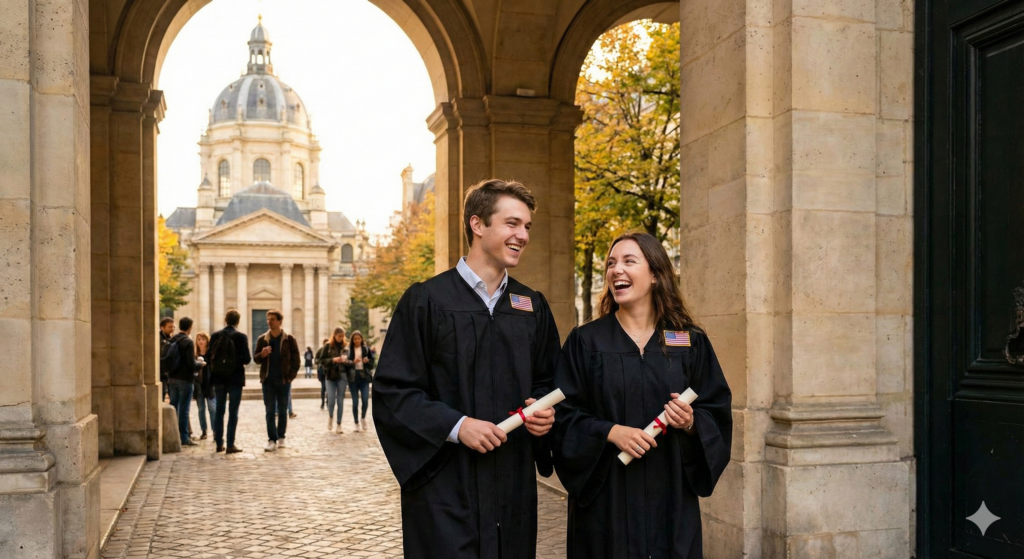
The Best International Universities for American Students
Let’s break this down by country, focusing on universities that combine academic excellence, reasonable admissions standards for Americans, affordability, and strong support for international students.
Germany
World-Class Engineering and Sciences (Basically Free)
Germany dominates when it comes to combining quality and affordability. Most public universities charge €0-€500 per semester—even for international students.
Technical University of Munich (TUM)
Why It’s Excellent:
- Ranked #1 in Germany, top 50 globally
- Elite engineering, computer science, and natural sciences
- Strong industry connections (BMW, Siemens, etc.)
- Munich is an incredible city (expensive but worth it)
Programs for Americans:
- Many bachelor’s programs in German (but manageable with language prep)
- Growing number of English-taught master’s programs
- Strong in: Engineering, Computer Science, Physics, Mathematics
Cost:
- Tuition: €0
- Living expenses: €1,000-€1,400/month
- Total yearly cost: $13,000-$18,000
For perspective: That’s less than ONE SEMESTER at most U.S. private universities.
Ludwig Maximilian University of Munich (LMU)
Why It’s Excellent:
- Germany’s most prestigious university for humanities and sciences
- Top 50 globally
- Historic institution (founded 1472)
- Beautiful campus in Munich
Programs for Americans:
- Strong in: Philosophy, Psychology, Economics, Life Sciences
- Increasing English-taught options
- Research-intensive environment
Cost:
- Tuition: €0
- Living expenses: €1,000-€1,400/month
- Total yearly cost: $13,000-$18,000
Heidelberg University
Why It’s Excellent:
- Germany’s oldest university (founded 1386)
- Top 100 globally
- Picturesque small city
- Strong in medicine and natural sciences
Programs for Americans:
- Medical school options (6-year program)
- Strong life sciences programs
- Beautiful, affordable city
Cost:
- Tuition: €0-€1,500/semester (varies by program)
- Living expenses: €800-€1,100/month
- Total yearly cost: $11,000-$15,000
Humboldt University Berlin
Why It’s Excellent:
- Historic prestige (29 Nobel laureates)
- Central Berlin location
- Strong humanities and social sciences
- Very international atmosphere
Programs for Americans:
- Philosophy, History, Political Science
- Some English-taught programs
- Berlin is the most cosmopolitan German city
Cost:
- Tuition: €0
- Living expenses: €900-€1,200/month
- Total yearly cost: $12,000-$16,000
The German Advantage:
- Three-year bachelor’s degrees
- Free or nearly free tuition
- High quality of life
- 18-month post-study work visa
- Path to permanent residence



Netherlands
International, English-Friendly, High Quality
The Netherlands has the most English-taught programs of any non-English-speaking country and is extremely welcoming to international students.
University of Amsterdam
Why It’s Excellent:
- Top 50 globally
- Highly international (one-third of students are international)
- Amsterdam is an incredible student city with plenty of things to do all times of the year
- Strong across many disciplines
Programs for Americans:
- Business, Economics, Psychology, Computer Science
- Almost entirely English-taught
- Liberal, progressive environment
- Bike everywhere culture
Cost:
- Tuition (non-EU): €9,000-€15,000/year
- Living expenses: €1,000-€1,400/month
- Total yearly cost: $22,000-$32,000
Still way cheaper than most U.S. universities, and the best part is you’re living in Amsterdam. Who wouldn’t want to do that?!
Delft University of Technology
Why It’s Excellent:
- Top engineering school in Europe
- Consistently ranked top 60 globally
- Cutting-edge facilities and research
- Strong industry partnerships
Programs for Americans:
- Engineering (all disciplines)
- Architecture (world-renowned program)
- Applied Sciences
- Most programs have English options
Cost:
- Tuition (non-EU): €10,000-€15,000/year
- Living expenses: €900-€1,200/month
- Total yearly cost: $21,000-$30,000
Utrecht University
Why It’s Excellent:
- Top 100 globally
- Beautiful historic city
- Very international atmosphere
- Central location (30 min to Amsterdam)
Programs for Americans:
- Liberal Arts & Sciences
- Social Sciences
- Life Sciences
- Many English-taught options
Cost:
- Tuition (non-EU): €9,000-€14,000/year
- Living expenses: €900-€1,200/month
- Total yearly cost: $21,000-$29,000
The Netherlands Advantage:
- Everyone speaks English
- Three-year bachelor’s degrees
- One-year job search visa after graduation
- Extremely bike-friendly
- Central European location
Discover all the English-taught European college programs in one place.
Beyond the States provides easy access to 12,600+ European bachelor’s and master’s programs across 870 universities, 550 cities, and 212 areas of study, plus all the resources you need to get there.
3400+
English-taught bachelor’s programs in our database.
550
Beautiful European cities to choose from.
$360,170
Typical savings against a private university in the US.
8200+
English-taught master’s programs in our database.
870
Top-tier universities accepting international students.
$65,038
Typical savings against in-state tuition in the US.
United Kingdom
Prestigious, English-Speaking, Three-Year Degrees
The UK offers prestigious universities with the obvious advantage of English-language instruction and three-year degrees (except Scotland).
University of Edinburgh
Why It’s Excellent:
- Top 30 globally
- Beautiful, historic city
- Strong across humanities and sciences
- Scotland’s capital
Programs for Americans:
- Computer Science, Engineering, Business
- Philosophy, Literature, History
- Medicine (six-year program)
- Four-year degrees in Scotland (unlike England)
Cost:
- Tuition: £20,000-£30,000/year ($26,000-$39,000)
- Living expenses: £1,000-£1,300/month
- Total yearly cost: $39,000-$55,000
Expensive, but for a top 30 global university, still competitive with U.S. private universities.
King’s College London
Why It’s Excellent:
- Top 35 globally
- Central London location
- Strong in humanities, law, medicine
- Historic institution
Programs for Americans:
- Law, Politics, International Relations
- War Studies (unique program)
- English, History, Philosophy
- Three-year degrees
Cost:
- Tuition: £21,000-£28,000/year ($27,000-$36,000)
- Living expenses: £1,200-£1,600/month (London is expensive)
- Total yearly cost: $42,000-$56,000
University of Manchester
Why It’s Excellent:
- Top 30 globally
- Strong STEM programs
- More affordable than London
- Vibrant student city
Programs for Americans:
- Engineering, Computer Science
- Business, Economics
- Life Sciences
- Three-year degrees
Cost:
- Tuition: £21,000-£27,000/year ($27,000-$35,000)
- Living expenses: £900-£1,200/month
- Total yearly cost: $38,000-$50,000
UK Advantage:
- English-speaking
- Three-year degrees (save a year)
- Prestigious global reputation
- Two-year post-study work visa
- Gateway to Europe
UK Reality Check:
- More expensive than continental Europe
- But still often cheaper than U.S. private universities
- Three years vs. four years makes total cost competitive
France
Prestige, Culture, and Affordability
France combines academic prestige with very low tuition at public universities. Plus all the benefits of just being in France like world-class attractions and food. Did I mention food?
Sciences Po (Paris Institute of Political Studies)
Why It’s Excellent:
- Elite institution for political science, international relations
- Produces French presidents and global leaders
- Extremely international
- Multiple campuses across France
Programs for Americans:
- Political Science, International Relations
- Economics, Sociology
- Dual BA programs with Columbia University
- Entirely English-taught undergrad programs available
Cost:
- Tuition: Based on family income (€0-€13,000/year)
- Living expenses: €1,000-€1,400/month (Paris)
- Total yearly cost: $13,000-$30,000
Sorbonne University
Why It’s Excellent:
- Historic prestige (founded 1257)
- Top 100 globally
- Strong in sciences and humanities
- Iconic Paris location
Programs for Americans:
- Sciences, Mathematics, Medicine
- Literature, Philosophy, History
- Some English-taught programs
Cost:
- Tuition: €2,770/year (public university rate)
- Living expenses: €1,000-€1,400/month (Paris)
- Total yearly cost: $15,000-$20,000
École Polytechnique
Why It’s Excellent:
- Elite engineering school (Grande École)
- Top engineering institution in France
- Near Paris
- Military academy tradition
Programs for Americans:
- Engineering, Applied Mathematics, Physics
- Bachelor’s program in English
- Very selective but prestigious
Cost:
- Bachelor’s tuition: €12,000/year
- Living expenses: €900-€1,200/month
- Total yearly cost: $24,000-$29,000
France Advantage:
- Public universities extremely affordable
- Three-year degrees
- Cultural immersion
- Learn French (valuable skill)
- Central European location
Spain
Sunshine, Lifestyle, and Great Universities
Spain offers excellent universities, warm weather, low cost of living, and an amazing lifestyle.
IE University (Madrid/Segovia)
Why It’s Excellent:
- Top business and international relations programs
- Extremely international (130+ nationalities)
- English-taught programs
- Modern, innovative teaching methods
Programs for Americans:
- Business Administration
- International Relations
- Data Science, Computer Science
- Architecture
Cost:
- Tuition: €21,000-€27,000/year
- Living expenses: €800-€1,100/month
- Total yearly cost: $32,000-$42,000
Private university, more expensive, but still competitive with U.S. schools.
Pompeu Fabra University (Barcelona)
Why It’s Excellent:
- Top-ranked young university
- Barcelona location
- Strong in economics, business, communication
- Very international
Programs for Americans:
- Business, Economics
- International Business Economics (English)
- Communication, Humanities
- Three-year degrees
Cost:
- Tuition: €2,000-€7,000/year (varies by program)
- Living expenses: €800-€1,100/month
- Total yearly cost: $12,000-$22,000
University of Barcelona
Why It’s Excellent:
- Large research university
- Strong across many fields
- Barcelona location
- More affordable public option
Programs for Americans:
- Various fields
- Some English-taught programs
- Strong research opportunities
Cost:
- Tuition: €2,500-€5,000/year
- Living expenses: €800-€1,100/month
- Total yearly cost: $13,000-$18,000
Spain Advantage:
- Affordable cost of living
- Amazing weather and lifestyle
- Mediterranean culture
- Learn Spanish (extremely useful)
- Three-year degrees
Ireland
English-Speaking EU Access
Ireland offers English-language education with EU benefits.
Trinity College Dublin
Why It’s Excellent:
- Ireland’s top university (top 100 globally)
- Historic campus in Dublin city center
- Strong across many fields
- Alumni include Oscar Wilde, Samuel Beckett
Programs for Americans:
- Computer Science, Engineering
- Business, Economics
- English, History, Philosophy
- Four-year degrees in Ireland
Cost:
- Tuition: €16,000-€23,000/year
- Living expenses: €1,000-€1,400/month
- Total yearly cost: $30,000-$42,000
University College Dublin
Why It’s Excellent:
- Ireland’s largest university
- Strong research focus
- Modern campus
- Highly international
Programs for Americans:
- Business (Smurfit School highly ranked)
- Engineering, Computer Science
- Life Sciences
Cost:
- Tuition: €17,000-€24,000/year
- Living expenses: €1,000-€1,400/month
- Total yearly cost: $31,000-$44,000
Ireland Advantage:
- English-speaking
- EU member state
- Friendly, welcoming culture
- Two-year post-study work visa
- Gateway to Europe
Switzerland
Elite Education (But Expensive Compared To The Rest of The EU)
Switzerland has world-class universities, though living costs are high.
ETH Zurich (Swiss Federal Institute of Technology)
Why It’s Excellent:
- Consistently top 10 globally
- Elite engineering and sciences
- Albert Einstein’s alma mater
- Incredible research facilities
Programs for Americans:
- Engineering (all fields)
- Computer Science, Mathematics
- Physics, Chemistry
- Bachelor’s mostly in German, Master’s in English
Cost:
- Tuition: CHF 1,298/year ($1,500) – incredibly cheap for this quality
- Living expenses: CHF 1,800-2,500/month ($2,000-$2,800)
- Total yearly cost: $25,000-$35,000
For a top 10 global university, still reasonable.
EPFL (École Polytechnique Fédérale de Lausanne)
Why It’s Excellent:
- Top 15 globally for engineering
- French-speaking part of Switzerland
- Beautiful lakeside campus
- Cutting-edge research
Programs for Americans:
- Engineering, Computer Science
- Life Sciences
- Architecture
Cost:
- Tuition: CHF 1,266/year ($1,450)
- Living expenses: CHF 1,600-2,200/month
- Total yearly cost: $21,000-$31,000
Switzerland Advantage:
- Highest quality education
- Central Europe location
- Multiple languages
- Excellent job market (high salaries)
Switzerland Reality:
- High cost of living
- But tuition is incredibly low
- Worth it for elite STEM education
Denmark, Sweden, Norway: Nordic Excellence
The Nordic countries offer high quality of life and strong universities.
University of Copenhagen
Why It’s Excellent:
- Top 100 globally
- Strong research university
- Copenhagen is incredibly livable
- High English proficiency
Programs for Americans:
- Some bachelor’s in English
- Many master’s in English
- Strong in Sciences, Social Sciences
Cost:
- EU students: Free
- Non-EU: DKK 45,000-120,000/year (€6,000-€16,000)
- Living expenses: €1,000-€1,400/month
- Total yearly cost: $19,000-$35,000
Lund University (Sweden)
Why It’s Excellent:
- Top 100 globally
- Sweden’s oldest university
- Charming university town
- Very international
Programs for Americans:
- Bachelor’s programs in English
- Engineering, Sciences, Social Sciences
- Strong student culture
Cost:
- EU students: Free
- Non-EU: SEK 90,000-140,000/year (€8,000-€13,000)
- Living expenses: €800-€1,200/month
- Total yearly cost: $18,000-$28,000
University of Oslo (Norway)
Why It’s Excellent:
- Norway’s top university
- Free tuition for all
- Beautiful city, nature access
- High quality of life
Programs for Americans:
- Many master’s in English
- Some bachelor’s in English
- Strong in Social Sciences, Sciences
Cost:
- Tuition: Free
- Semester fee: NOK 600 (€60)
- Living expenses: NOK 12,000-17,000/month (€1,100-€1,550)
- Total yearly cost: $14,000-$21,000
Nordic Advantage:
- High quality of life
- Progressive values
- Excellent English proficiency
- Safe, clean, efficient
- Nature access
Nordic Reality:
- High cost of living
- But often free or low tuition
- Dark winters (if you’re not in Copenhagen/southern Sweden)
Eastern Europe: Hidden Gems for Value
Don’t overlook Eastern European universities—quality education at extremely low prices.
Charles University (Prague, Czech Republic)
Why It’s Excellent:
- Founded 1348 (one of Europe’s oldest)
- Beautiful Prague location
- Strong across many fields
- Very affordable
Programs for Americans:
- Medicine (famous 6-year English program)
- Social Sciences, Humanities
- Natural Sciences
Cost:
- Programs in Czech: Free
- Programs in English: €8,000-€15,000/year
- Living expenses: €500-€800/month
- Total yearly cost: $14,000-€24,000 (English programs)
Jagiellonian University (Krakow, Poland)
Why It’s Excellent:
- Founded 1364
- Beautiful historic city
- Strong academic tradition
- Very affordable
Programs for Americans:
- Medicine, Life Sciences
- International Relations
- Various English-taught programs
Cost:
- Tuition: €2,000-€11,000/year (varies by program)
- Living expenses: €400-€700/month
- Total yearly cost: $7,000-€20,000
Eastern Europe Advantage:
- Extremely affordable
- Beautiful historic cities
- Growing economies
- Central European location
- Rich culture and history
How to Choose the Right International University
With so many options, how do you decide?
Consider These Factors:
1. Cost vs. Quality
- Germany/Norway: Best value (free/cheap + high quality)
- UK: Premium but three-year degrees
- Netherlands: Good balance of cost and English-language
2. Language
- Want English-only? UK, Ireland, Netherlands
- Willing to learn? Germany, France, Spain (more options + valuable skill)
- Language programs available at most universities
3. Your Field of Study
- Engineering/STEM: Germany, Switzerland, Netherlands
- Business: France, Spain, Netherlands, UK
- Humanities/Social Sciences: UK, Germany, France
- Medicine: Czech Republic, Poland, Germany (six-year programs)
4. Location Preference
- Northern Europe: Nordic countries, Germany, Netherlands
- Southern Europe: Spain, Portugal, Italy
- Western Europe: France, Belgium, UK, Ireland
- Central/Eastern Europe: Czech Republic, Poland, Austria
5. Post-Graduation Plans
- Want to work in Europe? Germany, Netherlands (good work visa options)
- Return to U.S.? Prestigious names matter (UK, French grandes écoles)
- Open to either? Flexible programs with global recognition
Admission Requirements Comparison
Generally Easier Than U.S. Top Schools:
- GPA requirement: Usually 3.0-3.5 (vs. 3.9+ for Ivy League)
- SAT generally not required. Same with the ACT for Europe.
- Essays: Usually shorter, simpler motivation letters
- Extracurriculars: Rarely important
- Transparent requirements: Know if you qualify
Remember: European universities focus on “can you handle the academic work?” not “have you saved the world by age 17?”
The Financial Reality: What You’ll Actually Save
Let’s do real math on total degree costs:
U.S. Private University:
- Tuition: $60,000/year x 4 years = $240,000
- Living expenses: $20,000/year x 4 years = $80,000
- Total: $320,000
Top UK University (King’s College London):
- Tuition: $30,000/year x 3 years = $90,000
- Living expenses: $18,000/year x 3 years = $54,000
- Total: $144,000
- Savings: $176,000
German Public University (TUM):
- Tuition: $0 x 3 years = $0
- Living expenses: $15,000/year x 3 years = $45,000
- Total: $45,000
- Savings: $275,000
That’s not a typo. You could save a quarter million dollars.
Even compared to U.S. public universities (in-state):
- U.S. public: $100,000-$120,000 for four years
- German university: $45,000 for three years
- Savings: $55,000-$75,000
Common Concerns Addressed
“Will U.S. employers recognize international degrees?”
Yes, especially from well-known universities. Plus:
- International experience is increasingly valued
- Shows adaptability and independence
- Language skills are assets
- Global networks are valuable
“What about graduate school in the U.S.?”
International bachelor’s degrees are accepted at U.S. graduate programs. Many international students do bachelor’s abroad, then U.S. master’s/PhD.
“Is it harder to study abroad?”
Different, not necessarily harder:
- More independent learning
- Less continuous assessment, more final exams
- Fewer gen-ed requirements
- More focused on your major
Some find it more challenging, others prefer it.
“What about social life?”
- International student communities are large and welcoming
- European students are friendly to Americans
- Student cities have vibrant social scenes
- Easier to travel and explore
“Can I come home for holidays?”
Yes. Budget for 2-3 trips per year. With the money saved on tuition, flights are easily affordable.
The Bottom Line: Think Bigger
The best university for you might not be in the United States.
It might be:
- A free engineering program in Munich
- A prestigious business school in Amsterdam
- A historic university in Edinburgh
- An affordable program in Barcelona
- A Nordic university in Copenhagen
These aren’t backup options or “settling.” They’re world-class institutions that offer:
- Education equal to or better than most U.S. universities
- Savings of $50,000-$250,000+
- Life experiences that transform your worldview
- Global networks that span continents
- Career advantages in an international marketplace
The question isn’t “Should I study abroad?”
The question is “Why wouldn’t I at least explore it?”
Ready to Explore Your Options?
Start researching. Look at university rankings. Calculate costs. Read student reviews. Join Facebook groups for Americans studying abroad.
Your perfect university might not be in Boston or California. It might be in Berlin, Amsterdam, Barcelona, or Edinburgh.
And the best part? You’ll graduate with a world-class degree, incredible experiences, a global network, and money in the bank instead of crushing debt.
Because sometimes the best American dream is the one you build abroad.