Best Universities for Physics in Europe
Only about 1 in 10 American families can actually predict what college will cost them. Tuition keeps climbing, and the admissions process often feels unclear at best.
What a lot of families miss is this: you can earn a fully accredited physics degree abroad, taught entirely in English, without hurting your career options or recognition back home.
And it gets better. Many European universities offer top-tier research opportunities, simpler admissions, and much lower tuition.
Here’s the real shift: studying physics in Europe, gives U.S. students access to strong programs, meaningful scholarships, and degrees that are recognized around the world.
Also, this isn’t about a semester abroad. You can complete your entire degree overseas, and do it in a way that’s practical, affordable, and worthwhile long-term.
Summary
Why Consider Europe for a Physics Degree?

There are some clear advantages here.
World-class research facilities: Europe is home to major institutions like CERN in Switzerland, along with advanced labs across countries like Germany. Whether you’re into theoretical or experimental physics, the resources are strong.
Transparent admissions: Many programs focus on grades and subject preparation, so you’re not left guessing how decisions are made.
Lower tuition and cost of living: In some countries, tuition is just a few thousand euros a year, or even free. Living expenses vary, but they’re often comparable to (or lower than) U.S. college towns.
English-taught programs: There are hundreds of programs taught fully in English, especially in physics.
Global recognition: European universities are well respected globally, including by U.S. grad schools and employers.
Let’s break this down further by country and program.
Best Countries in Europe to Study Physics
The country you choose will shape both your experience and your budget. Here’s a quick way to think about a few popular options:
| Country | Language of Instruction | Tuition for International Students | Highlights |
| Germany | Mostly English for MSc, some BSc | $0–$3,850/year | Merit-based, top research universities, strong STEM focus |
| Netherlands | English | $8,800–$16,500/year | Innovative teaching, English widely spoken, strong industry links |
| Switzerland | English | $1,100–$6,600/year | Home to CERN, cutting-edge physics research |
| Sweden | English | $9,900–$16,500/year | Focus on sustainability and technology integration |
| Denmark | English | $13,200–$16,500/year | Flexible curricula, strong experimental physics programs |
| Italy | English (growing number) | $1,100–$4,400/year | Affordable, rich history of physics research, EU scholarships |
Top Physics Programs in Europe Taught in English
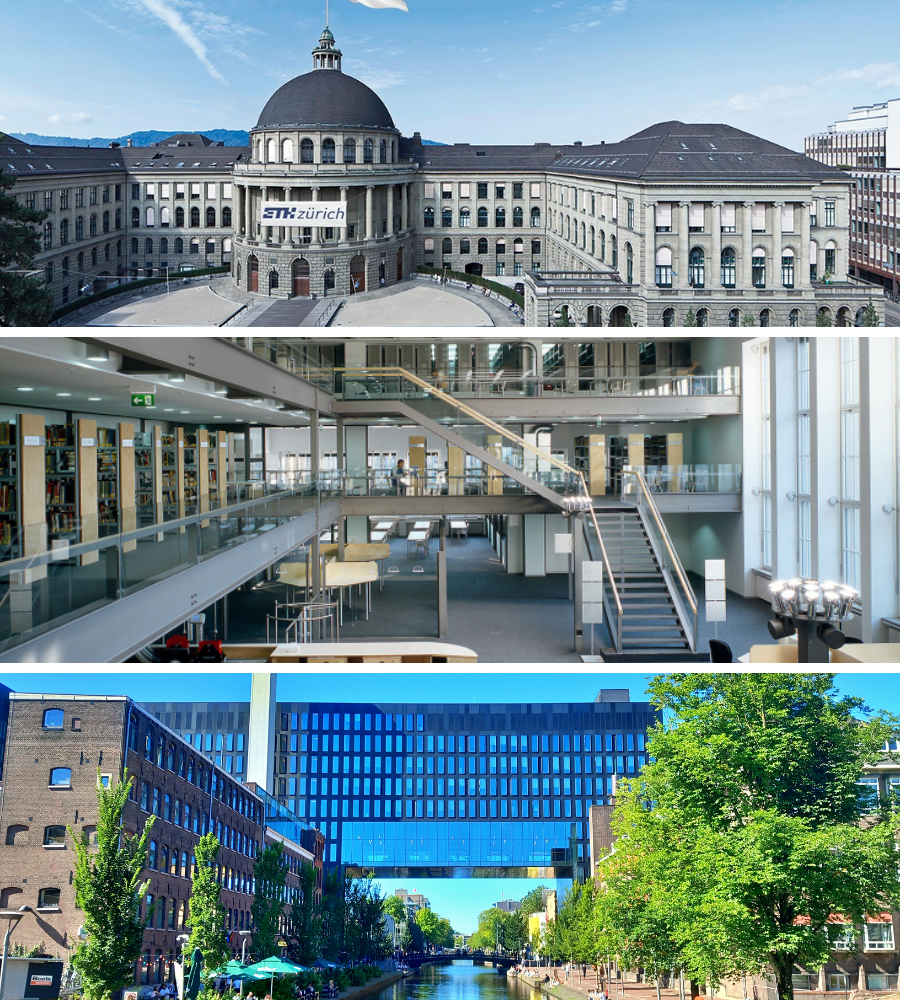
A few universities consistently come up for physics:
ETH Zurich, Switzerland – especially strong in quantum physics and engineering
Technical University of Munich, Germany – known for both theory and applied research
University of Amsterdam, Netherlands – great for computational and particle physics
Uppsala University, Sweden – strong in experimental and interdisciplinary work
Sapienza University of Rome, Italy – affordable, with solid research connections across Europe
These programs are academically rigorous and widely recognized. Many also lead directly into graduate study or research roles.
Discover all the English-taught European college programs in one place.
Beyond the States provides easy access to 12,600+ European bachelor’s and master’s programs across 870 universities, 550 cities, and 212 areas of study, plus all the resources you need to get there.
3400+
English-taught bachelor’s programs in our database.
550
Beautiful European cities to choose from.
$360,170
Typical savings against a private university in the US.
8200+
English-taught master’s programs in our database.
870
Top-tier universities accepting international students.
$65,038
Typical savings against in-state tuition in the US.
Affordable Physics Universities in Europe for International Students
This is usually the deciding factor.
Tuition can range from free (Germany) to around €15,000 per year (Denmark or Sweden)
Public universities are typically much cheaper than private ones
Scholarships are widely available for international students
Living costs depend on the city, but are often manageable
In many cases, the total annual cost (tuition + living) is still lower than a typical U.S. college.
| Expense | Germany | Netherlands | Switzerland |
| Tuition | $0–$3,850 | $8,800–$16,500 | $1,100–$6,600 |
| Housing | $440–$880 | $660–$1,320 | $770–$1,650 |
| Food & Misc | $275–$440 | $330–$550 | $440–$770 |
| Total | $715–$5,170 | $9,790–$18,370 | $2,310–$9,020 |
Physics Scholarships in Europe for International Students
Scholarships can make a big difference, and there are quite a few options:
Erasmus+ (EU-wide) – supports students across Europe
DAAD Scholarships (Germany) – strong funding for STEM students in Germany
Swedish Institute Scholarships – offers full scholarships for certain applicants
ETH Zurich Excellence Scholarship – covers both tuition and living expenses
Applying early helps, and strong academics matter. Some programs also look at research experience or extracurriculars.
Requirements for Physics Degrees in European Universities
Requirements vary, but most programs ask for:
High school diploma or equivalent (for BSc) or related bachelor’s degree (for MSc)
Solid background in math and physics
English proficiency (TOEFL, IELTS, or equivalent)
Letters of recommendation and a personal statement (varies by program)
Sometimes letters of recommendation and a personal statement
Overall, the process is usually more transparent than in the U.S., which makes planning easier.
Application Timeline & Tips
Most applications follow a similar rhythm:
- September–January: Gather documents and prepare applications
- October–February: Submit applications (deadlines vary)
- March–May: Receive decisions and apply for scholarships/visas
- June–August: Arrange housing and get ready to move
Career Opportunities After Studying Physics in Europe

A physics degree opens a lot of doors.
Research & Academia: Positions in universities, national labs, or EU research institutions.
Engineering & Technology: High-tech companies, AI, data science, and energy sectors.
Finance & Consulting: Quantitative roles in investment banks, risk management, and analytics.
Entrepreneurship: Startups in tech, renewable energy, or scientific instrumentation.
Having an international degree and experience can make you stand out in a global job market.
Who is This a Good Fit For?
This path tends to work well for students who:
Want a strong education without the high U.S. price tag
Prefer clear, merit-based admissions
Are open to living abroad for a few years
Are interested in research or interdisciplinary work
- Want a degree that’s recognized globally

Common Misconceptions About Studying Physics in Europe
Let’s address a few myths.
Myth 1: European Degrees Aren’t Recognized in the U.S.
They are. Top programs are well respected, and many graduates go on to U.S. grad schools or global companies.
Myth 2: You Must Speak the Local Language
Not necessarily. Many physics programs are fully taught in English.
Myth 3: Studying in Europe Is More Expensive Than the U.S.
Often the opposite. Tuition and living costs can be significantly lower, especially with scholarships.
Myth 4: European Admissions Are Confusing and Unpredictable
In most cases, they’re actually clearer. Programs usually spell out exactly what they’re looking for.
Frequently Asked Questions
We’re here to help answer your questions about best physics degree in Europe
Yes. There are hundreds of fully English-taught programs at both the bachelor’s and master’s level.
Yes. Many cover part or even all of your tuition and living costs.
Typically 3 years for a bachelor’s and 2 years for a master’s.
Yes. European degrees are widely accepted by U.S. graduate programs.
Next Steps
If you’re seriously considering this path, start by comparing countries, programs, and costs. Think about what kind of experience you want, not just academically, but day to day. Beyond The States can guide you through application strategy, country selection, and securing the right program for your goals.
Start with a strategy session here or explore our Platinum Admissions Package here to take the next step confidently.
It’s not the typical route, but for the right student, it can be a really smart one.