How Hard Is the MCAT?
The MCAT is one of the biggest barriers between students and medical school. For many, it’s the moment that determines whether medicine feels possible or out of reach.
Here’s what most families don’t realize. The MCAT is not just a difficult exam it’s a highly specific type of challenge that rewards strategy as much as knowledge. But it gets more interesting.
For some students, this entire step can be avoided. Earning a full, accredited medical degree abroad particularly in Europe often does not require the MCAT at all, and offers a more structured, transparent admissions process.
Summary
How Hard Is the MCAT?

Let’s answer this directly.
The MCAT is very hard.
It is often considered the most demanding graduate school entrance exam in the United States.
But here’s what that actually means:
- It’s not just about knowing science
- It’s about applying knowledge in unfamiliar situations
- It tests reasoning, not memorization
- It requires endurance over 7.5 hours
This is important. Many students underestimate the exam because they focus only on content. In reality, the MCAT is a skills-based test disguised as a knowledge exam.
Students who succeed tend to shift their mindset early from “studying information” to “training for performance.”
What is the MCAT and How is it Structured?
The MCAT (Medical College Admission Test) is developed by the AAMC and required by nearly all U.S. medical schools. It is designed to assess whether students are prepared for the academic rigor of medical education.
MCAT Sections Breakdown
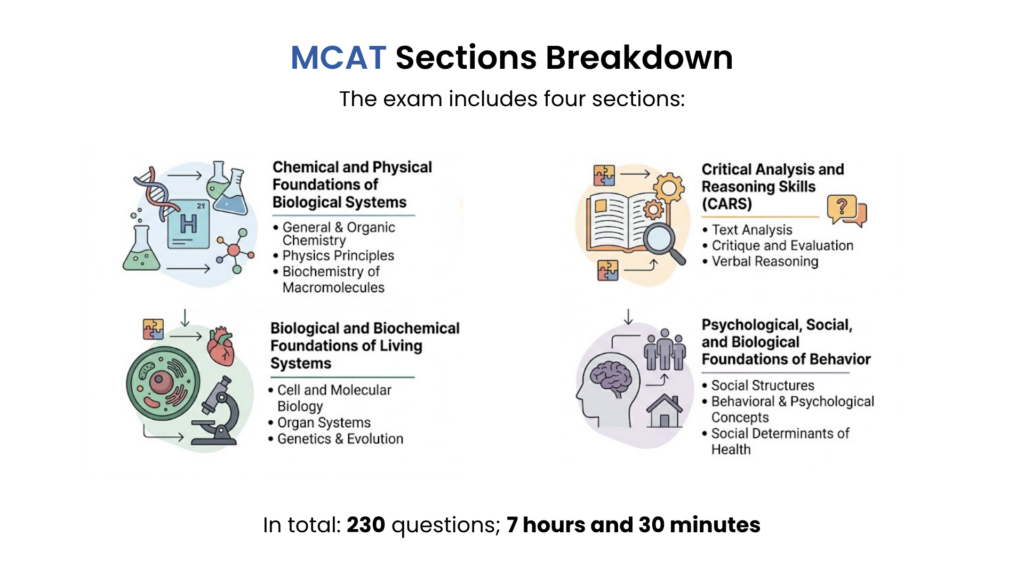
The exam includes four sections:
- Chemical and Physical Foundations of Biological Systems
- 59 questions
- Focus: chemistry, physics, biology integration
- Critical Analysis and Reasoning Skills (CARS)
- 53 questions
- Focus: reading comprehension and analysis
- Biological and Biochemical Foundations of Living Systems
- 59 questions
- Focus: biology and biochemistry
- Psychological, Social, and Biological Foundations of Behavior
- 59 questions
- Focus: psychology and sociology
In total:
- 230 questions
- 7 hours and 30 minutes (including breaks)
This makes it one of the longest standardized exams globally.
What Makes the MCAT So Difficult?
Let’s break this down.
1. Extreme Length and Mental Endurance
Sitting for 7.5 hours is not just tiring it’s strategic.
- Focus drops over time
- Mental fatigue impacts accuracy
- Small mistakes compound late in the exam
Many students struggle not because they lack knowledge, but because they lose focus.
2. Memorization Is Not Enough
This is where things shift.
Unlike typical college exams, the MCAT rarely asks direct recall questions. Instead, it requires:
- Interpreting experimental data
- Applying concepts in new contexts
- Explaining why an answer works
You must think like a scientist, not just a student.
3. Passage-Based Complexity
Almost every question is tied to a passage.
These passages often include:
- Scientific studies
- Graphs and data
- Dense academic language
Your job is to:
- Identify relevant information
- Ignore distractions
- Apply concepts quickly
4. Time Pressure
You get about 90 seconds per question.
That includes:
- Reading the passage
- Understanding the question
- Evaluating answer choices
Students frequently run out of time, especially in CARS.
5. The CARS Section
CARS deserves special attention.
- No outside knowledge required
- Entirely reasoning-based
- Highly unpredictable
Even strong science students often struggle here.
MCAT Score Range & Percentiles
Understanding scores helps contextualize difficulty.
| Score | Percentile | Interpretation |
|---|---|---|
| 528 | 100th | Near perfect |
| 520 | ~97th | Excellent |
| 515 | ~91st | Very strong |
| 510 | ~80th | Competitive |
| 505 | ~63rd | Above average |
| 500 | ~50th | Average |
Here’s what that means:
A 510 already places you in the top 20% of test takers.
Is it Hard to Get a 510 on the MCAT?
Short answer: Yes. But it’s achievable.
To reach a 510, students typically need:
- Strong foundational science knowledge
- Consistent study over several months
- Practice under real testing conditions
- Careful review of mistakes
Typical effort required:
- 300–500 study hours
- 5–10 full-length practice exams
- Continuous refinement of weak areas
This is important. The jump from a 500 to 510 is often not about intelligence it’s about precision and consistency.
Is the MCAT the Hardest Exam?
It’s one of the hardest, but context matters.
MCAT vs LSAT vs GRE vs GMAT
| Exam | Primary Focus | Difficulty Type |
|---|---|---|
| MCAT | Science + reasoning | Depth + endurance |
| LSAT | Logic + reading | Pure reasoning |
| GRE | General academics | Broad but less deep |
| GMAT | Business + math | Analytical logic |
Now here’s the twist:
The MCAT stands out because it combines:
- Deep subject knowledge
- Critical reasoning
- Long duration
Few exams require all three at this level.
How to Prepare for the MCAT Effectively
Preparation is where most students either gain momentum or fall behind.
Best MCAT Prep Strategies
- Prioritize active practice over passive reading
- Use question banks early
- Analyze mistakes in depth
- Focus on test-taking strategy, not just content
Read more: Blueprint MCAT Review
MCAT Study Plan Tips
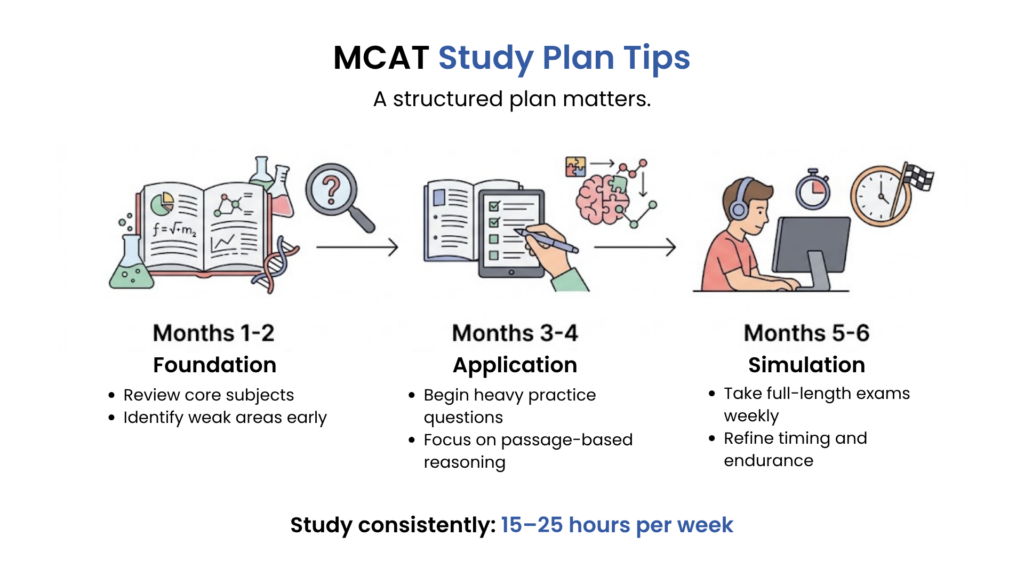
Months 1–2: Foundation
- Review core subjects (bio, chem, physics, psych)
- Identify weak areas early
Months 3–4: Application
- Begin heavy practice questions
- Focus on passage-based reasoning
Months 5–6: Simulation
- Take full-length exams weekly
- Refine timing and endurance
Study consistently: 15–25 hours per week
High-Impact Study Habits
- Study in focused blocks (60–90 minutes)
- Use spaced repetition
- Keep an error log
- Practice under timed conditions
As You Approach the MCAT Exam

This is where things shift.
At this stage, your goal is no longer learning new content. It’s about execution.
Focus on:
- Timing discipline
- Mental stamina
- Confidence under pressure
- Reducing avoidable mistakes
Take at least one final full-length exam under realistic conditions.
MCAT Test Day Tips
Test day is about control.
What to do:
- Arrive early and prepared
- Bring snacks and water
- Use breaks strategically
- Stay calm and focused
What to avoid:
- Overthinking difficult questions
- Rushing early sections
- Letting one bad section affect the rest
Here’s what matters:
Consistency beats perfection.
Cost Breakdown: The MCAT and Beyond
The MCAT is not just academically demanding, it’s financially significant.
Typical Costs
- Registration: ~$335
- Prep courses/materials: $300–$2,500+
- Practice exams: Often included or extra
- Retakes: Additional fees
Read more: Best MCAT Prep Course
Estimated Total Cost:
$1,000 to $3,000+
And that’s before applying to medical schools.
A Different Path: Studying Medicine Abroad
But wait.
Not all medical pathways require the MCAT.
Many European medical programs offer:
- No MCAT requirement
- Direct admission criteria
- Lower tuition costs
- English-taught degrees
- Recognized, accredited programs
Find the Perfect Degree Program in Europe
Explore accredited bachelor’s and master’s programs with clear admissions and lower costs. Join thousands of students already studying across Europe.
Why families consider this:
- Predictable admissions (grades-based, not holistic guesswork)
- Transparent requirements
- Lower total cost of education
And this changes the equation.
Students can move directly into medical training without spending years navigating competitive U.S. admissions systems.
Beyond The States focuses specifically on these full-degree programs not semester study abroad and vets them for accreditation, quality, and recognition.
Recommended products
-
Best Fit List™ Matching Service
Original price was: $3,500.00.$2,697.00Current price is: $2,697.00. -

How To Study Medicine Abroad
$299.00 -
College Admissions Counseling – Platinum
Original price was: $12,000.00.$8,997.00Current price is: $8,997.00.



Who Is This a Good Fit For?
The MCAT path is a good fit if you:
- Are committed to U.S. medical schools
- Perform well on standardized tests
- Are prepared for long-term academic competition
Studying abroad may be a better fit if you:
- Want clearer admissions criteria
- Prefer a more direct pathway into medicine
- Are concerned about cost and debt
- Are open to international education
Common Misconceptions About the MCAT
“Only top students can do well”
Not accurate. Many students improve significantly with structured preparation.
“You need a near-perfect score”
Most accepted students fall within a range, not at the top.
“More hours = better results”
Inefficient studying leads to burnout, not better scores.
“The MCAT is the only path to medicine”
There are legitimate, accredited alternatives globally.
Frequently Asked Questions
We’re here to help answer your questions about
Much harder. It emphasizes application, reasoning, and endurance rather than memorization.
A score of 510 or higher is generally considered competitive for many medical schools.
Most students prepare for 3 to 6 months, depending on their starting point.
Yes, but multiple attempts may impact your application depending on the school.
No. Many international programs do not require it.
Final Thoughts
The MCAT is challenging, but it’s also predictable.
Students who understand the structure, prepare strategically, and stay consistent can perform well. But it’s not the only route into medicine.
If you’re evaluating your options, it’s worth exploring accredited medical programs abroad that offer transparent admissions and lower costs.
Take time to compare pathways, review program requirements, and consider what aligns best with your goals. Beyond The States can help you identify vetted options and make a confident, informed decision.