How Long Can You Stay in Europe After Graduation?
One of the most overlooked factors in choosing a study destination in Europe is what happens after graduation.
For many U.S. students, the assumption is simple: complete a degree abroad and return home.
In practice, the reality is more flexible, and often more strategic.
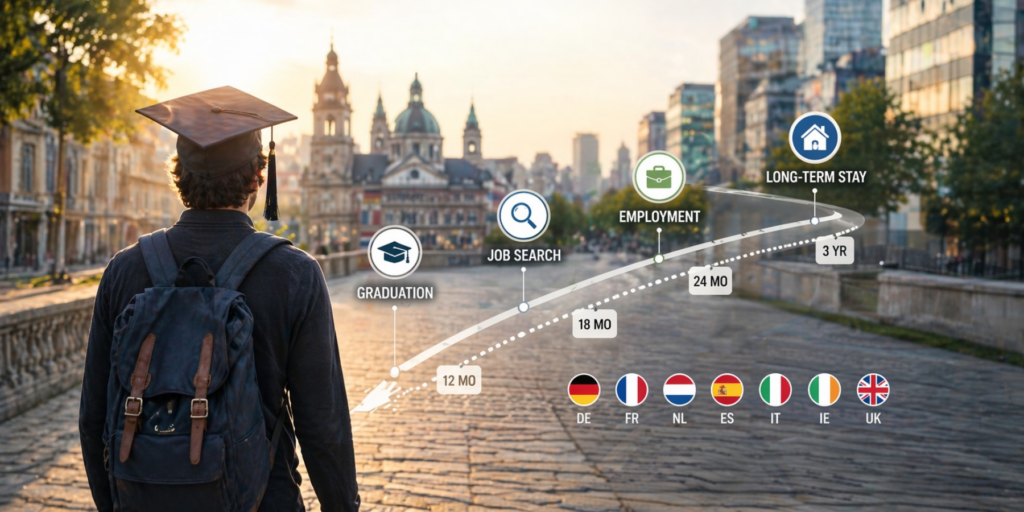
Across much of Europe, international graduates are allowed to remain in the country after finishing their studies. Depending on the destination, this post-study period typically ranges from 12 to 24 months, giving students time to seek employment or transition into longer-term residency pathways.
However, these opportunities are not uniform.
Each country sets its own immigration framework for graduates, meaning post-study stay options vary significantly across Europe.
Understanding these differences early is essential not only for choosing where to study, but also for planning long-term career mobility after graduation.
Summary
Can You Stay in Europe After Graduation?
Yes, in most cases, international graduates can stay in Europe after completing their degree, but the length and conditions depend on the country.
These post-study options typically allow you to:
- Search for a job
- Work full-time or part-time
- Transition to a work visa or residence permit
- Build eligibility for longer-term residency pathways
However, each country defines its own Post-Study Stay Rules in Europe, and they are not interchangeable.
Some are automatic extensions after graduation. Others require applications tied to job search intent or financial proof.
Stay Duration by Country in Europe
Here’s a clear comparison of the most common stay duration by country in Europe for graduates:
| Country | Post-Study Stay Duration | Visa Type | Key Notes |
|---|---|---|---|
| Germany | 18 months | Job Seeker Visa | Strong labor market transition |
| France | 12–24 months | APS (Temporary Residence Permit) | Longer for some master’s grads |
| Netherlands | 12 months | Orientation Year (Zoekjaar) | Highly flexible job search visa |
| Spain | 12 months | Job Seeker Visa | Converts to work permit after employment |
| Italy | 12 months | Post-Study Residence Permit | Requires application after graduation |
| Ireland | 12–24 months | Stay Back Visa | 1 year bachelor, 2 years master |
| UK | 2–3 years | Graduate Route Visa | 2 years bachelor/master, 3 years PhD |
Now let’s break down what each of these actually means in practice.
Germany Post-Study Stay Options
Germany offers one of the most structured post-graduation pathways in Europe.
After completing a degree, students can apply for an 18-month job seeker residence permit.
During this time:
- You can work in any job to support yourself
- You are expected to find a position related to your degree
- Once employed, you can transition into a work residence permit or EU Blue Card
Germany is especially strong for engineering, computer science, business, and applied sciences graduates.
Key takeaway: Germany gives you time and stability but expects job movement into a skilled role.
France Post-Study Visa Duration
France offers the APS (Autorisation Provisoire de Séjour) for graduates.
Typical duration:
- 12 months for most master’s graduates
- Up to 24 months in some extended cases or strategic pathways
During APS:
- You can work full-time
- You can search for employment
- You may transition into a salarié (employee) visa
France’s system is flexible but bureaucratic. Timing and paperwork matter.
Netherlands Graduate Visa Rules
The Netherlands offers the Orientation Year Visa (Zoekjaar).
Duration:
- 12 months after graduation
This is one of the most flexible post-study options in Europe.
During this year:
- No job offer required
- You can work freely in any sector
- Employers are incentivized to hire graduates with this visa
This is especially attractive for tech, design, logistics, and international business students.
Spain Post-Graduation Stay Options
Spain allows graduates to apply for a 12-month job seeker visaafter completing their studies.
Key features:
- Designed for job searching or entrepreneurship
- Can convert into a work permit once employed
- Lower cost of living supports longer job search flexibility
Spain is increasingly competitive for international graduates in tourism, business, and tech sectors.
Italy Post-Study Work Permit
Italy provides a 12-month post-study residence permit known as the “attesa occupazione.”
During this period:
- You can stay legally after graduation
- You may work while searching for employment
- Transition to work permit is required once hired
Italy’s system is less streamlined than Germany or the Netherlands, but still offers a clear legal bridge.
Ireland Stay Back Visa for Graduates
Ireland offers one of the most generous systems in Europe.
Stay duration:
- 1 year for bachelor’s graduates
- 2 years for master’s graduates
This is known as the Third Level Graduate Scheme.
Key advantages:
- English-speaking labor market
- Strong tech sector presence (Dublin especially)
- Straightforward transition into work permits
For U.S. students, Ireland often feels like the easiest cultural and professional transition.
UK Graduate Route Visa (Europe Context)
While no longer part of the EU, the UK remains a major option in the European higher education landscape.
The Graduate Route Visa allows:
- 2 years of stay after bachelor’s or master’s
- 3 years after PhD
During this time:
- Full work rights
- No sponsorship required initially
The UK system is relatively simple, but long-term residency requires employer sponsorship later.
Discover all the English-taught European college programs in one place.
Beyond the States provides easy access to 12,600+ European bachelor’s and master’s programs across 870 universities, 550 cities, and 212 areas of study, plus all the resources you need to get there.
3400+
English-taught bachelor’s programs in our database.
550
Beautiful European cities to choose from.
$360,170
Typical savings against a private university in the US.
8200+
English-taught master’s programs in our database.
870
Top-tier universities accepting international students.
$65,038
Typical savings against in-state tuition in the US.
Can You Work After Graduation in Europe?
Yes, but the conditions depend on your visa type.
Most post-study visas allow:
- Full-time work
- Freelance or contract work (in some countries)
- Job searching without employment restrictions
However:
- Some countries require you to transition into a skilled work visa after employment begins
- Others allow flexible work during the entire post-study period
The key is understanding whether your visa is:
- A job seeker visa
- A graduate residence permit
- A temporary work authorization
Each carries different rights and expectations.
How to Extend Your Stay in Europe After Graduation
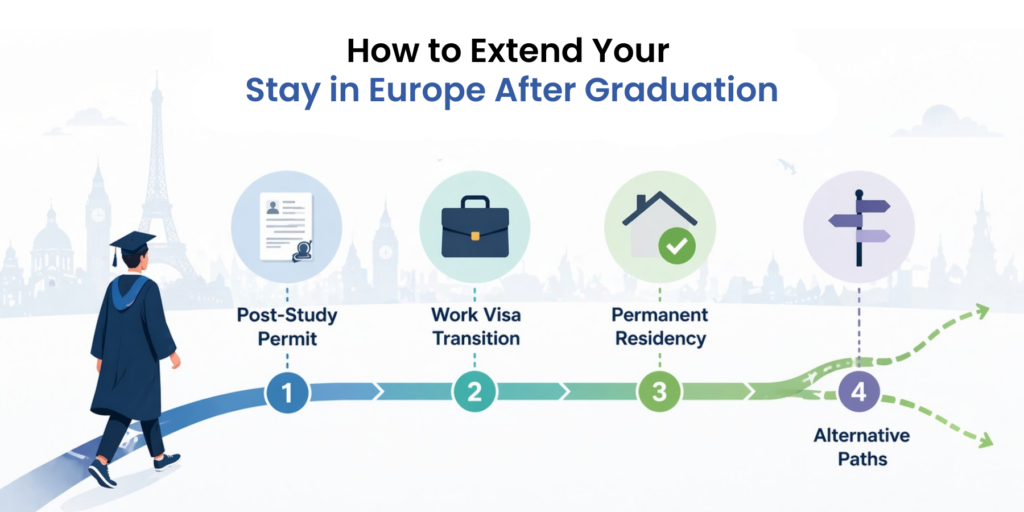
If your goal is long-term residence in Europe, your post-study visa is not the destination it’s the transition window. Think of it as a bridge between being a student and becoming a working resident.
Most countries in Europe (especially Germany, the Netherlands, France, Ireland, and the Nordics) structure their systems to allow graduates to stay temporarily while they shift into skilled employment.
1. Post-Study Residence Permit (The Transition Phase)
After graduation, most students receive a post-study job-seeking or residence permit. This allows you to stay legally in the country while you look for work.
Typical duration:
- 6–18 months depending on the country (e.g., Germany often gives up to 18 months)
During this time, your focus is not just “finding any job,” but finding one that meets visa requirements for long-term stay.
2. Transition to a Work Visa (The Critical Step)
Once you secure a job offer, you typically move into one of the following:
- EU Blue Card (common across the EU for high-skilled workers)
- National skilled worker visas (country-specific alternatives)
To qualify, the job usually must:
- Match your degree field (or closely related field)
- Meet a minimum salary threshold (varies by country)
- Be a formal contract with a recognized employer
This is the most important pivot point because it determines whether your stay becomes long-term or ends after the post-study period.
3. Building Toward Permanent Residency
Once employed, your time in Europe begins counting toward long-term residence or permanent residency.
Most countries require:
- 2–5 years of continuous legal residence (varies widely)
- Stable employment and tax contributions
- Proof of integration (sometimes language proficiency)
- Clean legal/immigration record
For example:
- Germany often allows permanent residency after ~33–60 months depending on visa type
- Portugal and some others may offer faster pathways under certain conditions
4. Alternative Extension Paths (Not Just Employment)
Employment is the main route, but not the only one. Students sometimes extend their stay through:
- Further education (Master’s → PhD progression)
- Research positions or academic roles
- Entrepreneur or startup visas (in select countries like France, Netherlands, Estonia)
- Internships transitioning into full-time contracts
These pathways still ultimately aim to convert you into a long-term skilled resident.
Requirements for Post-Study Visas
While each country differs, common requirements include:
- Completed degree from recognized institution
- Valid residence permit at time of graduation
- Proof of financial resources (varies by country)
- Health insurance coverage
- Application within a strict time window after graduation
- Sometimes proof of accommodation
Some countries require applications before your student visa expires timing matters.
Who is this a good fit for?
Studying in Europe with post-graduation stay options is a strong fit for students who:
- Want lower-cost accredited degrees compared to U.S. tuition
- Are open to building international work experience
- Prefer structured, merit-based admissions systems
- Are considering long-term global career pathways
- Want clearer ROI on undergraduate or graduate education
It may not be ideal for students who need guaranteed U.S.-based recruitment pipelines immediately after graduation.

Common Myths About Staying in Europe After Graduation
Myth 1: “You automatically get to stay after graduating”
Not true. You must apply for a post-study visa or extension.
Myth 2: “All European countries offer the same rules”
They don’t. Duration ranges widely from 12 months to 3 years.
Myth 3: “You need a job offer before graduating”
In many countries, you do not but you must actively search within the visa period.
Myth 4: “Post-study visas guarantee permanent residency”
They do not. They are transition pathways, not guarantees.
Frequently Asked Questions
We’re here to help answer your questions about Staying in Europe After Graduation
Most countries allow international graduates to stay 12 months to 2–3 years, depending on the country and visa type.
Yes. Post-study visas usually allow graduates to work full-time while job searching or transitioning to a skilled work visa, depending on the country.
Not immediately. Most countries give a job-seeking period after graduation, but you must secure a qualifying job before the visa expires to stay longer.
No. Most major study destinations do, but rules, duration, and work rights vary by country.
Not directly, but it can be the first step toward long-term residence if you move into a skilled work visa and meet residency requirements.
Conclusion
So, how long can you stay in Europe after graduation?
The realistic answer is 12 months to 3 years, depending on the country and its post-study visa system.
The UK and Ireland offer some of the longest structured stay options, while countries like Germany and the Netherlands provide strong job-seeking pathways with practical work rights after graduation.
But this is more than a visa detail.
For U.S. students, post-study stay rules can shape early career opportunities, earnings, and long-term mobility.
If you want help understanding which countries and programs align with your academic and career goals, Beyond the States offers structured guidance for U.S. students pursuing full degrees in Europe. You can start with a strategy session or explore structured admissions support through the Platinum Admissions package:
The right degree isn’t just about where you study. It’s about where you can stay, work, and build what comes next.