Is College Worth It?
College in the U.S. can now cost more than a house down payment. Student debt still tops $1.7 trillion. And yet, most jobs still reward a degree.
Here’s what most families don’t realize. The question isn’t just whether college is worth it, it’s which version of college makes financial and career sense in 2026.
Within the first few months of researching, many families discover something unexpected: you can earn a fully accredited bachelor’s degree abroad, often in English, for a fraction of the cost of U.S. tuition without doing a traditional “study abroad” semester.
Summary
Is College Worth It in 2026?

Short answer: Yes, for many students. But not in the way it used to be.
The value of a degree today depends on three variables:
- Total cost (not sticker price)
- Career alignment
- Institution and program quality
In 2026, the gap between high ROI degrees and low ROI degrees is wider than ever.
What’s changed?
- Tuition continues to rise in the U.S.
- Student debt remains a long-term burden
- Employers increasingly care about skills + experience, not just credentials
- International options are more accessible than ever
And this changes the equation.
College ROI vs Cost in 2026
Let’s break this down.
A college degree is an investment. Like any investment, you need to evaluate return vs cost.
Average U.S. Costs ( 2026 estimates)
- Public in-state: $25,000–$35,000/year (total cost)
- Public out-of-state: $40,000–$55,000/year
- Private universities: $55,000–$80,000+/year
Total 4-year cost:
$100,000 to $320,000+
Typical European Degree Costs
- Tuition: $0 to $15,000/year
- Duration: Often 3 years
- Total cost: $0 to $45,000 (tuition only)
Add living expenses, and many students still graduate with significantly less debt or none at all.
U.S. vs Europe: A Practical Comparison
| Factor | United States | Europe |
|---|---|---|
| Degree Length | 4 years | 3 years (most countries) |
| Tuition | High | Low to moderate |
| Admissions | Holistic, unpredictable | More transparent, merit-based |
| General Education | Required | Limited or none |
| Application Fees | Often $50–$100 per school | Often free or low-cost |
| ROI Potential | Varies widely | Often stronger due to lower cost |
Here’s what that means.
Lower cost + shorter degrees = faster entry into the workforce and less debt.
Benefits of Going to College in 2026
Despite the challenges, college still offers real advantages when chosen carefully.
1. Higher Lifetime Earnings (in many fields)
Degrees in areas like:
- Engineering
- Computer science
- Healthcare
- Finance
…still show strong earning potential.
But this is important.
Not all degrees provide equal returns. Major choice matters more than ever.
2. Access to Structured Career Pathways
Many professions still require degrees:
- Medicine
- Law
- Teaching
- Engineering
Without a degree, these paths are closed.
3. Skill Development and Network
College provides:
- Critical thinking skills
- Professional connections
- Internship pipelines
These are harder to replicate independently.
4. Global Career Opportunities
Studying internationally can expand your career options.
Graduating from a European university can open doors to:
- International companies
- Multinational work environments
- Global graduate programs
Why Studying in Europe Changes the Conversation
Many of the concerns about college today cost, unclear admissions, and uncertain ROI are tied specifically to the U.S. system.
Now here’s the part that matters.
When you look at fully accredited, English-taught degrees in Europe, a number of those problems look very different.
Let’s break this down.
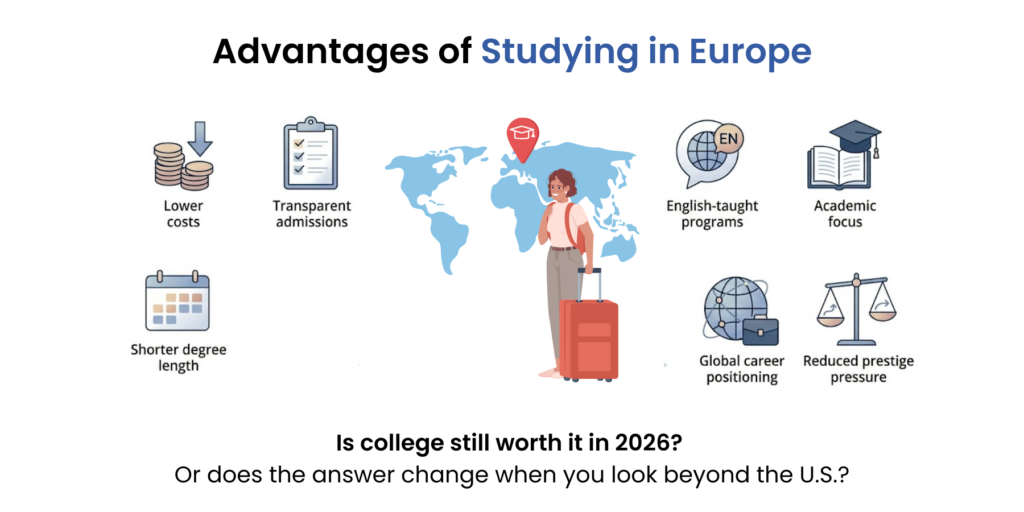
1. Lower Costs = Stronger ROI
One of the biggest criticisms of college in 2026 is cost.
In the U.S., students can easily spend:
- $100,000–$300,000+ for a degree
In contrast, many European programs offer:
- Tuition ranging from $0 to $15,000 per year
- Shorter degrees (often 3 years instead of 4)
Here’s what that means:
- Lower or no student debt
- Faster entry into the workforce
- A significantly improved return on investment (ROI)
This changes the entire financial equation.
2. Transparent, Merit-Based Admissions
U.S. admissions can feel unpredictable:
- Holistic reviews
- Essays, extracurriculars, “fit”
- Long timelines and uncertainty
Many European universities use:
- Clear academic requirements
- Predictable acceptance criteria
- Straightforward application processes
Students often know exactly where they stand before applying.
And this reduces stress significantly.
3. Shorter Degree Length
Most bachelor’s degrees in Europe take 3 years, not 4.
That means:
- One less year of tuition and living expenses
- One extra year earning a salary
- Faster career progression
But wait. this is important.
These degrees are still fully accredited and internationally recognized, including by U.S. graduate schools (when properly vetted).
4. English-Taught Programs
A common misconception is that studying in Europe requires fluency in another language.
In reality:
- Thousands of programs are taught entirely in English
- Countries like the Netherlands, Ireland, Germany, and Sweden offer extensive English options
Students can earn a full degree without needing to be bilingual.
Discover all the English-taught European college programs in one place.
Beyond the States provides easy access to 12,600+ European bachelor’s and master’s programs across 870 universities, 550 cities, and 212 areas of study, plus all the resources you need to get there.
3400+
English-taught bachelor’s programs in our database.
550
Beautiful European cities to choose from.
$360,170
Typical savings against a private university in the US.
8200+
English-taught master’s programs in our database.
870
Top-tier universities accepting international students.
$65,038
Typical savings against in-state tuition in the US.
5. Strong Academic Focus
European universities tend to be more academically focused:
- Fewer general education requirements
- More specialization from the start
- Clear alignment with career paths
For students who already know what they want to study, this can be a major advantage.
6. Global Career Positioning
Graduating from a European university can provide:
- International experience
- Cross-cultural skills
- Exposure to global job markets
Many students also gain access to:
- Post-graduation work visas (country-dependent)
- Internship opportunities across the EU
This can expand career options beyond the U.S.
7. Reduced “Prestige Pressure”
In the U.S., brand-name schools often dominate decision-making.
In Europe:
- There is less emphasis on rankings and prestige
- More focus on program quality and outcomes
This allows students to make more practical, cost-conscious decisions.
And This Changes the Equation
When people ask, “Is college worth it in 2026?”
They’re often really asking about the U.S. version of college.
But once you include international options especially fully accredited degrees in Europe, the answer becomes much more nuanced.
College can absolutely still be worth it.
But choosing the right system makes all the difference.

Cost Breakdown: Realistic Scenario

U.S. Private University (4 years)
- Tuition + fees: $60,000/year
- Living expenses: $15,000/year
Total: ~$300,000
European University (3 years)
- Tuition: $8,000/year
- Living expenses: $12,000/year
Total: ~$60,000
Difference: ~$240,000
That gap alone reshapes whether college is “worth it.”



Best Alternatives to College
If a traditional U.S. college doesn’t feel financially or academically aligned, there are structured alternatives:
1. Accredited European degrees
A growing option among U.S. students:
- English-taught programs
- Strong international recognition
- Lower tuition in many countries
2. Community college → transfer pathway
- Lower cost start
- Flexible entry point
- Transfer to 4-year university
3. Apprenticeships
Especially in:
- Trades
- Manufacturing
- Technical fields
4. Certifications + work experience
Best for:
- Tech
- Marketing
- Design
- Sales
How to Decide if College Is Right for You
This is where most families struggle.
Instead of asking “Is college worth it?” ask:
1. What career do I want?
- Does it require a degree?
- What degree specifically?
2. What is my total cost?
- Tuition
- Housing
- Travel
- Opportunity cost
3. What is my expected ROI?
- Starting salary
- Job placement rates
- Industry demand
4. Am I choosing based on fit or pressure?
Be honest.
Many students choose college because it feels like the default.
Tips for Making College Worth It
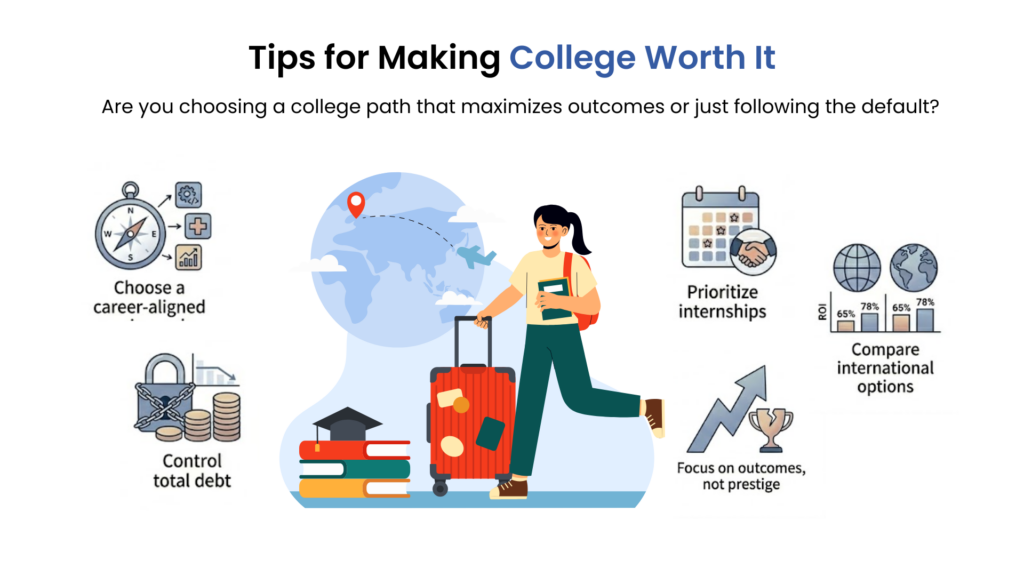
If you choose college in 2026, optimize for ROI:
1. Choose a career-aligned major early
Avoid “undecided” for too long.
2. Control total debt
Try to keep total borrowing aligned with expected first-year salary.
3. Prioritize internships
Experience often matters more than GPA.
4. Compare international options
A fully accredited degree abroad may reduce debt significantly.
5. Focus on outcomes, not prestige
Employers care more about skills than brand name in many fields.
Who Is This a Good Fit For?
A traditional or international college path may be a strong fit if:
- You have a clear or semi-clear career goal
- Your field requires a degree
- You want structured learning
- You are open to studying abroad
- You want to minimize debt
Studying in Europe may be especially ideal if:
- You want lower tuition
- You prefer transparent admissions
- You’re comfortable being more independent
- You want an international experience without “study abroad” costs
Common Myths About College in 2026
Myth 1: “A U.S. degree is always better”
Not necessarily.
Many European universities rank globally and are well respected by employers.
Myth 2: “Studying abroad is risky or unrecognized”
Accredited European degrees are widely accepted.
Graduate schools and employers recognize them.
Myth 3: “It’s harder to get into international programs”
In many cases, it’s actually more straightforward.
Admissions are often based on clear academic criteria.
Myth 4: “College guarantees success”
It doesn’t.
Your major, internships, and skills matter more than the degree alone.
Frequently Asked Questions
We’re here to help answer your questions about going to college in 2026
Yes. but its value depends heavily on cost, field of study, and career alignment. A high-cost degree with low earning potential may not be worth it.
ROI varies widely. STEM and healthcare degrees tend to offer strong returns, while some humanities degrees may have lower financial ROI unless paired with clear career pathways.
In most cases, yes. Tuition is significantly lower, and degrees are often shorter, reducing total cost.
Yes. As long as the university is accredited, degrees are recognized by employers and graduate programs.
Trade schools, certifications, and apprenticeships can be strong alternatives especially in high-demand industries.
Final Takeaway
So, is college worth it in 2026?
Yes, if you approach it strategically.
The old model, apply anywhere, pay whatever it costs, figure it out later no longer works for most families.
But there’s a better approach.
Compare costs. Evaluate outcomes. Consider global options.
And this is where things shift.
At Beyond The States, we focus on fully accredited, affordable degree programs in Europe not short-term study abroad. We research universities, vet programs, and help families find options that make financial and academic sense.
If you’re questioning the value of college, that’s a good thing.
It means you’re asking the right question.
Explore programs. Compare countries. Or take the Beyond The States quiz to see what options align with your goals.