How Much Physics Is On The MCAT?
Medical school admissions in the U.S. are more competitive than ever, and the MCAT remains one of the biggest hurdles in the process. Many students spend months preparing only to realize too late that they underestimated one subject: physics.
Here’s the reality. Physics is not a small, isolated part of the MCAT. It’s deeply embedded in the exam and directly impacts your score. But here’s the good news you don’t need to be a physics major to do well.
And this is where things shift.
As students begin preparing, many also explore alternative pathways to medical school. Some choose to earn a full, accredited degree abroad, where admissions can be more predictable, tuition is lower, and academic preparation still aligns with exams like the MCAT.
Understanding how much physics is on the MCAT, and how it actually shows up can dramatically improve your score without overwhelming your study plan.
Summary
MCAT Section That Includes Physics
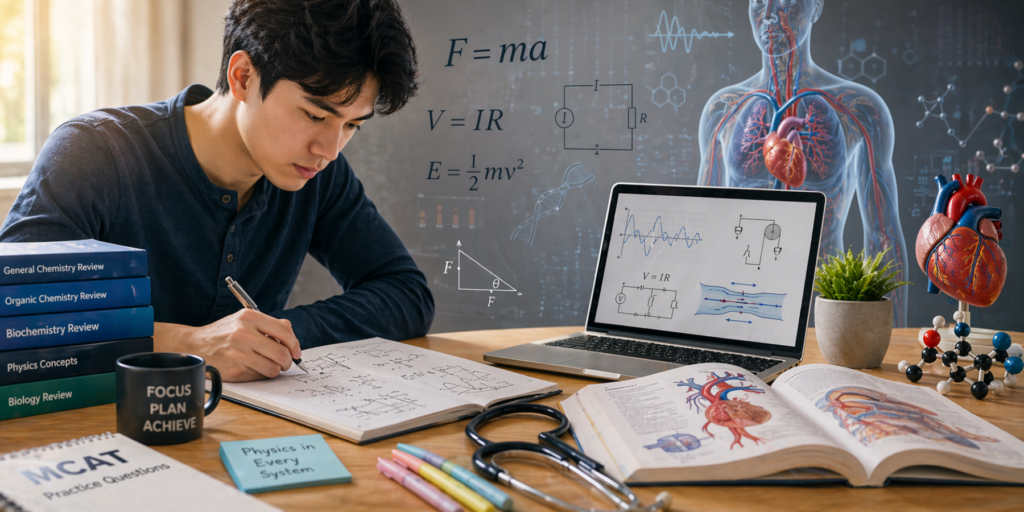
Chemical and Physical Foundations of Biological Systems
All MCAT physics appears in one section:
Chemical and Physical Foundations of Biological Systems (CPBS)
This section includes:
- General chemistry
- Organic chemistry
- Biochemistry
- Biology
- Physics
It is designed to test scientific reasoning, not just recall.
CPBS Section = Integrated Chemistry + Physics + Biology + Biochemistry\text{CPBS Section = Integrated Chemistry + Physics + Biology + Biochemistry}
Key point: Physics is never isolated. It is always embedded in passage-based reasoning.
How Much Physics Is on the MCAT?
The most common question students ask is straightforward:
How much physics is on the MCAT?
While the AAMC does not publish exact physics-only counts, test prep analyses consistently estimate:
- ~15 to 25 physics-related questions per exam
- Spread across passage sets and discrete items
- Integrated with chemistry and biology context
This means physics typically makes up:
- Roughly 25–40% of CPBS content
- But only 10–15% of the entire MCAT
Read more: How Hard Is the MCAT?
Why the range matters
Physics questions are not labeled. A single passage may include:
- Chemistry calculations
- Biomechanics reasoning
- Fluid dynamics concepts
So “physics questions” often overlap with other sciences.
MCAT Physics Section Time Allotted
The CPBS section structure:
| Component | Value |
|---|---|
| Total Questions | 59 |
| Time Limit | 95 minutes |
| Physics Coverage | Integrated throughout |
There is no separate timer for physics. You must manage:
- Reading speed
- Passage interpretation
- Multi-step calculations
This is where many students struggle not because of physics itself, but because of time compression.
MCAT Physics Topics Covered
Physics on the MCAT is highly predictable in scope. You are not tested on advanced theoretical physics. You are tested on applied, introductory-level concepts.
Core topic breakdown:
Kinematics and Motion
- Velocity, acceleration, displacement
- Graph interpretation
- Projectile motion basics
Forces and Newton’s Laws
- Newton’s 1st, 2nd, 3rd laws
- Friction and tension
- Free-body diagrams
Work, Energy, and Power
- Work-energy theorem
- Kinetic and potential energy
- Power calculations
Fluids and Pressure
- Density
- Buoyancy
- Bernoulli’s principle (basic application)
Electricity and Circuits
- Ohm’s Law
- Series vs parallel circuits
- Voltage, current, resistance
Waves, Sound, and Optics
- Wave speed relationships
- Frequency and wavelength
- Reflection and refraction
Thermodynamics and Heat
- Heat transfer
- Phase changes
- Specific heat capacity
Magnetism and Nuclear Physics
- Basic electromagnetism
- Radioactive decay concepts
- Half-life calculations
Read more: How Long to Study for the MCAT
MCAT Physics Formulas You Need to Know
You will not receive a formula sheet during the MCAT, so memorization is required before test day. Some passages may include a relevant equation, but this is not guaranteed.
Instead, you are expected to recognize when to apply a concept and recall the correct relationship quickly under time pressure.
You will, however, be given a wet-erase booklet during the exam to work through calculations and notes.
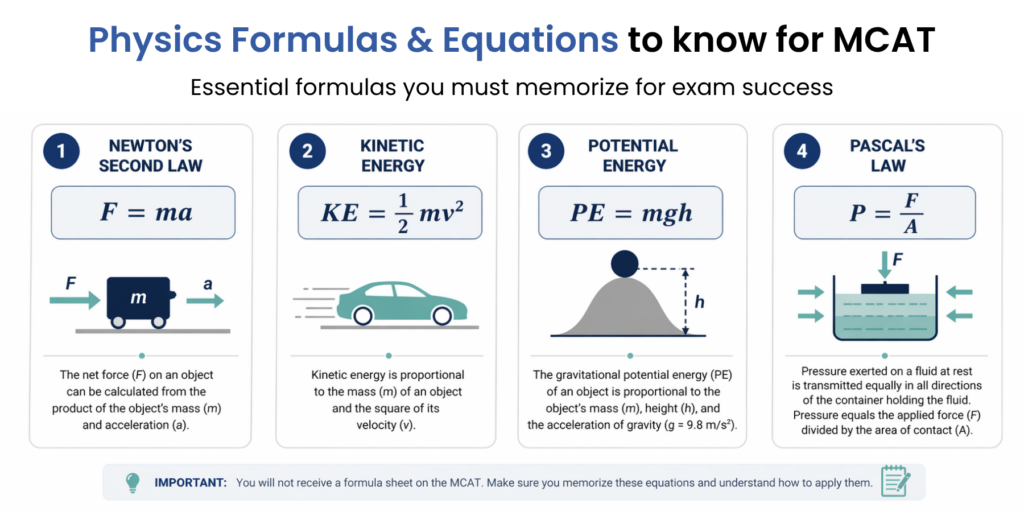
Newton’s 2nd Law
F = m x a
Newton’s 2nd Law states that the net force acting on an object is equal to the product of its mass and its acceleration. In other words, more force produces more acceleration, while greater mass resists changes in motion.
Kinetic Energy
KE = 1/2 x m x v2)
Kinetic energy is the energy of motion. It depends on an object’s mass and increases rapidly with velocity because velocity is squared in the equation.
Potential Energy
PE = m x g x h
Gravitational potential energy is the energy stored due to an object’s height in a gravitational field. It increases with greater mass, greater height, and stronger gravitational force.
Pascal’s Law
P=F/A
Pascal’s Law describes how pressure behaves in a confined fluid. It states that pressure applied to a fluid at rest is transmitted equally in all directions throughout the fluid and to the walls of its container.
Important note: Memorizing formulas alone is not enough. The MCAT often tests whether you can choose the correct equation in a passage-based setting rather than simply recall it.
Related article: Best MCAT Prep Course
Why you don’t get a formula sheet
The MCAT intentionally omits formulas to test:
- Recall under pressure
- Conceptual understanding
- Application across contexts
This reflects medical training expectations, where problem-solving often occurs without reference materials.
MCAT Physics Practice Questions
MCAT physics questions are not standalone math problems. They are embedded in passages that require you to interpret data, identify the correct principle, and apply it under time pressure.
Below are a couple of physics practice questions similar to what you will find on the MCAT.
Question 1:
A student studies a cart moving on a frictionless track. The cart starts from rest and accelerates at a constant rate of 3 m/s² for 4 seconds. What is the final velocity of the cart?
(A) 3 m/s
(B) 6 m/s
(C) 12 m/s
(D) 16 m/s
Question 2:
A 20 Ω resistor is connected to a 10 V battery. What is the current flowing through the circuit?
(A) 0.5 A
(B) 2 A
(C) 10 A
(D) 200 A
Read more: Blueprint MCAT Review
Multi-Step Reasoning Format
MCAT physics questions often require more than one step to solve correctly.
For example, you may need to:
- Identify the relevant concept from the passage
- Select the correct equation
- Substitute values with proper units
- Convert units if needed
- Interpret the result in context
The difficulty is less about advanced math and more about structured reasoning under time pressure.
How to Study for MCAT Physics
A structured approach matters more than studying for long hours. MCAT physics is not about mastering advanced theory it’s about understanding core concepts and applying them quickly in passage-based questions.
Here’s what that means.
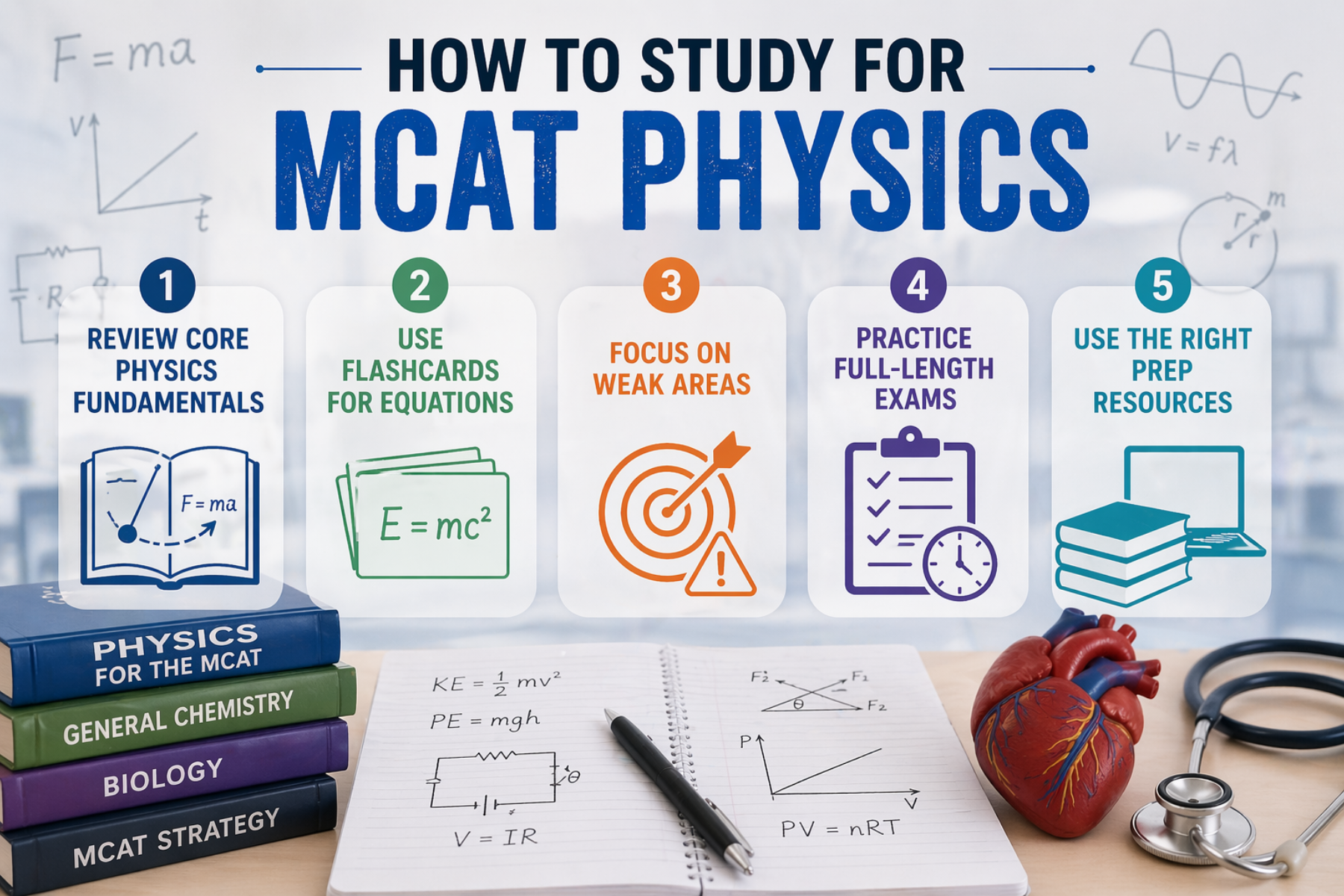
Review Core Physics Fundamentals
Start with the basics. The MCAT focuses on introductory physics concepts that appear in real-world and biological contexts.
Focus on:
- Motion, forces, energy, circuits, and fluids
- Understanding relationships (how one variable affects another)
- Interpreting graphs, charts, and diagrams
You don’t need to memorize long derivations. Instead, make sure you understand how and why formulas work. If you can explain a concept in simple terms, you’re on the right track.
Use Flashcards for Equations
You are expected to recall formulas quickly during the exam.
Use flashcards effectively:
- Study a little every day using spaced repetition
- Group formulas by topic (mechanics, electricity, fluids)
- Include units and when to use each equation
This is important. Many students memorize formulas but struggle to recognize when to apply them. Focus on both recall and application.
Focus on Weak Areas
Most students have predictable weak spots in MCAT physics.
Common areas include:
- Circuits (especially series vs. parallel)
- Fluids and pressure
- Forces and free-body diagrams
Instead of reviewing everything equally, identify where you struggle and spend more time there. Targeted review leads to faster improvement than general rereading.
Practice Full-Length Exams
Full-length exams are one of the most effective ways to prepare.
They help you:
- Build stamina for a long exam
- Practice time management
- Get used to passage-based questions
When reviewing:
- Go through every missed question
- Identify whether the issue was a concept gap or a careless mistake
- Look for patterns in your errors
This is where real progress happens.
Use the Right Prep Resources
Not all study materials reflect the actual MCAT format.
Choose resources that:
- Emphasize passage-based practice
- Provide clear, step-by-step explanations
- Help you focus on weak areas
Avoid resources that focus only on calculations without context. The MCAT tests reasoning, not just math.
Who Is This a Good Fit For?
MCAT physics preparation is manageable for students who:
- Prefer structured problem-solving
- Can practice consistently over time
- Are willing to learn through repetition
- Do not rely on memorization alone
It is more challenging for:
- Students avoiding quantitative reasoning
- Those skipping full-length practice exams
- Candidates who delay physics until late prep stages

Common Misconceptions About MCAT Physics
Myth 1: Physics is the smallest MCAT subject
Not true. It is deeply embedded across CPBS.
Myth 2: Memorizing formulas is enough
The MCAT prioritizes application, not recall.
Myth 3: Physics is separate from biology
In reality, most questions are bio-context physics.
Myth 4: You can skip physics and still score high
Unlikely. Even strong biology performance cannot compensate fully.
Frequently Asked Questions
We’re here to help answer your questions about MCAT Physics
Typically around 15–25 questions, integrated within the CPBS section.
The Chemical and Physical Foundations of Biological Systems section.
No. Only introductory college-level physics is required.
Not in content depth, but it is harder in time pressure and application style.
No. You must memorize all essential equations.
Final Thoughts
MCAT physics is not designed to test advanced technical knowledge. It is designed to test whether you can interpret physical principles in biological systems under time constraints.
The students who perform well are not necessarily the ones who study the most they are the ones who practice the smartest.
If you’re considering earning a full degree abroad, this still matters. Scientific expectations stay consistent, even if the admissions process is more structured and transparent.
This is where Beyond The States can help.
We identify fully accredited, English-taught degree programs across Europe and show you how they align with U.S. medical school requirements. That includes clarity on prerequisites, admissions criteria, and realistic pathways forward without the guesswork.
Find the Perfect Degree Program in Europe
Explore accredited bachelor’s and master’s programs with clear admissions and lower costs. Join thousands of students already studying across Europe.

You can explore programs by country, compare options, or get personalized guidance through a strategy session. It’s a practical starting point for building a plan that actually fits your goals.