How to Get Into College With a Low GPA
A 2.5 GPA can feel like a closed door in the U.S. admissions system. Highly selective schools dominate the conversation, and it’s easy to assume your options are shrinking fast.
Here’s what most families don’t realize.
There are hundreds of accredited universities, many in Europe where your GPA isn’t the only deciding factor. And yes, you can earn a full bachelor’s degree abroad (not just study abroad) that’s recognized in the U.S. and globally.
Summary
How to Get Into College With a Low GPA
Let’s answer the main question directly.
Yes, you can get into college with a low GPA. But it requires a shift in strategy.
Instead of trying to “fix” your GPA overnight (which isn’t realistic), you focus on two things:
- Strengthening what you can control now
- Applying to colleges that evaluate students differently
Now here’s the part that matters.
Not all colleges interpret GPA the same way. In fact, some will actively look beyond it if you give them a reason to.
Why GPA Matters in College Admissions
GPA matters because it shows consistency. Colleges want to know: can you handle academic work over time?
But GPA has limitations.
A 3.0 at one high school might reflect a completely different level of rigor than a 3.0 at another. Some schools inflate grades. Others grade more strictly. Some students take advanced courses; others don’t have access to them.
This is important.
Colleges know GPA is imperfect. That’s why many institutions especially outside the U.S. look at additional indicators of readiness.
How Colleges Review Low GPA Applications

In the U.S., many colleges use what’s called a “holistic review.” That means they don’t just look at your GPA they try to understand your full story.
In practice, that includes:
- Your grades over time (not just your final GPA)
- The difficulty of your classes
- Your test scores (if submitted)
- Your personal statement
- Activities and recommendations
But here’s where students get confused.
Holistic review sounds flexible, but it’s also unpredictable. There isn’t always a clear formula. Two students with similar GPAs can get very different results depending on how their story is interpreted.
Now here’s the twist.
Many European universities don’t use holistic admissions at all. Instead, they publish specific academic requirements. If you meet them, you’re admitted. If you don’t, you’re not.
That clarity can be incredibly helpful especially if your GPA doesn’t reflect your full potential.

Strengthening Your College Application
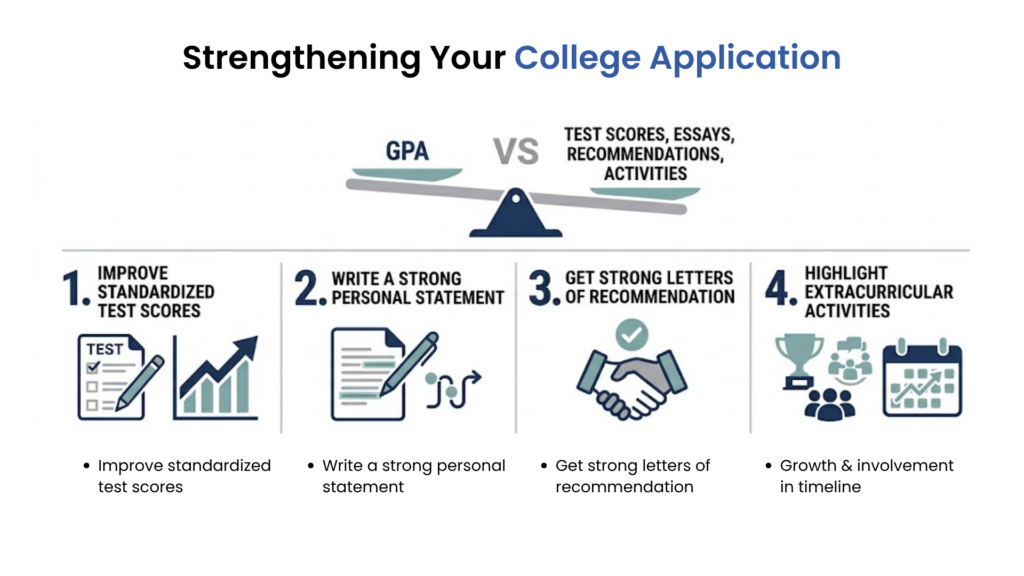
If your GPA is lower than you’d like, your goal is not to “hide” it. Your goal is to balance it.
Think of your application as a scale. GPA is one side. Everything else can add weight to the other.
Let’s walk through how to do that effectively.
Improve Your Standardized Test Scores
Test scores are one of the fastest ways to strengthen your academic profile.
Unlike GPA, which reflects years of work, test scores can improve in a matter of months with focused effort.
Here’s what that means in practice:
- A strong SAT or ACT score can show colleges that you have the academic ability your GPA might not reflect
- It gives admissions officers a standardized benchmark to compare you with other applicants
- In some cases, it can move your application from “borderline” to “competitive”
If you’re considering Europe, this becomes even more relevant. Some universities require specific exam results (like APs or SAT scores) instead of relying heavily on GPA.
Write a Strong Personal Statement
Your personal statement is where context comes into play.
This is not about making excuses. It’s about helping the admissions team understand what your transcript doesn’t show.
For example, if your GPA dropped during a specific period, explain what was happening but keep it concise. Then shift your focus to what changed and how you improved.
This is important.
Colleges are not looking for perfection. They are looking for evidence that you can succeed moving forward.
A strong essay shows:
- Self-awareness
- Responsibility
- Growth
Get Strong Letters of Recommendation
Recommendations add a human perspective to your application.
A transcript shows numbers. A recommendation shows effort, attitude, and potential.
The most effective letters come from teachers who can say:
- This student improved significantly over time
- This student worked harder than their grades suggest
- This student is capable of handling college-level work
That kind of insight can make a meaningful difference.
Highlight Extracurricular Activities
Activities are often misunderstood.
It’s not about doing everything. It’s about showing commitment and impact.
For example, working a part-time job, taking care of family responsibilities, or leading a small club can be just as meaningful as traditional extracurriculars.
Here’s what matters:
- Consistency over time
- Responsibility
- Initiative
These qualities signal maturity something colleges value, especially when GPA is lower.
Explain Your Low GPA Strategically

If there’s a clear reason behind your GPA, you should address it but carefully.
Keep it brief. Stay factual. Avoid over-explaining.
Then shift the focus.
Admissions teams want to see what you’ve done since.
- Have your grades improved?
- Have you taken harder courses?
- Have you developed better study habits?
This is where many students go wrong. They focus too much on the past instead of showing progress.
Build a Strong Academic Comeback
One of the most powerful signals you can send is improvement.
If your grades trended upward even slightly that matters.
But you can also create a comeback after high school:
- Taking community college classes
- Completing online accredited courses
- Demonstrating strong recent academic performance
Here’s why this works.
Colleges care more about what you’re capable of now than what happened two years ago.
Consider Community College Pathways
Community college is often seen as a backup plan. In reality, it’s a strategic option.
It allows you to:
- Start fresh academically
- Build a stronger GPA
- Transfer to a four-year university later
But it’s not the only alternative.
And this is where things shift.
A Different Path: Earning a Full Degree Abroad
Many students don’t realize this is an option.
You can apply directly to universities in Europe and earn a full bachelor’s degree taught entirely in English. These are not study abroad programs they are complete, accredited degrees.
And importantly, the admissions process is often more transparent.
Instead of trying to interpret your entire profile, universities may focus on:
- Whether you meet specific subject requirements
- Whether you have the necessary academic background
- Whether your qualifications align with the program
That means a lower GPA doesn’t automatically disqualify you.
At Beyond The States, this is exactly what we help students navigate finding programs where the requirements are clear and realistic.
Discover all the English-taught European college programs in one place.
Beyond the States provides easy access to 12,600+ European bachelor’s and master’s programs across 870 universities, 550 cities, and 212 areas of study, plus all the resources you need to get there.
3400+
English-taught bachelor’s programs in our database.
550
Beautiful European cities to choose from.
$360,170
Typical savings against a private university in the US.
8200+
English-taught master’s programs in our database.
870
Top-tier universities accepting international students.
$65,038
Typical savings against in-state tuition in the US.
Apply to Test-Optional Colleges
Test-optional policies can be helpful, but they are often misunderstood.
If your GPA is low and you also don’t submit test scores, you may be removing an opportunity to strengthen your application.
In many cases, submitting a solid test score is actually beneficial.
Choose Colleges with Flexible Requirements
Not every college expects the same academic profile.
Some prioritize:
- Improvement over time
- Personal background
- Specific skills or interests
Others, especially in Europe focus on whether you meet defined academic criteria.
This changes the equation.
Instead of guessing what a college wants, you can apply to programs where the expectations are clearly stated.
Tips for Choosing the Right Colleges
Choosing the right colleges is key when you have a low GPA. The goal is to apply where you are both eligible and likely to succeed.
1. Understand admissions style
U.S. colleges often use holistic admissions, meaning GPA is only one factor and decisions can be unpredictable. European universities are usually more transparent and criteria-based, focusing on specific academic requirements. This makes outcomes easier to anticipate.
2. Check accreditation
Make sure any international university is officially accredited. Accredited European degrees are fully legitimate and recognized by employers and graduate schools, including in the U.S. This is a key step to ensure your degree has long-term value.
3. Compare total cost
Look beyond tuition.
- U.S. total cost: often $30,000–$80,000+ per year
- Europe total cost: often $13,000–$33,000 per year (including living expenses)
This difference can significantly impact affordability over a full degree.
4. Review scholarships realistically
With a low GPA, large merit scholarships in the U.S. may be harder to access. In Europe, lower baseline tuition often replaces the need for major scholarships, making costs more predictable.
5. Plan for visas early
Studying abroad requires a student visa, proof of funds, and health insurance. The process is structured but time-sensitive, so deadlines matter.
6. Think about long-term outcomes
Check whether the degree supports your goals whether that’s entering the workforce, returning to the U.S., or applying to graduate school. Accredited European degrees are widely recognized when the program is properly vetted.
7. Apply where requirements match your profile
Let’s break this down. The best colleges for a low GPA are not just “easier” schools they are the ones where your academic background actually matches the entry requirements. That alignment increases your chances of both admission and success.
U.S. vs Europe: Admissions Comparison
| Factor | U.S. Colleges | European Universities |
|---|---|---|
| Admissions Style | Holistic, subjective | Criteria-based, transparent |
| GPA Importance | High | Moderate to variable |
| Essays | Very important | Sometimes optional |
| Test Scores | Optional/varies | Often required or considered |
| Cost | High ($20K–$80K/year) | Lower (€3K–€15K/year typical) |
| Degree Recognition | U.S. accredited | Globally recognized |
Cost Breakdown: U.S. vs Europe
Let’s look at realistic numbers.
United States (Annual Estimate)
- Tuition: $20,000–$80,000
- Housing & living: $12,000–$20,000
- Total: $32,000–$100,000
Europe (Annual Estimate)
- Tuition: $3,000–$15,000
- Housing & living: $10,000–$18,000
- Total: $13,000–$33,000
Here’s what that means:
A full degree abroad can cost less than one year at many U.S. universities.



Who Is This a Good Fit For?
This approach works well for students who:
- Feel their GPA doesn’t reflect their true ability
- Want a more straightforward admissions process
- Are open to studying internationally
- Need a more affordable option
It’s not about taking an “easier” path. It’s about choosing a clearer one.
Common Misconceptions
“A low GPA means I won’t get into a good college.”
Not true. It means you need a more strategic approach.
“Studying abroad isn’t a real degree.”
Accredited European degrees are widely recognized by employers and graduate schools.
“Only top students can study internationally.”
Many programs are designed for a range of academic profiles not just perfect GPAs.
“Colleges only care about GPA.”
Not true. Many schools also weigh test scores, essays, recommendations, and improvement over time.
“You need perfect grades to study in Europe.”
False. Many European universities admit students based on specific subject requirements rather than overall GPA.
“Studying abroad is more expensive than the U.S.”
In many cases, it’s the opposite European degrees often have significantly lower total tuition and living costs than U.S. universities.
Frequently Asked Questions
We’re here to help answer your questions about Getting Into College With a Low GPA
Yes. Many colleges, both in the U.S. and abroad accept students with GPAs in this range, especially if other parts of your application are strong.
Some colleges accept GPAs below 2.5, especially open-admission schools or certain international programs with alternative criteria.
Yes, but often differently. Many focus on relevant subjects or specific qualifications rather than cumulative GPA.
In many cases, yes. Tuition and overall costs are often significantly lower in Europe.
Yes. Many students complete full degrees abroad, but transfer options may also be available depending on the program.
Final Thoughts
A low GPA doesn’t define your future, but it does require a smarter strategy.
You have options:
- Strengthen your current application
- Build a new academic record
- Choose colleges more strategically
- Consider earning a full degree abroad
If you want help identifying programs that align with your academic profile, Beyond The States can guide you through vetted, English-taught options across Europe.
You can explore programs, compare countries, or book a strategy session to map out your next steps with clarity.