How to Write an Academic CV
Many students spend hours polishing a resume, only to find out that graduate schools, research positions, and academic opportunities often want something entirely different: an academic CV.
And that distinction matters more than most people think.
A strong academic CV can help you stand out when applying for master’s programs, PhDs, research assistantships, scholarships, fellowships, and academic jobs. A weak one can make it harder for admissions committees or hiring panels to see the full scope of your accomplishments, even if you’re highly qualified.
Here’s why this is especially important.
If you’re planning to attend graduate school in Europe or pursue research opportunities abroad, knowing how to write an academic CV is essential. Many English-taught degree programs overseas require one as part of the application process, particularly for master’s and doctoral programs.
Summary
What Is an Academic CV?
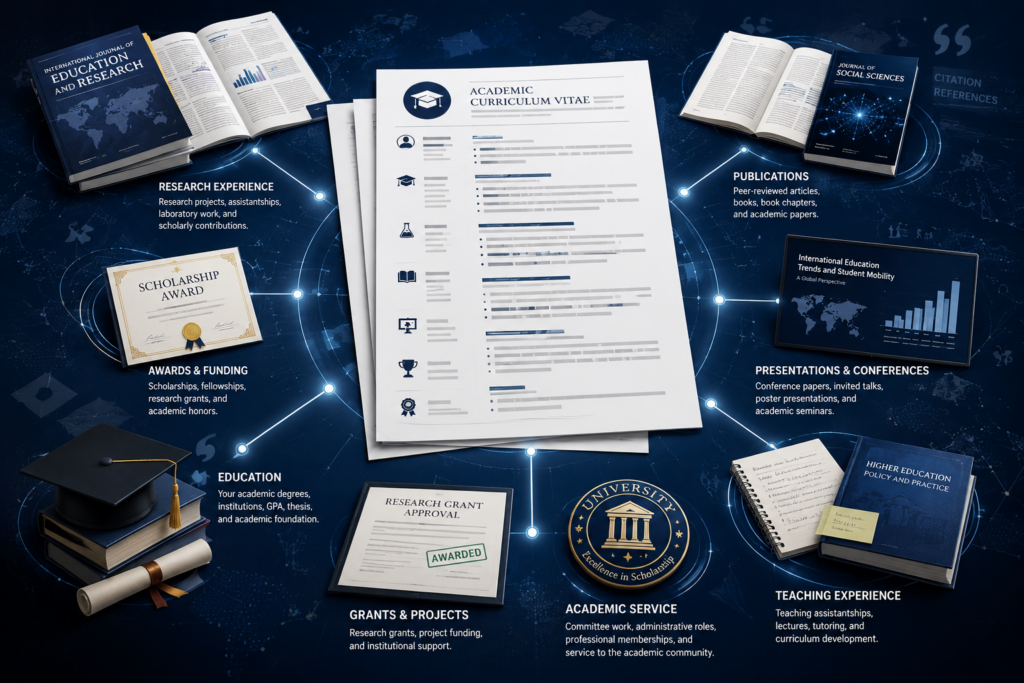
An academic CV (Curriculum Vitae) is a detailed document that highlights your educational background, research experience, teaching activities, publications, presentations, grants, and other academic achievements.
Think of it as a record of your scholarly work and qualifications.
In the United States, people often use “CV” and “resume” interchangeably. Academic institutions, however, usually treat them as two very different documents.
Academic CVs are commonly required for:
- Master’s degree applications
- PhD admissions
- Research assistant positions
- Academic scholarships
- Fellowships
- Postdoctoral opportunities
- University teaching positions
- Research grants
This is particularly common when applying to universities abroad, where admissions decisions often place significant weight on academic preparation and demonstrated achievements.
Academic CV vs Resume
One of the most common mistakes students make is submitting a resume when an academic CV is requested.
Here’s the difference.
| Academic CV | Resume |
|---|---|
| Detailed and thorough | Brief and focused |
| Multiple pages are acceptable | Usually 1–2 pages |
| Highlights academic achievements | Highlights professional experience |
| Includes research and publications | Often leaves out research details |
| Used for graduate school and academic roles | Used for most industry positions |
| Updated continuously | Customized for specific jobs |
When Should You Use an Academic CV?
Use an academic CV when applying for:
- Graduate programs
- PhD programs
- Research opportunities
- Fellowships
- Scholarships
- Academic internships
- University positions
Use a resume for most private-sector jobs unless the employer specifically asks for a CV.

Join the conversation.
Get real answers.
Beyond the States is a student community for those building their future in Europe.
How to Write an Academic CV: Step-by-Step
The best academic CVs are well-organized, detailed, and easy to scan.
Admissions committees often review hundreds of applications. A clear structure helps them quickly understand your qualifications and achievements.
Let’s go section by section.
1. Personal Information
Start with your:
- Full name
- Address
- Telephone number
- Professional email address
- LinkedIn profile (optional)
- Academic website (if applicable)
Avoid including personal information such as your age, marital status, religion, or a photo unless the institution specifically requests it.
Example:
Sarah Johnson
Chicago, Illinois, USA
+1 555-123-4567
[email protected]
linkedin.com/in/sarahjohnson
2. Research Interests
Include a brief overview of your academic interests.
This section gives faculty members a quick sense of your focus areas and whether your interests align with their research groups.
Example:
- International education policy
- Comparative higher education systems
- Student mobility and globalization
- Educational access and equity
You can also write a short paragraph describing your research interests and future goals.
3. Education
For many applicants, this is one of the most important sections of the CV.
Include:
- Degree title
- Institution name
- Graduation date
- GPA (if it’s strong)
- Thesis title
- Dissertation title
- Supervisor name
Example:
Bachelor of Arts in Political Science
University of Wisconsin–Madison
Expected Graduation: May 2027
GPA: 3.85
Senior Thesis: “Student Mobility Trends in European Higher Education”
Supervisor: Dr. Jane Smith
4. Awards and Funding
If you’ve received academic recognition, make sure it’s easy to find.
Include:
- Scholarships
- Merit awards
- Research grants
- Travel grants
- Fellowships
- Academic honors
- Department awards
Example:
- Undergraduate Research Fellowship, 2025
- Dean’s List, 2023–2025
- International Conference Travel Grant, 2026
5. Research Experience
Research experience is often a major factor in graduate admissions decisions.
Include:
- Research assistantships
- Laboratory work
- Independent research projects
- Postdoctoral positions
- Fellowships
For each role, describe:
- Your responsibilities
- Research methods used
- Key outcomes
- Any resulting publications
Example:
Research Assistant
Department of Sociology
University of Michigan
September 2024 – Present
- Conducted qualitative interviews with study participants
- Assisted with literature reviews
- Analyzed survey data using SPSS
- Contributed to manuscript preparation
6. Teaching Experience
Many applicants overlook teaching experience, but it can add real value to an academic CV.
Include:
- Lecturing
- Teaching assistantships
- Tutoring
- Mentoring
- Workshop facilitation
- Laboratory instruction
Whenever possible, provide details such as:
- Course title
- Student level
- Class size
- Responsibilities
Example:
Teaching Assistant
Introduction to Psychology
Spring 2025
- Led weekly discussion sections
- Graded assignments and exams
- Held office hours
- Assisted with curriculum development
7. Administrative Experience
Universities also value service and leadership contributions.
Examples include:
- Conference organization
- Student committees
- Research group coordination
- Academic society leadership
- Event planning
This section may also appear under titles such as:
- Academic Service
- Academic Responsibilities
- Professional Service
8. Relevant Training
Use this section to highlight specialized training and professional development.
Examples include:
- Research methods training
- Teaching certifications
- Laboratory safety training
- Data analysis workshops
- Project management programs
Admissions committees often appreciate evidence that you’ve invested in developing your skills beyond the classroom.
9. Research, Technical, and Laboratory Skills
If you have substantial technical expertise, create a dedicated skills section.
Research Skills
- Quantitative data analysis
- Qualitative interviewing
- Survey design
Technical Skills
- R
- Python
- SPSS
- MATLAB
Laboratory Skills
- PCR techniques
- Cell culture
- Microscopy
10. Patents
If applicable, include:
- Patent title
- Inventors
- Patent number
- Date granted
This section is most common in engineering, technology, and scientific disciplines.
11. Professional Memberships
Professional memberships show that you’re actively engaged in your field.
Examples include:
- American Psychological Association
- American Political Science Association
- Modern Language Association
Include membership dates when relevant.
12. Publications
Publications are one of the strongest indicators of academic achievement.
List them using a consistent citation style throughout your CV.
Peer-Reviewed Publications
Johnson, S., Smith, J. (2026). Student Mobility in European Higher Education. Journal of International Education, 18(3), 112–128.
Book Chapters
Johnson, S. (2025). International Student Experiences. In R. Brown (Ed.), Global Education Perspectives.
If you have an extensive publication record, consider organizing it into categories such as:
- Selected Publications
- Peer-Reviewed Articles
- Book Chapters
- Reports
13. Conference Presentations and Posters
Presentations show that you’re actively participating in the academic community.
Include:
- Full author list
- Presentation title
- Conference name
- Date
- Location
Example:
Johnson, S. “Student Mobility Patterns Across Europe.”
Presented at the Annual Conference of the Comparative Education Society.
Berlin, Germany. June 2026.
It’s also helpful to separate different types of presentations, such as:
- Invited talks
- Conference papers
- Poster presentations
14. Referees
Academic references really do matter.
You’ll usually be expected to include:
- Full name
- Title
- Institution
- Email address
- Your relationship to them
Pick people who actually know your work, not just someone with an impressive title.
Good referees are often:
- Research supervisors
- Thesis advisors
- Professors
- Principal investigators
Academic CV Template
Here’s a common structure for an academic CV:
- Personal Information
- Research Interests
- Education
- Awards and Funding
- Research Experience
- Teaching Experience
- Administrative Experience
- Relevant Training
- Research and Technical Skills
- Patents
- Professional Memberships
- Publications
- Conference Presentations and Posters
- Referees
You can absolutely adjust the order depending on your field and where you are in your academic journey. There’s no single “perfect” format.
Common Mistakes to Avoid
Treating an Academic CV Like a Resume
A lot of students trim things down too much because they’re used to resume rules.
But an academic CV is different. It’s supposed to include more detail, not less. Leaving things out can actually weaken your application.
Using Inconsistent Formatting
Small formatting issues can make the document harder to read than it needs to be.
Try to stay consistent with:
- Font
- Heading style
- Citation format
- Date format
It sounds minor, but it makes a difference.
Omitting Research Details
Research experience often carries a lot of weight in applications.
Don’t just list it briefly explain what you did and what your role was. That context matters.
Exaggerating Accomplishments
Admissions teams and hiring panels do check details.
Keep everything accurate. It’s not worth overstating anything.
Forgetting to Update the Document
Think of your CV as something that grows with you.
Update it regularly when you add new research, awards, conferences, or experience. Don’t leave it until application season.
Why Academic CVs Matter for International Graduate Admissions
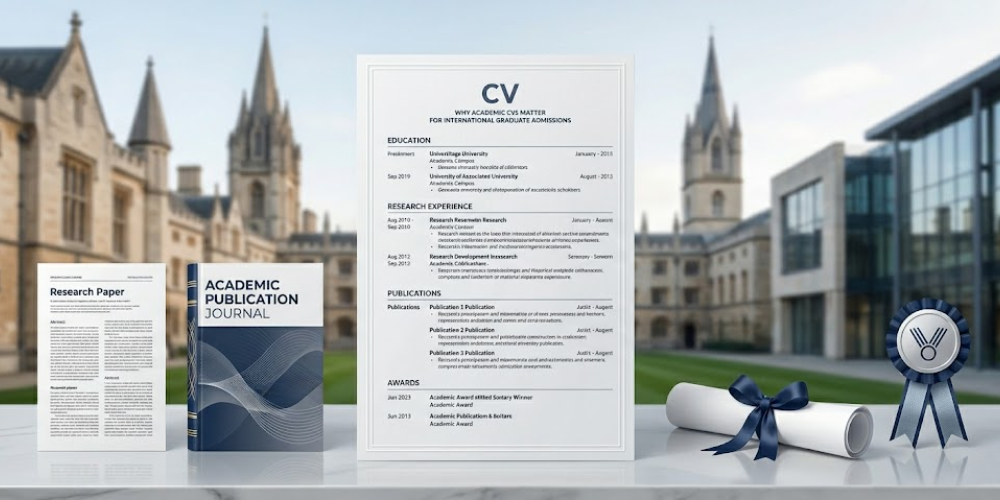
If you’re applying abroad, especially for graduate programs, the academic CV usually plays a bigger role than it does in the U.S.
Many European universities use fairly transparent criteria and focus heavily on things like:
- Academic preparation
- Research experience
- Publications
- Relevant coursework
- Subject-specific skills
That makes the process feel more straightforward in many cases, since decisions are less subjective.
A clear, well-structured CV helps admissions committees quickly see whether your background fits what they’re looking for.
For master’s and PhD applicants in Europe, spending time on this document can genuinely improve your chances.
Get an English-taught Master’s in Europe
Kick-start your education abroad with a powerful master’s degree taught entirely in English. Avoid taking on any student loans and take your 9 to 5 job… international!
Who Is This a Good Fit For?
Learning how to build a strong academic CV is especially useful if you’re:
- Applying for master’s programs
- Applying for PhD programs
- Looking for research assistant roles
- Applying for scholarships
- Pursuing fellowships
- Considering an academic career
- Exploring graduate study abroad
Even if you’re still an undergraduate, it’s smart to start early. You can build it over time instead of rushing later.

Common Myths About Academic CVs
Myth #1: Academic CVs Must Be One Page
Not true.
They’re often multiple pages, and that’s completely normal if you have the experience.
Myth #2: Only Professors Need Them
Also false.
Students use academic CVs all the time for grad school, scholarships, and research roles.
Myth #3: Publications Are Required
Nope.
Many strong applicants don’t have any publications. What matters more is your coursework, research experience, and academic involvement.
Myth #4: Formatting Doesn’t Matter
It does.
A messy CV is harder to read, and that can hurt your presentation even if your content is strong.
Frequently Asked Questions
We’re here to help answer your questions about academic CV
It’s a detailed document that includes your education, research, teaching experience, publications, presentations, awards, and other academic work.
There’s no strict limit.
Undergraduates might have 2–4 pages, while researchers with more experience can have much longer CVs.
A CV is detailed and academic-focused. A resume is shorter and usually focused on professional experience.
Many do, especially in Europe and in research-heavy fields.
Usually no, unless you’re early in your undergraduate studies and don’t have much university experience yet.
Any time you complete something meaningful research, awards, conferences, or new academic work.
Final Thoughts
An academic CV isn’t just a list of achievements. It’s more like a snapshot of your academic path what you’ve studied, what you’ve explored, and where your interests are heading.
If you’re planning to study abroad, this document often plays a bigger role than students expect.
At Beyond The States, we help students find accredited, English-taught degree programs across Europe and understand exactly what admissions teams are looking for. These are full degree programs, often at a much lower cost than many U.S. options, without compromising on quality.
If you’re exploring international study, we can help you figure out your options. Take our College Match Quiz, explore different countries, or book a free strategy session with our team.
We focus on helping you connect your goals with the right programs, and present your academic profile in the strongest way possible.