Can Americans Go to College in Europe?
The average tuition at a private university in the U.S. is now over $40,000 a year. Even public schools can get close once you add out-of-state tuition, housing, and fees. For a lot of families, that just doesn’t add up.
Here’s the part many people miss.
Yes, Americans can go to college in Europe. Not just for a semester abroad, but for a full bachelor’s or master’s degree. These are accredited programs, often taught entirely in English, and they usually cost much less.
That changes things.
Summary
Can Americans Go to College in Europe?
Yes. U.S. students can apply directly to European universities and earn degrees that are recognized globally including back in the U.S.
This isn’t the same as study abroad.
Instead of going through a U.S. college for a semester overseas, you apply straight to a European university and complete your entire degree there. These programs tend to be more focused from the start, you choose your field early and dive into it.
That leads to a few big differences:
- Lower tuition
- Shorter degrees (often 3 years for a bachelor’s)
- Clearer admissions criteria
- Less focus on extracurriculars and “building a story”
Why More Americans Are Choosing Europe
Cost is a big factor, but it’s not the only one.
European universities take a more straightforward approach. Admissions are based mostly on whether you meet the academic requirements. There’s less guesswork, and fewer hidden expectations.
Here’s what stands out:
Key Benefits of Studying in Europe for U.S. Students
- Lower tuition costs
Some public universities charge little to no tuition, even for international students. - English-taught programs
There are thousands of English-taught degrees across countries like the Netherlands, Germany, Ireland, and Sweden. - Transparent admissions
You’ll usually see exact requirements GPA, specific courses, and sometimes test scores. - Shorter degrees
Most bachelor’s programs take 3 years instead of 4. - Global experience
You graduate having lived abroad, which builds independence and adaptability. - Travel accessibility
Living in Europe makes it much easier (and often cheaper) to visit other countries.
A lot of families assume studying abroad is complicated. In reality, it can be more straightforward than applying in the U.S.
Top English-Taught Universities in Europe
This is one of the biggest concerns, and usually not a real issue.
There are thousands of full degree programs taught entirely in English. These aren’t exchange programs they’re designed for international students, including Americans.
Instead of searching randomly, it helps to focus on universities that already enroll U.S. students regularly.
Best for Business and Economics
- Bocconi University (Italy)
One of Europe’s top business schools with strong placement into global finance and consulting. - Erasmus University Rotterdam (Netherlands)
Highly regarded for economics with a large international student population. - Copenhagen Business School (Denmark)
Strong industry connections and specialized business programs.
Best for STEM and Engineering
- Delft University of Technology (Netherlands)
One of Europe’s top engineering schools with selective English-taught programs. - KTH Royal Institute of Technology (Sweden)
Known for innovation, sustainability, and strong research output. - Constructor University (Germany)
Fully English-speaking with structured programs and strong support for international students.
Best for a Broad Range of Majors
- University of Amsterdam (Netherlands)
Wide selection of English-taught degrees across social sciences and humanities. - Trinity College Dublin (Ireland)
Globally recognized with a familiar academic structure for U.S. students. - Lund University (Sweden)
Strong in sustainability, global studies, and interdisciplinary programs.
Best for Global, Flexible Programs
- IE University (Spain)
Modern, flexible curriculum with a strong international focus. - Maastricht University (Netherlands)
Problem-based learning model and highly international environment.
There isn’t one “best” school. It really comes down to fit, your goals, your budget, and your academic background.
Discover all the English-taught European college programs in one place.
Beyond the States provides easy access to 12,600+ European bachelor’s and master’s programs across 870 universities, 550 cities, and 212 areas of study, plus all the resources you need to get there.
3400+
English-taught bachelor’s programs in our database.
550
Beautiful European cities to choose from.
$360,170
Typical savings against a private university in the US.
8200+
English-taught master’s programs in our database.
870
Top-tier universities accepting international students.
$65,038
Typical savings against in-state tuition in the US.
Cost of Studying in Europe for American Students
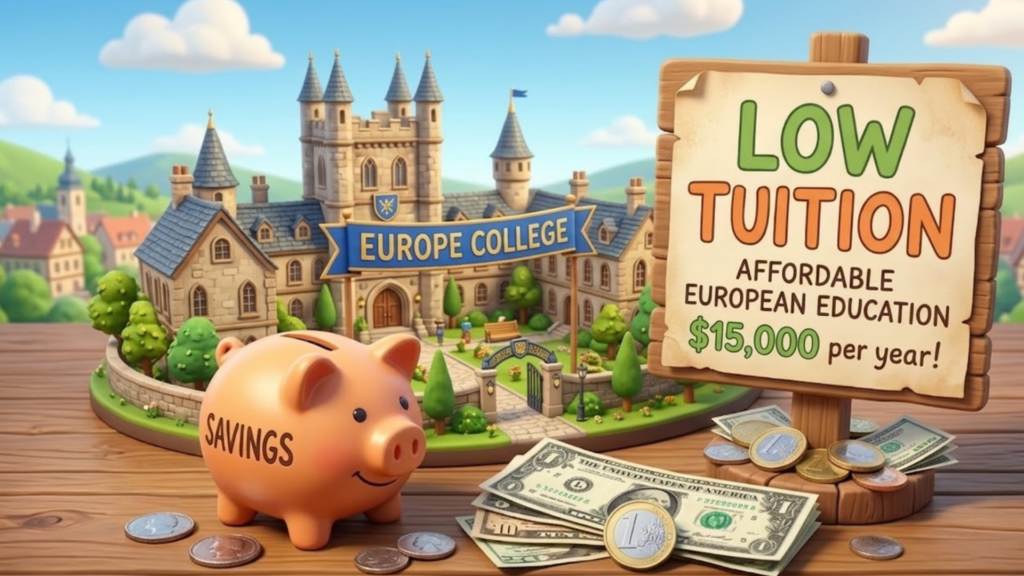
For many families, this is where things really shift.
Tuition Comparison: U.S. vs Europe
| Category | United States | Europe |
| Public University (Out-of-State) | $25,000–$45,000/year | $0–$15,000/year |
| Private University | $40,000–$70,000/year | $3,000–$20,000/year |
| Bachelor’s Degree Length | 4 years | 3 years |
Estimated Annual Costs in Europe
- Tuition: $0–$20,000
- Housing: $6,000–$12,000
- Food & Living: $4,000–$8,000
- Health Insurance: $500–$1,500
Total: $10,000–$30,000 per year (all-in)
Even at the higher end, that’s often less than tuition alone in the U.S.
Requirements for U.S. Students to Study in Europe

Admissions in Europe are usually more structured and predictable than in the U.S.
Common requirements:
Common Requirements
- High school diploma (or equivalent)
- Specific coursework (depends on the program)
- GPA minimums
- SAT/ACT scores (sometimes)
- English proficiency test (if needed)
- Motivation letter (in some cases)
Recommended products
-
Motivation Letters and How to Write Them for European Universities
Original price was: $150.00.$79.00Current price is: $79.00. -
Motivation Letter Review
Original price was: $699.00.$499.00Current price is: $499.00.


What’s usually not required:
- Long extracurricular lists
- Personal branding narratives
- Multiple recommendations
That said, some programs especially competitive ones like engineering or medicine, may require AP exams or specific subjects.



How to Apply to European Universities as an American
The process varies slightly by country, but the structure is consistent.
1. Choose your program first
In Europe, you don’t apply to a general college, you apply to a specific degree.
So:
- You pick your major upfront
- There’s no “undecided” option
- Switching later can be tricky
This part matters more than people expect. Your eligibility depends on how closely your high school coursework matches the subject you’re applying for.
Find the Perfect Degree Program in Europe
Explore accredited bachelor’s and master’s programs with clear admissions and lower costs. Join thousands of students already studying across Europe.

2. Check the exact admission requirements
European universities are very clear about what they want. Each program lays out its criteria, and they’re usually firm.
You’ll often see:
- Minimum GPA
- Required courses (like calculus for engineering)
- SAT/ACT scores (varies by country)
- AP exams (sometimes, especially for competitive programs)
There’s no guesswork here. If you meet the requirements, you’ve got a solid shot.
3. Prepare your application documents
Most applications are straightforward and document-based.
Typically, you’ll need:
- High school transcripts
- Test scores (if required)
- A copy of your passport
- A motivation letter (for some programs)
What you usually won’t need:
- Multiple essays
- Extracurricular lists
- Recommendation letters
One key difference from the U.S.: your academics matter more than your personal story.
4. Submit your application
How you apply depends on the country.
It might be:
- A national system (like Studielink in the Netherlands)
- Or directly through the university’s website
Fees are often lower than in the U.S., and some schools don’t charge one at all.
5. Get your decision
This part tends to move faster than U.S. admissions.
In some cases:
- You’ll hear back within a few weeks
- Offers may be conditional (based on final grades or test scores)
No waitlists. No long stretches of uncertainty.
6. Accept your offer and secure your spot
Once you’re admitted, you’ll confirm your spot. That might include:
- Paying a deposit
- Sending final transcripts
- Completing enrollment forms
7. Apply for your student visa
AAfter you’ve accepted your offer, you’ll apply for a student visa in your destination country.
You’ll typically need:
- Proof of admission
- Proof of financial means
- Health insurance
- Valid passport
Processing times can vary, so it’s smart to start early.
This approach shifts things quite a bit.
Instead of applying to a long list of schools and hoping something works out, most students apply to a smaller number of programs where they clearly meet the requirements.

Student Visas for Americans Studying in Europe
For most countries, yes, you’ll need a student visa.
The good news is that the process is usually manageable and fairly standard.
Common requirements include:
- Acceptance letter from a university
- Proof of financial means
- Health insurance
- Valid passport
- Background documentation
Most students apply after they’ve been admitted and before they arrive. Some countries also allow part-time work while you study, which can help with living costs.
Recommended products
-
Visa & Relocation Concierge
Original price was: $2,999.00.$2,497.00Current price is: $2,497.00.

Are European Degrees Recognized in the U.S.?
This comes up a lot.
Short answer: yes, as long as the university is accredited.
European universities follow national accreditation systems tied to the Bologna Process, which helps standardize degrees across countries.
Graduates regularly:
- Return to the U.S. for jobs
- Apply to U.S. graduate schools
- Work internationally
At Beyond The States, we focus only on accredited programs, so students know their degree will be recognized.
Who Is This a Good Fit For?
Studying in Europe isn’t the right move for everyone. But for some students, it works really well.
You’ll likely do well if you:
- Want a more affordable degree
- Like clear, academic-based admissions instead of a “holistic” process
- Are comfortable being on your own and figuring things out
- Already have a good sense of what you want to study
- Are open to living another country abroad for few years
It might not be the best fit if you:
- Want to try out different majors before deciding
- Picture a traditional U.S. campus experience (sports, dorm life, etc.)
- Don’t feel ready to live abroad or be independent just yet
Common Myths About Studying in Europe
“Degrees won’t be recognized back home”
It will, as long as the university is accredited. These degrees are widely recognized.
“You need to speak another language”
Not necessarily. Many programs are taught entirely in English.
“It’s harder to get in”
Often, it’s actually more straightforward. Requirements are clearly listed and mostly based on academics.
“It’s only for elite students”
Not at all. There’s a wide range of universities, just like in the U.S., with options for different academic levels.
Timeline: When to Start the Process
A little planning goes a long way here.
Typical Timeline
- Spring (Junior Year): Start researching programs
- Summer: Narrow your list and get your documents ready
- Fall (Senior Year): Submit applications
- Winter/Spring: Receive decisions
- Spring/Summer: Apply for your visa and plan the move
Some programs, especially competitive ones have earlier deadlines, so it’s worth double-checking.
Frequently Asked Questions
We’re here to help answer your questions about going to college in Europe as American
In some countries, like Germany, public universities charge little or no tuition, even for international students. You’ll still need to cover living expenses, though.
It depends. Some programs ask for them, others don’t.
Yes, but they can be limited. In many cases, the lower tuition is the main financial advantage.
Often, yes. Many student visas allow part-time work.
In some countries, you can apply for a post-study work visa and stay for a period of time.
Final Thoughts
So, can Americans go to college in Europe?
Yes. And for a lot of students, it’s a practical, more affordable alternative to staying in the U.S.
The key is choosing the right program, knowing what’s required, and starting early enough to stay on track.
If you’re considering it, begin by exploring vetted programs, comparing countries, and understanding what fits your goals.
You can also take the Beyond The States quiz to see options that match your interests and budget, or schedule a strategy session to get a clearer plan.
It’s not the right path for everyone. But for the right student, it can be a really smart one.