The College Hack Nobody Tells You
College costs keep rising, but most families are still following the same expensive script: apply broadly, hope for merit aid, and prepare for years of debt.
That approach is familiar. It is not always the smartest one.
Here’s what most families don’t realize.
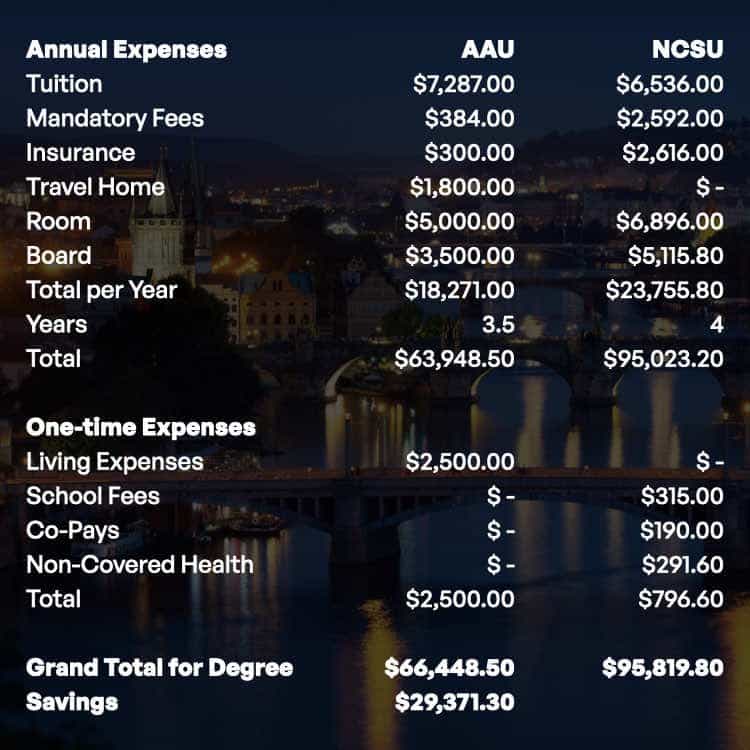
One of the biggest college hacks nobody tells you is that you do not have to complete your entire degree the traditional U.S. way. Many students can earn a full, accredited bachelor’s degree abroad, often in Europe for far less than the cost of one year at a private U.S. university.
And this is where things shift.
The best college strategy is not just about getting in. It is about getting a strong degree, keeping costs reasonable, and building a path to real career opportunities.
Summary
Why College Hacks Matter

Too many students treat college like a brand decision.
It should be a financial and career decision first.
The average family often focuses on rankings, campus tours, and reputation, while overlooking questions that matter more:
- How much debt will this create?
- Will this degree lead to strong career options?
- Are there lower-cost paths to the same outcome?
- Is there a better option outside the U.S.?
Here’s what that means: the best college decision is not always the most obvious one.
Sometimes, it is the least flashy option.
That includes community colleges, transfer pathways, international degrees, and practical career planning from day one.
At Beyond The States, we focus on full bachelor’s and master’s degrees abroad not just semester study abroad programs because affordability and transparency matter.
Discover all the English-taught European college programs in one place.
Beyond the States provides easy access to 12,600+ European bachelor’s and master’s programs across 870 universities, 550 cities, and 212 areas of study, plus all the resources you need to get there.
3400+
English-taught bachelor’s programs in our database.
550
Beautiful European cities to choose from.
$360,170
Typical savings against a private university in the US.
8200+
English-taught master’s programs in our database.
870
Top-tier universities accepting international students.
$65,038
Typical savings against in-state tuition in the US.
The College Hack Nobody Tells You
The biggest college hack nobody tells you is simple:
You should optimize for outcomes, not appearances.
That might mean:
- Starting at community college
- Choosing a European university for a full degree
- Prioritizing internships over prestige
- Selecting majors with clear career value
- Using campus resources most students ignore
Let’s break this down.
The smartest students are often not the ones paying the most. They are the ones making intentional decisions early.
And yes, that includes looking beyond U.S. borders.
At Beyond The States, we focus on full bachelor’s and master’s degrees taught entirely in English across Europe, not semester abroad programs. These are accredited degrees, recognized by employers and graduate schools, often with significantly lower tuition and clearer admissions requirements.
That changes the equation.
Study Abroad for Less in Europe
This is one of the most overlooked strategies for making college affordable.
Many U.S. families think international education means luxury travel pricing.
In reality, full degrees in Europe can cost dramatically less than U.S. tuition.
And we are not talking about “study abroad” for one semester.
We mean earning your full accredited bachelor’s degree abroad.
Find the Perfect Degree Program in Europe
Explore accredited bachelor’s and master’s programs with clear admissions and lower costs. Join thousands of students already studying across Europe.

U.S. vs Europe Cost Comparison
| Option | Average Annual Tuition | Typical Degree Length | Total Tuition Estimate |
|---|---|---|---|
| Private U.S. University | $35,000–$60,000+ | 4 years | $140,000–$240,000+ |
| Public U.S. Out-of-State | $25,000–$40,000 | 4 years | $100,000–$160,000 |
| English-Taught Degree in Europe | $3,000–$15,000 | 3 years (many countries) | $9,000–$45,000 |
That does not include potential housing savings or the shorter degree structure common in Europe.
Why This Works
Many European universities offer:
- Transparent admissions requirements
- Lower tuition for international students
- English-taught bachelor’s programs
- Strong academic quality
- Degrees recognized internationally
Students often apply directly to the program not through a vague “holistic” process.
That means less guesswork.
This is important.
Affordability should not require sacrificing legitimacy. Accredited European universities can absolutely lead to graduate school, U.S. employment, and strong long-term outcomes.

Save Money With Community College Transfer
Not every smart strategy requires leaving the country.
One of the best tips for making college more affordable is starting at community college.
Why It Works
Students can complete:
- General education requirements
- Foundational major coursework
- Transfer prerequisites
…at a fraction of university tuition.
Then they transfer into a four-year institution to complete the bachelor’s degree.
This can reduce total costs dramatically.
Common Mistakes to Avoid
Do not assume all credits transfer automatically.
Students should verify:
- Transfer agreements
- Course equivalencies
- Degree planning requirements
The strategy works best when planned early.
Not after two years of random classes.
Apply for Hidden Scholarships
Many families focus only on large national scholarships.
That is usually a mistake.
Some of the best funding opportunities are smaller, local, and less competitive.
Apply for Hidden Scholarships By Looking Here
- Local foundations
- Community organizations
- Employer-sponsored scholarships
- Professional associations
- Department-specific awards
- International university scholarships
Winning three $2,000 scholarships can matter more than chasing one impossible $50,000 award.
Consistency beats lottery thinking.
Choose Classes With Career Value

Not every elective has the same long-term return.
Students should ask:
Will this class help me get hired?
That does not mean every course must be directly vocational. But students should be intentional.
Choose Classes With Career Value By Prioritizing
- Writing-intensive courses
- Public speaking
- Data analysis
- Business fundamentals
- Technical literacy
- Industry-specific certifications
- Project-based learning
Employers care about evidence of capability.
Course selection can help build that.
Read more: Degrees That Are NOT Worth It Anymore
Use Office Hours to Build Connections
This is one of the simplest advantages students ignore.
Professors are not just there to grade papers.
They can become:
- Internship connectors
- Research mentors
- Recommendation writers
- Graduate school advocates
- Career advisors
Use Office Hours to Build Connections Early
Do not wait until senior year.
Students who regularly attend office hours often build stronger academic and professional relationships.
That matters for scholarships, internships, and references.
And it costs nothing.
Internships Before Graduation
Graduating without experience makes the job search harder.
Internships matter because they reduce the gap between education and employment.
Prioritize Experience Early
Even by sophomore year, students should look for:
- Part-time internships
- Research assistant roles
- Freelance projects
- Campus leadership positions
- Volunteer work with professional relevance
Paid is ideal.
Relevant is essential.
The best internships often come from relationships, not job boards.
Which brings us to the next point.
Build Your Network Early
Networking sounds intimidating. It should not.
It often means:
- Talking to professors
- Joining student organizations
- Connecting with alumni
- Following up after internships
- Asking thoughtful career questions
Relationships compound over time.
Students who start early are rarely scrambling later.
Build your network early because opportunities usually come through people, not job boards.
Use Campus Resources for Free
Families pay for resources students often never touch.
That is wasted value.
Use Campus Resources for Free
Examples include:
- Career centers
- Resume reviews
- Interview prep
- Mental health counseling
- Tutoring centers
- Alumni networks
- Software access
- Career fairs
- Language support
- Financial advising
Students should use these early, not only during a crisis.
Learn High-Income Skills Alongside College
A degree matters.
Skills matter too.
Students should leave college with both.
Learn High-Income Skills Alongside College
Examples include:
- Data analytics
- Excel and financial modeling
- Coding fundamentals
- Digital marketing
- UX research
- Sales communication
- Project management
- Writing for business
This is not about chasing trends.
It is about employability.
Students who combine academic credentials with practical skills are often far more competitive.
Avoid Common College Mistakes
Most expensive mistakes are preventable.
Avoid Common College Mistakes Like:
- Choosing based only on rankings
- Borrowing without understanding repayment
- Ignoring transfer planning
- Waiting too long for internships
- Applying too late for scholarships
- Assuming all international degrees are risky
- Not researching accreditation
- Treating college as separate from career planning
The earlier students think strategically, the better.
Who Is This a Good Fit For?
These strategies are especially strong for:
Students Who Want Lower Debt
Reducing tuition creates more freedom after graduation.
Families Focused on ROI
Cost and outcomes matter more than branding.
Students Open to International Options
Especially those interested in earning a full degree in Europe.
Career-Focused Students
Those who want internships, strong networks, and practical skill development.
Students Frustrated by U.S. Admissions Chaos
European admissions are often clearer, more transparent, and more merit-based.
That clarity helps.
Common Myths About Studying Abroad for a Full Degree
Myth: Degrees Abroad Are Not Legitimate
False.
Many European universities are highly respected and internationally recognized. Accreditation matters, and vetted programs can absolutely lead to graduate school or U.S. employment.
Myth: It Is Only for Wealthy Families
Often the opposite.
Many families choose Europe because it is more affordable than U.S. private colleges.
Myth: It Is Just a Study Abroad Semester
Not with Beyond The States.
We focus on full degrees taught entirely in English.
That is a very different path.
Myth: Admissions Are Too Complicated
Often they are simpler.
Many programs have clearer academic requirements and less emphasis on subjective admissions processes.
Frequently Asked Questions
We’re here to help answer your questions about college hack
Partly, but the bigger idea is strategic decision-making.
That includes choosing affordable degree paths, building career value early, and avoiding unnecessary debt. For many students, a full degree abroad is one of the strongest options.
Sometimes, yes.
Some international universities participate in U.S. federal aid programs, but eligibility varies by institution and country. Students should verify this early.
Absolutely, when planned correctly.
The key is transfer strategy. Students should confirm credits and degree pathways before enrolling.
They care most about skills, internships, results, and communication.
A strong accredited degree plus relevant experience often matters more than a familiar campus name.
Students should verify national accreditation, university recognition, and graduate school compatibility.
This is one reason families work with advisors who specialize in vetted international programs.
Final Thoughts
The college hack nobody tells you is not a trick.
It is better planning.
The smartest path is often not the most expensive one. It is the one that helps students graduate with strong credentials, manageable costs, and real career momentum.
For some families, that means community college first.
For others, it means earning a full bachelor’s degree in Europe for a fraction of U.S. tuition.
Both can be excellent choices.
The goal is clarity.
If you are exploring affordable international degrees, country options, or English-taught programs abroad, Beyond The States helps families research vetted universities and realistic pathways.
Start by exploring programs, comparing countries, or taking the Beyond The States quiz to see what options may fit best.