Best Universities in Europe for American Students
The average cost of a four-year degree in the U.S. has climbed past $100,000. and that’s before you factor in interest. For a lot of families, the whole process feels expensive, confusing, and hard to predict.
But here’s something many people don’t realize:
You don’t have to stay in the U.S. to earn a respected, accredited degree. Thousands of American students are completing full bachelor’s and master’s programs across Europe. Many of these programs are taught entirely in English, and they often cost far less.
That’s where things start to look different.
Summary
Best Universities in Europe for American Students
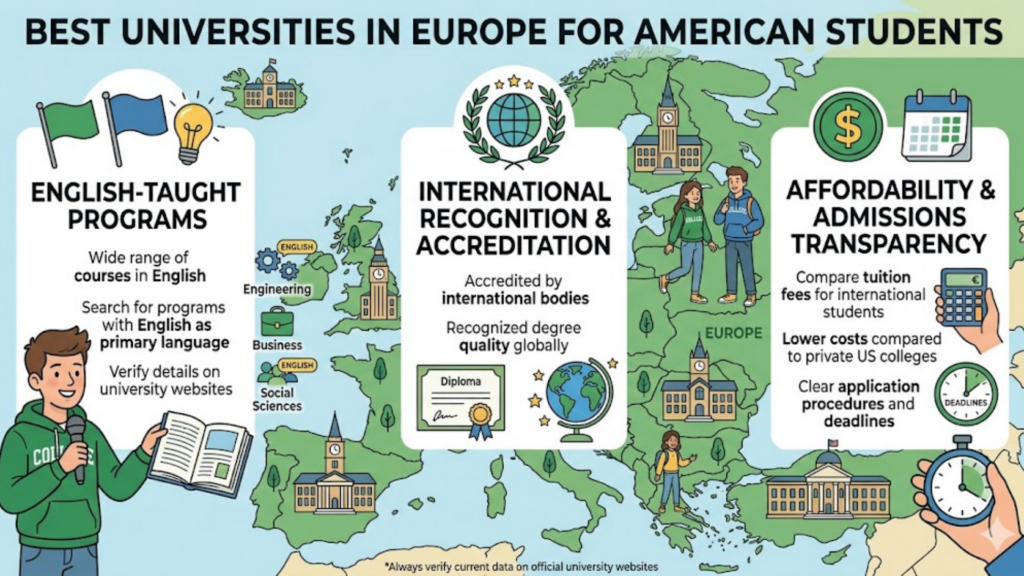
There’s no single answer, it depends on what you’re looking for. But three things matter most:
- English-taught programs
- Recognized and accredited degrees
- Affordable tuition with clear admissions
Here are some universities that consistently check those boxes.
Top-Ranked and Well-Known Options
These schools offer strong reputations, English-taught programs, and good career prospects after graduation.
University of Amsterdam (Netherlands)

- English-Taught Programs: Business Administration, Computer Science, Psychology, International Relations
- Tuition for U.S. Students: €10,000–€15,000/year (bachelor’s programs)
- Scholarships Available: Holland Scholarship, Amsterdam Merit Scholarship
- Key Benefits for U.S. Students:
- Very international student body
- Clear, merit-based admissions
- Strong research reputation
- Option to stay for a year after graduation to look for work
University College Dublin (Ireland)

- English-Taught Programs: Business, Engineering, Computer Science, Law
- Tuition for U.S. Students: €20,000–€25,000/year
- Scholarships Available: Global Excellence Scholarship, Dean’s Scholarship
- Key Benefits for U.S. Students:
- Feels similar to a U.S. academic structure
- Strong connections with global employers
- No language barrier, everything is in English
- 1–2 year post-study work options
KU Leuven (Belgium)

- English-Taught Programs: Engineering, Business, Life Sciences, Computer Science
- Tuition for U.S. Students: €6,000–€10,000/year
- Scholarships Available: International Master’s Scholarships, Merit-Based Awards
- Key Benefits for U.S. Students:
- One of Europe’s top research universities
- Lower tuition compared to similar-ranked schools
- Strong job prospects across Europe
Lund University (Sweden)

- English-Taught Programs: Sustainability, Engineering, Economics, Life Sciences
- Tuition for U.S. Students: €13,000–€17,000/year
- Scholarships Available: Lund University Global Scholarship, Swedish Institute Scholarships
- Key Benefits for U.S. Students:
- Diverse, international community
- Strong focus on innovation and sustainability
- One-year job search option after graduation
Trinity College Dublin (Ireland)

- English-Taught Programs: Humanities, Science, Technology, Business
- Tuition for U.S. Students: €20,000–€27,000/year
- Scholarships Available: Global Excellence Scholarship, Trinity International Scholarships
- Key Benefits for U.S. Students:
- Well-known globally
- Located in an English-speaking country
- Strong track record for graduate school placement
- Clear admissions process
Affordable and High-Value Universities
- University of Warsaw (Poland)
Low tuition, strong academic programs, growing international reputation. - University of Porto (Portugal)
Excellent value, especially for business and engineering. - University of Vienna (Austria)
Extremely low tuition for many programs, rich academic tradition. - Charles University (Czech Republic)
One of Europe’s oldest universities with affordable English-taught options.
Universities With No or Low Tuition
Some countries offer extremely low-cost education, even for Americans:
- Germany (public universities)
- Norway (public universities, though cost of living is higher)
- Austria (very low tuition)
In some cases, a full degree abroadin Europe can cost less than a single year at a private U.S. college.
Do you need to speak another language?
A common misconception is that you need to speak another language to study in Europe.
No.
There are thousands of English-taught programs across Europe, especially in:
These programs are designed for international students and follow widely recognized standards.
At Beyond The States, we focus exclusively on these programs, so you don’t have to filter through options that won’t work.
Discover all the English-taught European college programs in one place.
Beyond the States provides easy access to 12,600+ European bachelor’s and master’s programs across 870 universities, 550 cities, and 212 areas of study, plus all the resources you need to get there.
3400+
English-taught bachelor’s programs in our database.
550
Beautiful European cities to choose from.
$360,170
Typical savings against a private university in the US.
8200+
English-taught master’s programs in our database.
870
Top-tier universities accepting international students.
$65,038
Typical savings against in-state tuition in the US.
Cost of Studying in Europe vs USA
Here’s a simple comparison.
Tuition Comparison
| Category | United States | Europe |
| Public University (Out-of-State) | $25,000–$40,000/year | $0–$15,000/year |
| Private University | $40,000–$70,000/year | $3,000–$20,000/year |
| Elite Institutions | $70,000+ | Often $10,000–$25,000 |
Living Costs (Annual Estimate)
- Western Europe: $10,000–$18,000
- Central/Eastern Europe: $7,000–$12,000
Total Cost (4-Year Degree)
- U.S.: $120,000–$300,000+
- Europe: $40,000–$100,000 (often less)
Even without scholarships, Europe is often significantly more affordable.



Scholarships in Europe for American Students
Tuition is already lower, but scholarships are still available.
They usually fall into three groups:
Government-Funded Scholarships
University-Specific Scholarships
Many universities offer:
- Merit-based awards
- Tuition discounts
- Honors program funding
External Scholarships
- Fulbright (primarily for graduate students)
- Private foundations
That said, the biggest advantage is usually the lower starting cost, not the scholarships.
Best Degree Programs in Europe for American Students
Some fields are especially strong and widely available:
Popular and strong programs
- Business & International Management
- Engineering (Mechanical, Civil, Electrical)
- Computer Science & Data Science
- International Relations & Political Science
- Psychology
- Sustainability & Environmental Studies
Growing areas include:
- Artificial Intelligence
- Renewable Energy
- Global Health
- Digital Media & Communications
European degrees are typically:
- More specialized from the start
- Shorter (3 years for bachelor’s degrees in many countries)
- Focused on real-world application
Student Life in Europe for American Students

Student life is different from the U.S., but that’s not a bad thing.
Academic Structure
- Fewer general education requirements
- More independent learning
- Clear grading systems
Campus Culture
- Less emphasis on campus housing and sports
- More integration into the city
- Strong international student communities
Travel Opportunities
- Affordable travel between countries
- Exposure to multiple cultures
- Weekend trips are common
But it’s worth being clear about one thing. This isn’t a typical “study abroad” experience. You’re earning a full degree, building a global network, and learning how to live independently in another country.
Can you work in Europe after graduating?
This is a big question and in many cases, the answer is yes.
Post-Graduation Work Options
- Netherlands: 1-year “orientation visa”
- Germany: 18-month job search visa
- Ireland: 1–2 year stay-back option
- Sweden: 1-year job-seeking permit
Industries Hiring International Graduates
- Tech and IT
- Engineering
- Finance and consulting
- International business
A local language can help, but many roles especially in tech are available in English. Salaries may be lower than in the U.S., but so are living costs and student debt.
Admissions: How Europe Differs from the U.S.
Admissions in Europe are more straightforward and focused on academics.
- More transparent
- More academically focused
- Less dependent on essays and extracurriculars
You’ll typically need:
- High school diploma
- Specific course requirements (especially for STEM)
- Proof of English proficiency (if required)
You usually won’t need:
- Multiple recommendation letters
- Long extracurricular lists
- Personal essays
If you meet the requirements, you’re likely in. If not, you’re not. It’s clear and predictable.
Who Is This a Good Fit For?
Studying in Europe isn’t for everyone. But it’s a strong option if you:
- Want a more affordable degree
- Prefer clear admissions criteria
- Are open to living abroad for a few years
- Value international experienceand independence
It may not be ideal if you:
- Want a traditional U.S. campus experience
- Prefer to explore different subjects before choosing a major
- Aren’t ready to live in another country
Common Misconceptions About Studying in Europe
“Degrees won’t be recognized in the U.S.”
They are. Many European universities are globally ranked, and graduates regularly return to the U.S. for work or graduate school.
“You need to speak another language”
You don’t. There are thousands of English-taught programs.
“It’s only for wealthy students”
Actually, many families choose Europe because it’s more affordable.
“Admissions are harder”
They’re just different, and often simpler.
Frequently Asked Questions
We’re here to help answer your questions about Best Universities in Europe for American Students
Yes, as long as the university is accredited.
Yes, though some programs require certain subjects.
Bachelor’s programs are usually three years.
Often no, though some programs may require them.
Sometimes, but this path works best if you plan to finish your degree in Europe.
Most deadlines fall between January and April.
Final Thoughts
Europe offers something many U.S. students are looking for: a clearer process, lower costs, and degrees that are recognized globally.
This isn’t just a short-term experience. It’s a full academic path, one that can open doors internationally while keeping long-term costs more manageable.
At Beyond The States, we help students find English-taught programs that match their goals, budget, and academic background. If you want help figuring out your next step, you can explore your options or book a strategy session to talk it through.