How Many Times Can You Take The MCAT?
Many students don’t hit their target MCAT score on the first try. That’s normal. But retaking the exam isn’t unlimited and poor planning can quietly weaken an otherwise strong application.
Here’s what most students don’t realize.
You can take the MCAT multiple times, but strict caps apply across single years, consecutive years, and your lifetime. And every attempt counts.
Now here’s the part that matters.
If you’re pursuing medical school whether in the U.S. or earning a full, accredited medical degree abroad taught in English, your MCAT strategy plays a major role in your timeline, cost, and stress level. In fact, many European programs don’t require the MCAT at all, offering a different path entirely.
Let’s break this down.
Summary
MCAT Retake Limits and Rules
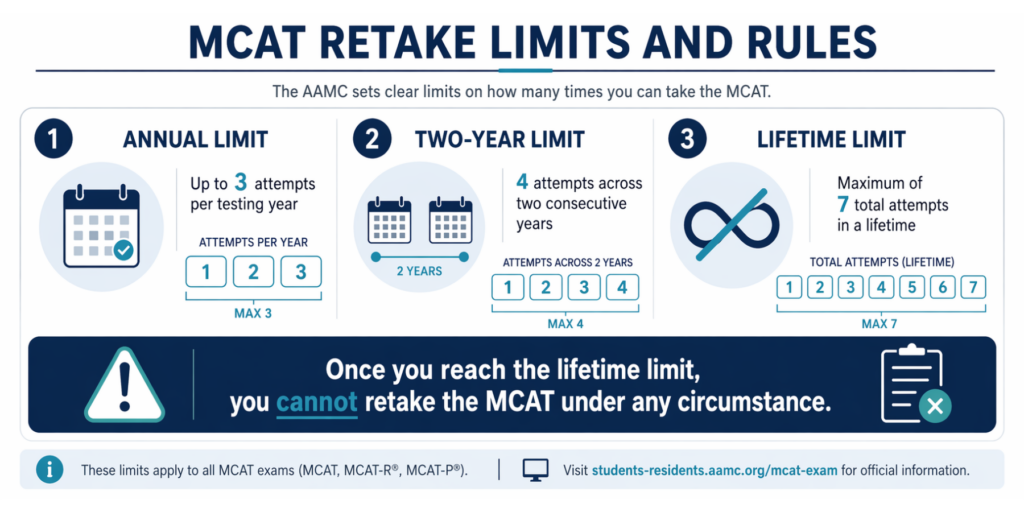
The Association of American Medical Colleges (AAMC) sets clear limits on how many times you can take the MCAT.
MCAT Attempt Limits per Year
You can take the MCAT:
- Up to 3 times in a single testing year
MCAT Attempt Limits Over Time
- 4 times over two consecutive years
- 7 times over your lifetime
MCAT Lifetime Attempt Limit
Once you reach 7 total attempts, you cannot take the MCAT again, no exceptions.
Here’s a simple breakdown:
| Time Frame | Attempt Limit |
|---|---|
| Per Year | 3 |
| Two Consecutive Years | 4 |
| Lifetime | 7 |
This is important.
Every attempt counts toward your lifetime total, regardless of your score.
Read more: How Hard Is the MCAT?
MCAT Retake Policies Explained
Understanding the rules is one thing. Knowing how they apply in real situations is another.
Do Voided or No-Show Exams Count?
Yes, sometimes.
- Voided exams: Count as an attempt
- No-shows: Count as an attempt
- Canceled registrations (before deadline): Do NOT count
Here’s what that means.
If you sit for the exam and choose to void your score, it still counts toward your limit, even though schools won’t see the score.
MCAT Retake Policies Explained
On paper, multiple attempts look like flexibility. In practice, they require discipline, timing, and a clear plan.
Here’s what that means.
Do Voided or No-Show Exams Count?
Yes, and this is where many students get caught off guard.
A voided exam feels like a reset. It isn’t.
Voided exams:
- You sit for the exam, complete it (or part of it), then choose to void
- Your score is not released to schools
- But the attempt still counts toward your limits
Voiding can still be the right move in very specific situations:
- You had a technical issue during the test
- You experienced illness or a serious disruption
- You know your performance is far below your baseline
But voiding because you “feel unsure” is risky. Many students underestimate their performance.
No-shows:
- If you register and don’t show up, it counts as an attempt
- There is no score, but the attempt is recorded
This is one of the most costly mistakes, because you gain no data from the experience.
Cancellations:
- If you cancel within the allowed window, it typically does not count
- You may lose part of your fee depending on timing
Here’s the practical takeaway:
- Reschedule or cancel early if you’re not ready
- Don’t rely on voiding as a safety net
Medical School Policies on Multiple Scores
Every U.S. medical school receives your full MCAT testing history through Association of American Medical Colleges.
There is no official “score replacement” system.
But schools don’t all interpret scores the same way.
How Schools Evaluate Multiple Scores
Admissions committees typically use one of three approaches:
1. Highest Score Focus
- Emphasis on your best performance
- Common at some MD programs
- Still, other scores are visible and considered in context
2. Most Recent Score
- Focus on your latest attempt
- Assumes your most recent score reflects your current ability
3. Holistic Score Review (Most Common)
- Evaluates all attempts together
- Looks for patterns, trends, and consistency
This is where strategy matters most.
How Schools View Multiple MCAT Attempts
Taking the MCAT more than once is normal. Taking it multiple times without improvement is not.
Admissions committees are not just evaluating your score, they’re evaluating your decision-making.
What Strong Retake Patterns Look Like
Upward trajectory:
- Example: 503 → 508 → 512
- Signals growth, better preparation, and resilience
Clear improvement after adjustment:
- You changed study methods, timing, or resources
- Your score reflects that change
Limited, purposeful attempts:
- 1–3 total attempts is typical
- Each attempt has a clear rationale
What Raises Concerns
Score stagnation:
- Example: 505 → 506 → 505
- Suggests ineffective preparation
Declining scores:
- Example: 510 → 507 → 504
- Raises questions about readiness and judgment
Excessive attempts:
- 4+ attempts is where scrutiny increases
- Not disqualifying, but it must be explained
Now here’s the twist.
Admissions committees are not asking, “How many times did you take it?”
They’re asking, “Did you learn, adapt, and improve?”
Strategic Planning for MCAT Retakes
When Should You Retake the MCAT?
A retake should be a data-driven decision, not an emotional reaction.
Strong reasons to retake:
- Your score is below your target range by a meaningful margin
- Your practice test average was significantly higher than your real score
- You experienced a clear external disruption (illness, emergency)
When You Should Pause Instead
- Your practice scores match your real score
- You don’t have a new study strategy
- You’re relying on “trying harder” instead of changing approach
Here’s a useful benchmark:
- Retake only if you can realistically improve by 3–5+ points
Anything less often doesn’t change admissions outcomes.
Read more: When Should You Take the MCAT?
Risks of Taking the MCAT Too Many Times
This is important.
Each additional attempt has diminishing returns, and increasing risk.
1. Attempt Limits Are Finite
- You only have 7 lifetime attempts
- Using them inefficiently reduces future flexibility
2. Score Plateau Risk
Many students hit a plateau after 2–3 attempts.
Why?
- Content gaps remain unaddressed
- Test-taking habits don’t change
- Burnout reduces performance
3. Application Optics
Multiple attempts without improvement can signal:
- Poor planning
- Lack of self-assessment
- Inefficient study strategies
4. Timeline Delays
Each retake can push your application back by a full year.
And this changes the equation.
Delaying your application has real costs:
- Lost earning potential
- Additional prep expenses
- Extended academic timelines
How to Improve Your Score Before Retaking
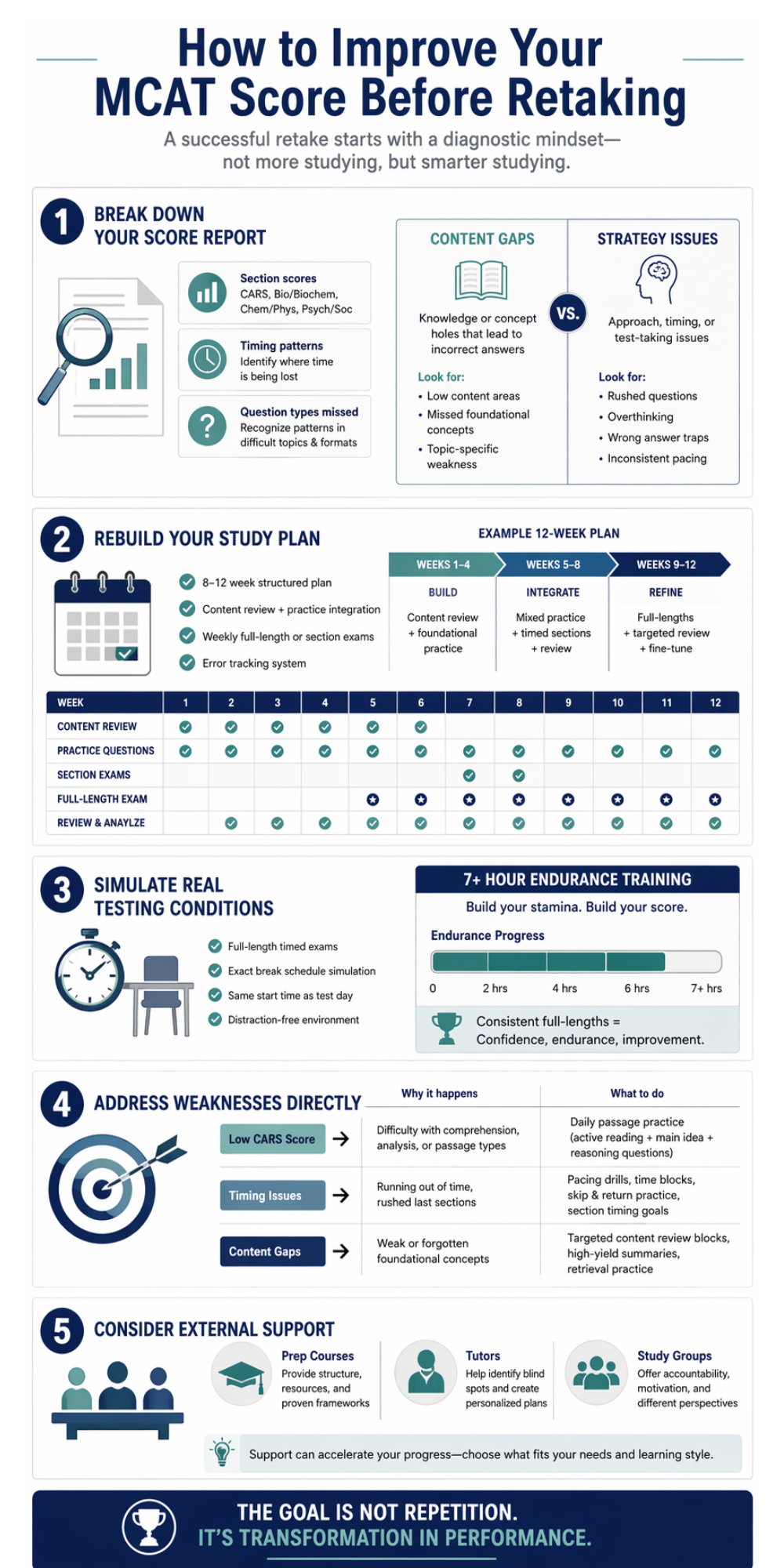
A successful retake starts with a diagnostic mindset.
Not “study more”, but “study differently.”
Step 1: Break Down Your Score Report
Look at:
- Section scores (CARS, Bio/Biochem, Chem/Phys, Psych/Soc)
- Timing patterns
- Question types you missed
Identify:
- Content gaps vs. strategy issues
Step 2: Rebuild Your Study Plan
Effective plans include:
- 8–12 weeks minimum
- Content review + practice integration
- Weekly full-length or section exams
- Error tracking system
Step 3: Simulate Real Testing Conditions
- Take full-length exams under timed conditions
- Follow exact break schedules
- Build stamina for a 7+ hour test
Step 4: Address Weaknesses Directly
Examples:
- Low CARS → daily passage practice
- Timing issues → pacing drills
- Content gaps → targeted review
Step 5: Consider External Support
If you’ve already attempted once or twice:
- Prep courses can provide structure
- Tutors can identify blind spots
- Study groups can improve accountability
The goal is not repetition. It’s transformation in performance.
Related article: How Long to Study for the MCAT
Related article: Best MCAT Prep Course
MCAT Registration and Scheduling Tips
How to Plan Your Test Dates Wisely
MCAT scheduling is competitive and strategic timing matters.
Registration Strategy
- Register as early as possible (2–3 months minimum)
- Choose a location and date that minimizes stress
- Avoid stacking test dates too closely
Align With the Application Cycle
For U.S. applicants:
- January–April: Ideal first attempt window
- May–June: Retake window if needed
- After June: Risky for same-cycle applications
Here’s what that means.
Your MCAT timeline should support not delay, your application.
Best Time to Retake the MCAT
The best retake is not the fastest one. It’s the most prepared one.
Strong Retake Timing
- Practice scores consistently higher than your previous real score
- You’ve completed a full study cycle
- You have 6–10 weeks of focused preparation
Weak Retake Timing
- Retesting within a few weeks
- No change in study strategy
- Rushing to meet deadlines
But wait.
Rushing a retake often leads to the same or worse outcome while using up another attempt.
Considering Medical School Abroad: A Strategic Alternative
Now here’s where things shift.
Many accredited medical programs in Europe:
- Do not require the MCAT
- Use clear academic criteria instead of holistic admissions
- Offer direct-entry programs from high school or early college
This is not study abroad. These are full medical degrees taught in English and recognized internationally.
For students struggling with repeated MCAT attempts, this can be a practical alternative.
Discover all the English-taught European college programs in one place.
Beyond the States provides easy access to 12,600+ European bachelor’s and master’s programs across 870 universities, 550 cities, and 212 areas of study, plus all the resources you need to get there.
3400+
English-taught bachelor’s programs in our database.
550
Beautiful European cities to choose from.
$360,170
Typical savings against a private university in the US.
8200+
English-taught master’s programs in our database.
870
Top-tier universities accepting international students.
$65,038
Typical savings against in-state tuition in the US.
Cost Comparison: U.S. vs Europe Medical Education
| Category | U.S. Medical School | Europe (English-Taught Programs) |
|---|---|---|
| Tuition (per year) | $40,000–$70,000+ | $8,000–$25,000 |
| MCAT Required | Yes | Often No |
| Admissions Style | Holistic, competitive | Merit-based, transparent |
| Total Duration | 8+ years (incl. undergrad) | 5–6 years direct entry |
Here’s what that means.
For some students, avoiding repeated MCAT attempts and saving significant cost makes studying abroad a strategic decision, not a backup plan.



Who Is This a Good Fit For?
The traditional MCAT path works well if you:
- Perform strongly on standardized tests
- Can dedicate significant time to preparation
- Are targeting U.S. MD or DO programs
Exploring alternatives may make sense if you:
- Struggle with high-stakes testing
- Want more predictable admissions criteria
- Are cost-conscious
- Are open to international education pathways

Common Misconceptions About MCAT Attempts
“You can retake it as many times as you want”
False. There are strict caps 3 per year, 7 lifetime.
“Schools only look at your highest score”
Not entirely true. Many schools review all attempts and trends.
“Voiding a test doesn’t count”
Incorrect. Voided exams still count toward your attempt limits.
“More attempts increase your chances”
Not necessarily. Too many attempts can weaken your application.
Frequently Asked Questions
We’re here to help answer your questions about MCAT Retake Policies
You can take the MCAT up to 7 times in your lifetime.
You can take it up to 3 times in a single year.
Yes. No-shows count toward your attempt limit.
Yes. Even if you void your score, it still counts as an attempt.
It depends. A clear improvement trend helps. Multiple similar or declining scores can raise concerns.
Only if your target schools require a higher score and you’re confident you can improve significantly.
Final Thoughts
The MCAT is important. But it’s not the only path to becoming a doctor.
A smart strategy isn’t about taking the test as many times as possible. It’s about knowing when to retake and when to consider other options.
If you’re weighing your next step, it may be worth exploring medical programs abroad that offer:
- Transparent admissions
- Lower costs
- No MCAT requirement
At Beyond The States, we specialize in helping students find fully accredited, English-taught degree programs across Europe.
If you’re not sure where you stand, you can explore your options or schedule a strategy session to map out your path.