When Should You Take the MCAT?
The MCAT is often treated like a deadline. In reality, it’s a timing decision that can shape your entire medical school application strategy.
Most U.S. pre-med students don’t realize this early enough. They prepare hard, register late, or misalign their test date with their application cycle and end up limiting their options before they even submit an application.
The MCAT is not just about preparation, it’s about alignment. With application cycles, coursework, clinical experience, and even gap year planning. Choosing when to take it can either open doors or delay your entire path to medical school.
Summary
When Should You Take the MCAT?

Most students should take the MCAT between March and May of the year they plan to apply to medical school.
Why?
Because medical school applications open in June, and admissions are rolling. That means earlier applications are reviewed first, and interview spots are not evenly distributed throughout the cycle.
To be competitive, your MCAT score should be ready when you submit your application, not weeks later.
Simple rule:
- Best timing: March–May
- Acceptable timing: June–early July
- Risky timing: August–September
Now let’s break down why that matters.
What Is the MCAT and Why Timing Matters
The MCAT (Medical College Admission Test) is a standardized, computer-based exam required for admission to most U.S. and Canadian medical schools. It evaluates:
- Biological and biochemical foundations
- Chemical and physical sciences
- Psychology and sociology
- Critical reasoning and passage analysis
Most of the content comes from introductory undergraduate science courses. However, the challenge is not content familiarity, it’s integration under time pressure.
Why timing matters more than most students expect:

Medical schools do not wait for your MCAT score to review your application.
They review applications as they become complete.
So if your application is submitted in June but your MCAT score arrives in July or August, you are already later in the queue, even if your score is excellent.
This is one of the most misunderstood parts of the process.
MCAT Test Dates and Availability
The MCAT is offered from January through September, with the highest concentration of test dates between March and July.
Key realities:
- Popular spring dates fill early (March–May)
- Urban test centers book months in advance
- Summer dates (June–July) are the most competitive
- Late summer (August–September) is limited and strategically late for admissions
What students underestimate:
You don’t just choose a date based on readiness, you choose based on availability.
Once seats fill, flexibility disappears.
MCAT Registration Timeline

Registration is structured in advance and opens in phases.
Typical cycle:
- October: Registration opens for January–May test dates
- February: Registration opens for June–September test dates
Seats are assigned on a first-come, first-served basis.
Important implications:
- Waiting to “feel ready” often means fewer date options
- High-demand centers may fill within days
- Rescheduling later is possible, but limited and costly
This is why MCAT planning should begin 6–12 months before your intended test date, not 6–12 weeks before.
Best Time of Year to Take the MCAT
There is a clear performance + admissions overlap window.
Best window: March to May
This is the ideal range because:
- You complete enough coursework to be prepared
- Scores return before applications open
- You retain maximum flexibility for retakes
Secondary window: June to early July
This can still work if:
- You are submitting applications in early June
- You are confident in your score readiness
- You are not planning a retake
Late window: August–September
This is where strategy becomes constrained:
- Applications are already under review
- Interview spots may be filling
- Retake options are limited for the same cycle
When to Take the MCAT for Application Cycle Alignment
Medical school applications operate on a rolling admissions system, meaning:
- Applications are reviewed as they are received
- Interview invitations are issued continuously
- Seats are filled gradually over months
Ideal alignment:
| Step | Timeline |
|---|---|
| MCAT prep begins | September–January |
| MCAT taken | March–May |
| Score released | April–June |
| Application submitted | June |
| Secondary applications | July–August |
| Interviews | September onward |
Why this matters:
A strong MCAT score submitted late is often less competitive than a slightly lower score submitted early.
Timing affects visibility.
When to Take the MCAT – Junior or Senior Year?
Most students take the MCAT after completing their prerequisite coursework, which usually includes:
- General chemistry
- Organic chemistry
- Biology
- Physics
- Psychology and sociology
That typically places testing during junior year or the summer after junior year.
Junior Year (Most Strategic Option)
Most applicants test during:
- January–May of junior year
- Or June after spring semester ends
Why this works best:
- Aligns with application cycle
- Allows time for a retake
- Keeps academic momentum intact
- Supports early submission (a major advantage in rolling admissions)
Senior Year (Less Common, More Risky)
Some students delay until senior year due to:
- Heavy coursework load
- Late academic planning
- Weak early preparation
However, this introduces risks:
- Delayed application submission
- Reduced school selection flexibility
- Possible gap year requirement
Key takeaway:
Junior year is not just common, it is strategically optimal for most students.
When to Take MCAT During a Gap Year
Many students now take a gap year before medical school, and it can be strategically beneficial if used correctly.
Benefits of gap year MCAT timing:
- Full-time study availability
- Higher score potential
- Reduced academic pressure
- More structured preparation cycles
Ideal gap year timeline:
- Fall: structured MCAT prep begins
- Winter: full-length exams and refinement
- Spring (March–May): MCAT exam
- Summer: application submission for next cycle
Important caution:
A gap year should be intentional. Medical schools value productivity during this time:
- Clinical experience
- Research
- Service work
- Academic growth
It is not simply a pause it is a development period.
MCAT Study Timeline
Most students require 300–350 hours of preparation for a competitive MCAT score.
Typical breakdown:
- Content review: 40%
- Practice questions: 30%
- Full-length exams: 20%
- Review and correction: 10%
Example schedule:
- 4–6 months total prep time
- 10–15 hours per week
- Increased intensity in final 6 weeks
This is where many students miscalculate: they choose a test date first, then try to fit studying into it.
The correct approach is the opposite.
Read more: Best MCAT Prep Course
How to Build Your MCAT Study Schedule
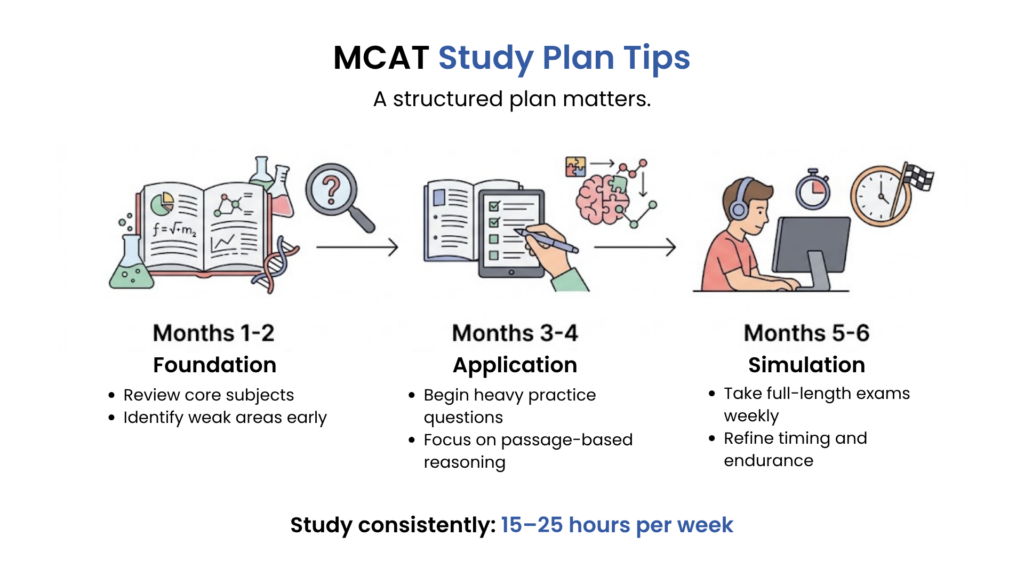
A realistic MCAT schedule should be reverse-engineered from your test date.
Phase 1: Foundation (Months 1–2)
- Content review (books/videos)
- Light practice questions
Phase 2: Application (Months 3–4)
- Targeted practice sets
- Weak area reinforcement
Phase 3: Simulation (Final 4–6 weeks)
- Full-length exams weekly
- Timing practice
- Error review cycles
Read more: Blueprint MCAT Review
Weekly structure:
- 15–25 hours/week typical
- More during dedicated study blocks
- Less during heavy academic periods
How Late Can You Take the MCAT?
Technically, the MCAT can be taken through September of your application year.
However, strategically:
- Ideal latest time: July
- Absolute latest recommended time: August
- September: generally outside optimal admissions timing
Why late testing is risky:
- Application review may already be underway
- Interview invitations are distributed earlier in cycles
- Fewer spots remain in later months
Even strong scores lose some strategic advantage when submitted late.
Retaking the MCAT Strategy
Retaking the MCAT is common but should be deliberate.
When a retake makes sense:
- Score significantly below target schools
- Practice exams showed higher readiness
- External factors impacted performance
When a retake does NOT help:
- Minimal expected improvement
- Weak preparation foundation
- Late timing in application cycle
Important rule:
A retake should improve your admissions position, not just your confidence.
Factors to Consider Before Choosing Your MCAT Date
Before locking in a test date, evaluate:
- Academic workload (especially science-heavy semesters)
- Completion of prerequisite courses
- Availability of dedicated study time
- Application cycle timing
- Retake flexibility
- Personal stress and burnout risk
This is where many students go wrong they choose convenience instead of strategy.
Test Center and Exam Day Logistics
Logistics matter more than students expect.
Consider:
- Distance to test center
- Parking and transportation reliability
- Morning arrival time requirements
- Familiarity with location
- Scheduling flexibility
A stressful test-day environment can affect performance more than content gaps.
MCAT Score Release and Application Timing
MCAT scores are released approximately 30–35 days after testing.
Example:
- April MCAT → May score release
- June MCAT → July score release
This delay is critical for application planning.
Key insight:
Your application is only considered “complete” when your MCAT score is received.
Who Is This Strategy Best For?
This MCAT timing approach is ideal for:
- Traditional U.S. pre-med students
- Students applying to competitive MD programs
- First-generation applicants navigating timelines independently
- Students balancing coursework and MCAT prep
- Gap year applicants optimizing performance
Recommended products
-

How To Study Medicine Abroad
$299.00 -
Study Nursing Abroad
$299.00 -
College Admissions Counseling – Platinum
Original price was: $12,000.00.$8,997.00Current price is: $8,997.00.



Common Misconceptions About MCAT Timing
“I should take it as soon as I finish prerequisites”
Finishing your courses is important, but it doesn’t mean you’re test-ready. The MCAT requires dedicated prep time to practice applying concepts and building endurance.
“A higher score later is always better”
Not necessarily. Because admissions are rolling, an earlier complete application can have an advantage, even with a slightly lower score.
“I can take the MCAT anytime during the application cycle”
While technically true, your application won’t be fully reviewed until your score is received. A later test date can delay your entire application.
“Taking it later gives me more time, so it’s safer”
More time can help, but pushing your test date too far back reduces flexibility for retakes and can weaken your application timing.
“I’ll just retake it if needed”
Retakes are possible, but only if your timing allows it. A late first attempt can eliminate that option within the same cycle.
Frequently Asked Questions
We’re here to help answer your questions about
Most students should take it between March and May of their application year to align with rolling admissions.
Junior year is most common and strategically preferred due to earlier application timing and retake flexibility.
Most students need 3–6 months and approximately 300–350 study hours.
Yes, and many students perform better with full-time preparation during a gap year.
After July is generally considered late for competitive rolling admissions.
Final Thoughts
When should you take the MCAT?
Not simply when you finish studying. Not when your schedule clears. Not when it feels convenient.
You should take it when your preparation timeline and medical school application cycle align.
That alignment determines whether your score works for you or against you.
If you are also exploring broader educational pathways, including structured international degree options that are more transparent and merit-based, organizations like Beyond The States help students compare accredited full-degree programs across Europe and understand alternative routes to professional careers.
You can explore options, schedule a strategy session or learn about guided admissions support through their Platinum Admissions program.
The MCAT is not just a test date decision. It is a timeline decision, and getting it right changes everything that follows.