Cost of Living Spain vs USA
The average college graduate in the United States leaves school with tens of thousands of dollars in student debt. Meanwhile, students in Spain can often earn an accredited bachelor’s degree while spending less on tuition and everyday living than many Americans pay just for rent.
That’s the part a lot of families don’t realize.
You’re not limited to expensive U.S. universities or short-term study abroad programs. American students can earn full, internationally recognized degrees in Europe often entirely in English for a much lower cost.
And once families start looking at the numbers, the conversation changes.
For many people, the question isn’t whether studying abroad is possible anymore. It’s whether paying American-level college costs still makes sense.
Summary
Is Spain Cheaper Than the USA?
Yes. In most areas, Spain is significantly less expensive than the United States.
Housing, groceries, transportation, healthcare, and university tuition all tend to cost less. Depending on the city and lifestyle, Americans may spend anywhere from 30% to 60% less living in Spain than they would in major U.S. cities.
That includes students earning full degrees abroad.
The biggest savings usually come from:
- Rent
- Healthcare
- Public transportation
- University tuition
- Dining and groceries
Madrid and Barcelona are more expensive than smaller Spanish cities, but even they’re often cheaper than places like Boston, New York, Los Angeles, or Chicago.
Cost of Living: Spain vs. USA
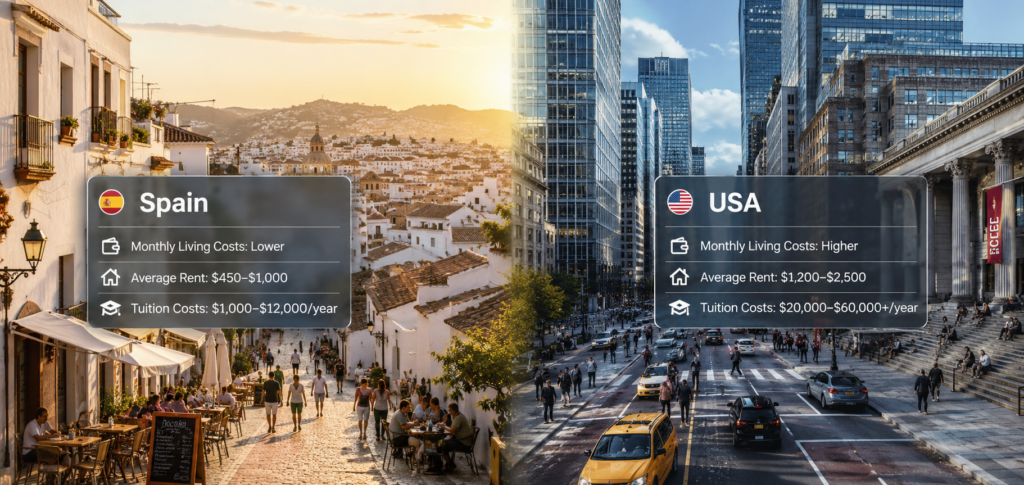
When people compare Spain and the U.S., they often think about vacation costs.
But living somewhere long term is completely different.
Residents benefit from local pricing, affordable public transportation, lower university tuition, and subsidized healthcare systems. Those things add up quickly over a few years.
Average Monthly Living Costs: Spain vs. United States
| Expense | Spain (Student Estimate) | United States (Student Estimate) |
|---|---|---|
| Rent (shared apartment) | $400–$900 | $900–$2,000 |
| Groceries | $200–$350 | $350–$600 |
| Public transportation | $30–$60 | $80–$150 |
| Mobile phone | $15–$30 | $50–$90 |
| Healthcare/insurance | Often lower | Often significantly higher |
| Dining out | $10–$15 meals common | $18–$30 meals common |
| University tuition | Often $3,000–$12,000/year | Often $20,000–$80,000/year |
Exact costs depend on the city and your lifestyle. Still, the overall pattern is pretty consistent: Spain is usually much more affordable.
How Much Cheaper Is Spain Than the US?
For many Americans, living in Spain can cost 40% to 50% less overall.
Housing alone changes the math dramatically.
A student sharing an apartment in Valencia or Granada may pay less than half of what a student would spend in cities like Boston or San Diego. Even Madrid can compare favorably to major U.S. urban areas.
Average Rent in Spain vs. the United States
Housing is usually the biggest monthly expense for students and families, so it matters more than people sometimes expect.
| City | Average Shared Student Housing |
|---|---|
| Madrid | $700–$1,100 |
| Barcelona | $700–$1,200 |
| Valencia | $450–$800 |
| Granada | $350–$700 |
| New York City | $1,500–$2,500+ |
| Boston | $1,200–$2,200 |
| Los Angeles | $1,200–$2,000 |
| Chicago | $900–$1,800 |
A lot of families focus almost entirely on tuition. But housing can drive the total cost of college just as much.
Lower living expenses can make a huge difference, even before tuition savings are factored in.
Tuition Costs: One of the Biggest Differences
The U.S. university system often combines high tuition with financial aid packages that can be difficult to predict.
Spain tends to be more straightforward.
Many universities publish clear tuition rates upfront, so families can estimate costs before applying.
For English-taught bachelor’s degrees in Spain, tuition often falls around:
- Public universities: approximately €1,000–€6,000 per year
- Private universities: approximately €6,000–€20,000 per year
Even some private universities in Spain cost less than out-of-state tuition at U.S. public universities.
And these are full accredited degrees not exchange programs.
Degrees from recognized Spanish universities are internationally respected and can be used for graduate school applications or careers in the United States and elsewhere.
Discover all the English-taught European college programs in one place.
Beyond the States provides easy access to 12,600+ European bachelor’s and master’s programs across 870 universities, 550 cities, and 212 areas of study, plus all the resources you need to get there.
3400+
English-taught bachelor’s programs in our database.
550
Beautiful European cities to choose from.
$360,170
Typical savings against a private university in the US.
8200+
English-taught master’s programs in our database.
870
Top-tier universities accepting international students.
$65,038
Typical savings against in-state tuition in the US.
Can Americans Afford to Live in Spain?
In many cases, yes more easily than they expect.
Lower daily expenses open doors for families who feel priced out of the traditional American college path.
Students often find they can:
- Live independently sooner
- Borrow less in student loans
- Budget more predictably
- Use affordable public transportation
- Live comfortably without needing a car
That said, there are still upfront costs families need to plan for.
Upfront Costs to Expect
Moving abroad isn’t free. Families should budget for:
- Flights
- Visa processing
- Housing deposits
- Residency paperwork
- Health insurance
- Emergency savings
Most students should expect higher startup costs during the first few months.
But over four years, total expenses are often still much lower than attending a comparable U.S. university.
Living in Spain vs. USA: Pros and Cons
Spain isn’t automatically the right choice for every student.
The best fit depends on personality, academic goals, budget, and how comfortable someone feels living internationally.
Pros of Living in Spain
1. Lower overall costs
Housing, transportation, and tuition are generally much more affordable.
2. Better public transportation
Many students can get around easily without owning a car.
3. International experience
Students gain global perspective and intercultural experience that employers increasingly value.
4. Simpler admissions processes
European admissions are often more direct and focused on academics.
5. Slower pace of life
A lot of students appreciate the stronger work-life balance.
Cons of Living in Spain
1. Bureaucracy can be frustrating
Visa paperwork and residency processes sometimes require patience.
2. Language barriers still exist
Even in English-taught programs, daily life may require some Spanish.
3. Cultural adjustment takes time
Classroom expectations and academic systems can feel different at first.
4. Distance from family
Travel costs and time zone differences are real factors.
Interestingly, many students who worry most about adapting abroad end up settling in faster than they expected especially when they’re part of structured degree programs with good international student support.
Cost Breakdown for an American Student in Spain
Here’s a realistic monthly budget example for a student living outside Madrid or Barcelona.
Estimated Monthly Student Budget in Spain
| Expense | Estimated Cost |
|---|---|
| Shared apartment | $500 |
| Utilities | $60 |
| Groceries | $250 |
| Transportation | $40 |
| Phone | $20 |
| Dining/social | $150 |
| Miscellaneous | $100 |
| Total | Approximately $1,120/month |
In many U.S. cities, rent alone can cost more than that.
For middle-income families especially, that changes the whole equation.
Who Is This a Good Fit For?
Living and studying in Spain can be a great option for students who:
- Want a more affordable path to a degree
- Are excited by international experiences
- Prefer walkable, city-centered lifestyles
- Want to reduce student debt
- Enjoy cultural immersion
- Appreciate clear admissions requirements and transparent costs
Find the Perfect Degree Program in Europe
Explore accredited bachelor’s and master’s programs with clear admissions and lower costs. Join thousands of students already studying across Europe.

It can work especially well for:
- Independent students
- Gap year students
- Families looking to lower overall education costs
- Students interested in international business, hospitality, communications, or the social sciences
Choosing the Right City in Spain
Not every city in Spain feels the same, and that’s part of the appeal.
Madrid

Best for:
- Big-city energy
- International connections
- Business opportunities
It’s one of the more expensive cities in Spain, but still often cheaper than major U.S. cities.
Barcelona

Best for:
- Creative industries
- International student life
- Mediterranean lifestyle
Barcelona is vibrant and highly international, though housing prices have climbed in recent years.
Valencia

Best for:
- A balance between affordability and city life
- Beach access
- Lower housing costs
Many students see Valencia as one of the best-value cities in Spain.
Granada

Best for:
- Very affordable living
- A classic student atmosphere
- A smaller-city feel
It’s especially appealing for students trying to keep costs low.
Common Misconceptions About Studying in Spain
“Degrees from Spain are not legitimate.”
False.
Accredited Spanish universities are internationally recognized. Many are part of the European Higher Education Area (EHEA), which helps standardize degree systems across Europe.
Students regularly move on to:
- U.S. graduate schools
- International careers
- Global companies
- Professional licensing pathways, depending on the field
“You must speak fluent Spanish.”
Not necessarily.
A growing number of universities offer full bachelor’s and master’s degrees taught entirely in English.
That said, knowing even basic Spanish can make everyday life a lot easier, and more enjoyable too.
“Studying abroad is only for wealthy students.”
In many cases, the opposite is true.
For some families, earning a degree abroad can actually cost less than attending an out-of-state public university in the U.S.
“European admissions are impossible to navigate.”
They’re often more straightforward than people expect.
Many European universities place more emphasis on academic qualifications and less on the highly subjective admissions factors common in parts of the U.S. system.
FAQ: Cost of Living in Spain Compared to America
Is Spain cheaper than the USA?
Yes. In general, Spain is significantly less expensive than the United States when it comes to housing, transportation, healthcare, and university tuition.
How much cheaper is Spain than the U.S.?
Depending on the city and lifestyle, living in Spain can cost roughly 30% to 60% less than living in many U.S. cities.
Can Americans afford to live in Spain as students?
Many can.
Lower tuition and lower day-to-day living costs often make Spain far more financially accessible than a traditional U.S. university path.
What is the average rent in Spain vs. the United States?
Shared student housing in Spain can range from about $350 to $1,200 per month depending on the city.
In comparable U.S. cities, similar housing often ranges from $900 to $2,500 or more.
Are degrees from Spain recognized in the United States?
Yes, as long as the university is properly accredited.
Many Spanish universities are well respected internationally and recognized in the U.S.
Do I need to speak Spanish to study in Spain?
Not always.
Many universities offer full degree programs in English, especially at the bachelor’s and master’s levels.
Final Thoughts
The conversation around higher education is shifting.
Families are asking tougher questions about debt, affordability, and long-term value. Spain has become part of that conversation for a reason.
Lower living costs. Transparent tuition. Internationally recognized degrees. A different approach to student life.
It’s not the right fit for everyone. But for far more students than most people realize, it’s a realistic option.
Beyond The States helps students explore fully accredited degree programs across Europe, including English-taught options in Spain. We research universities, compare affordability, and help families figure out which pathways genuinely make sense for their goals and budget.
You can explore programs, compare country options, or schedule a free strategy session through Beyond The States.