Internships Abroad for College Students
More than 70% of employers say they value candidates with international experience and cross-cultural skills. Yet many U.S. students still assume that studying or interning abroad is only for language majors or families with large budgets.
Here’s what many families don’t realize.
International experience is no longer just a nice extra on a resume. It’s becoming a real differentiator in an increasingly competitive job market. More students are also discovering that earning a fully accredited degree abroad—not just spending a semester overseas—can open doors to internships, global connections, and more affordable education options.
Summary
Why International Experience Matters More Than Ever
Students often ask if an internship abroad is really worth the extra planning.
In most cases, yes.
Employers increasingly want graduates who can work across cultures, adapt to unfamiliar situations, and collaborate with international teams. Those skills are hard to develop from a classroom alone.
At the same time, many European universities offer affordable, accredited degrees taught entirely in English. Students pursuing full degrees abroad often have easier access to internship opportunities throughout Europe, creating both academic and career advantages.
And perhaps the biggest shift? International experience is no longer limited to a single study abroad semester.
What Are Internships Abroad for College Students?
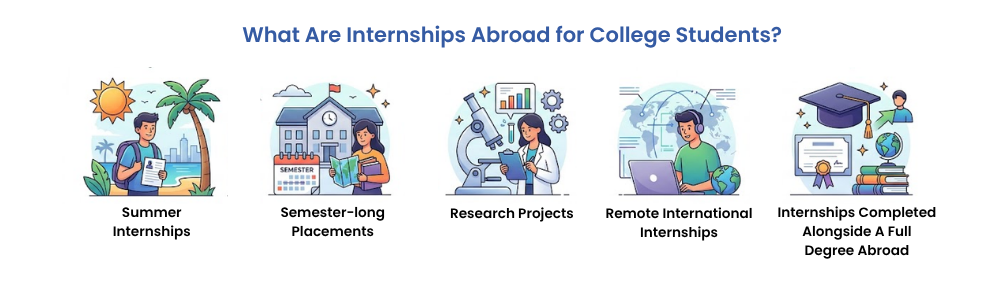
International internships give students the chance to gain professional experience while working in another country or with international organizations.
These opportunities can include:
- Summer internships
- Semester-long placements
- Research projects
- Remote international internships
- Internships completed alongside a full degree abroad
Definition of International Internships
An international internship combines professional development with cultural immersion. Students work in real organizations while learning to navigate different workplace norms, communication styles, and business practices.
Unlike tourism or short-term travel, these experiences are centered on career preparation.
Domestic vs. International Internships
| Factor | Domestic Internship | International Internship |
|---|---|---|
| Workplace Culture | Familiar | New cultural environment |
| Professional Network | Mostly local | Global connections |
| Communication Skills | Limited cross-cultural exposure | Strong intercultural development |
| Resume Differentiation | Common | Often highly distinctive |
| Language Exposure | Usually English only | Potential multilingual environment |
International internships can showcase adaptability and initiative in ways many domestic experiences simply cannot.
Academic Credit Internships
Many universities allow students to earn academic credit through internships abroad.
Programs may include:
- Faculty supervision
- Reflection assignments
- Internship seminars
- Transferable credits
Students pursuing degrees in Europe often find internships built directly into their programs, especially in countries like the Netherlands and Germany.
Short-Term vs. Semester-Long Internships
Short-term internships typically last between four and twelve weeks and often take place during summer breaks.
Semester-long experiences may include:
- Full-time placements
- Combined coursework and work experiences
- Internship semesters integrated into degree programs
The good news is that students can often choose an option that fits both their academic goals and budget.
Why Should College Students Consider Internships Abroad?
International internships offer much more than an interesting line on a resume.
Career Development
Employers increasingly value graduates who demonstrate:
- Adaptability
- Problem-solving skills
- Initiative
- Cross-cultural competence
An internship abroad can help students stand out in competitive hiring environments.
Internships Abroad for College Students Build Transferable Skills
Students often develop:
- Project management skills
- Professional communication abilities
- Global business awareness
- Greater confidence in unfamiliar situations
These are skills that transfer across industries and career paths.
Cross-Cultural Communication Skills
Global companies operate across borders. Whether someone works in finance, engineering, healthcare, education, or technology, collaborating with international teams is becoming increasingly common.
Students who intern abroad often gain experience with:
- Different communication styles
- International workplace expectations
- Cultural approaches to problem-solving
- Diverse team environments
Global competence is quickly becoming a workplace necessity rather than a niche advantage.
Personal Growth and Independence
Living and working abroad often speeds up personal growth.
Students frequently report improvements in:
- Confidence
- Independence
- Resilience
- Decision-making skills
Simply managing everyday life in another country can build maturity and adaptability in ways that are hard to replicate.
Global Networking Opportunities
Professional relationships built abroad can create opportunities long after graduation.
International networks may lead to:
- Future job opportunities
- Graduate school recommendations
- Research collaborations
- International career pathways
What Types of Study Abroad Internship Opportunities Are Available?
International internships are much more varied than many students expect.
Paid Internships Abroad

Some countries and industries offer paid internships, although compensation varies based on:
- Country regulations
- Industry sector
- Internship duration
- Student visa requirements
Paid opportunities are more common in areas such as:
- Engineering
- Technology
- Business
- Finance
Virtual International Internships

Remote internships have made international experience more accessible.
Students can:
- Work with global organizations from home
- Gain international experience without relocation costs
- Build cross-cultural communication skills virtually
For students with budget limitations, this can be an especially attractive option.
Research Internships

Research internships are particularly appealing for students considering graduate school.
Popular fields include:
- Environmental science
- Public health
- Psychology
- Biology
- Engineering
Research placements abroad can strengthen graduate school applications while exposing students to different academic systems.
Industry-Specific Placements

Business Internships
Students may work in:
- Marketing
- International business
- Entrepreneurship
- Consulting
Engineering Internships
Opportunities often include:
- Manufacturing
- Sustainability projects
- Renewable energy
- Product development
Education Internships
Examples include:
- Teaching assistantships
- International schools
- Educational nonprofits
Healthcare Internships
Programs may involve:
- Public health initiatives
- Healthcare administration
- Research placements
Clinical opportunities vary depending on country regulations and licensing requirements.

Join the conversation.
Get real answers.
Beyond the States is a student community for those building their future in Europe.
Which Countries Offer the Best Internship Opportunities for Students?
Different countries offer different strengths.
Spain
Spain remains one of Europe’s most popular destinations for international students.
Its strengths include:
- Strong tourism and hospitality industries
- A growing startup ecosystem
- Lower living costs than many Western European countries
- An increasing number of English-taught degree programs
Students earning degrees in Spain often benefit from internship opportunities integrated into their studies.
Italy
Italy offers opportunities in:
- Fashion
- Design
- Business
- Arts and cultural industries
- International relations
Many English-taught programs combine affordability with access to major European industries.
Germany
Germany is particularly attractive for students interested in:
- Engineering
- Technology
- Manufacturing
- Research
Many public universities have low or no tuition fees, making degree programs especially appealing.
Germany’s strong economy also creates internship opportunities throughout students‘ studies.
Netherlands
The Netherlands consistently ranks among the top destinations for English-taught education.
Advantages include:
- A large number of English-speaking workplaces
- An international business environment
- A strong internship culture
- High-quality universities
Many Dutch programs place a strong emphasis on practical learning and industry engagement.
How Can College Students Find International Internship Programs?
Finding quality opportunities takes some research.
University Partnerships
Many universities maintain exchange agreements and internship partnerships abroad.
Students should explore resources such as:
- Career centers
- International offices
- Faculty connections
Third-Party Internship Providers
Organizations specializing in international placements can make the process easier.
Services often include:
- Placement assistance
- Housing support
- Visa guidance
- Cultural preparation
That said, students should carefully evaluate both quality and cost.
Direct Company Applications
Some students apply directly to overseas companies.
This route may require:
- Additional research
- Greater independence
- Earlier planning
However, it can also provide more flexibility and lower costs.
Study Abroad Organizations
Organizations focused on international education can provide guidance on:
- Country selection
- Program quality
- Accreditation
- Internship integration
This becomes especially valuable for students considering full degrees abroad alongside internship opportunities.
International Internship Costs: What Should Families Expect?
Costs can vary significantly.
| Expense | Estimated Range |
|---|---|
| Program Fees | $1,500–$8,000+ |
| Housing | $500–$1,500/month |
| Flights | $500–$1,500 |
| Insurance | $200–$600 |
| Daily Expenses | Depends on the country |
One important consideration: students pursuing full degrees in Europe often benefit from substantially lower tuition costs compared to many U.S. institutions. That can create more flexibility for internships and other international experiences during their studies.
Beyond The States International Internship Counseling
Finding the right internship abroad can feel overwhelming.
Students have to consider:
- Countries
- Visa requirements
- Academic compatibility
- Program quality
- Career alignment
Our International Internship Counseling service helps students identify opportunities that fit both their academic goals and long-term career plans.
Because we focus extensively on international education pathways, we understand how internships fit into broader degree planning, including for students pursuing full bachelor’s degrees in Europe.
We also help families answer questions such as:
- Which countries best align with career goals?
- Are internships integrated into degree programs?
- How do costs compare?
- Which opportunities offer the strongest long-term value?
Recommended products
-
International Internship Counseling
Original price was: $2,500.00.$497.00Current price is: $497.00.

Who Is This a Good Fit For?
International internships may be a great option for students who:
- Want to stand out in the job market
- Are considering international careers
- Enjoy experiencing new cultures
- Value practical learning opportunities
- Are interested in earning a full degree abroad
They can be especially valuable for students pursuing fields such as:
- Business
- International relations
- Engineering
- Sustainability
- Public health

Common Misconceptions About Internships Abroad
Myth: International internships are only for wealthy students.
Not necessarily.
Many countries offer relatively affordable living costs, and some internships provide compensation.
Myth: Employers don’t value international experience.
In reality, many employers actively seek candidates with global competencies and cross-cultural skills.
Myth: Credits and degrees earned abroad aren’t legitimate.
This misconception comes up often.
Many European universities are internationally recognized and fully accredited. Degrees earned abroad are generally accepted by employers and graduate schools in the United States, provided students attend properly accredited institutions.
Myth: You need to speak another language.
Not always.
Many internship opportunities and degree programs across Europe are taught entirely in English.
Frequently Asked Questions
We’re here to help answer your questions about
For many students, yes. International internships can strengthen resumes, build professional skills, and expand global networks.
Often, yes. Many universities offer academic credit options or integrate internships directly into degree programs.
It depends on your goals. Germany is strong for engineering, the Netherlands for international business, Spain for affordability, and Italy for design and cultural industries.
Sometimes. Internships can create professional connections and open doors to future opportunities.
For some students, earning a full degree abroad may offer greater affordability, more integrated internship opportunities, and a longer international experience than a single semester overseas.
Final Thoughts
Internships abroad for college students offer much more than a temporary travel experience.
They provide practical skills, professional connections, and global perspectives that matter more and more in today’s workforce. For some students, these experiences become the first step toward something bigger: earning a full accredited degree abroad and building an international career foundation.
At Beyond The States, we help families navigate these options with clarity and transparency. We research programs, compare costs, and help students identify pathways that align with their goals.
Explore country options, review degree opportunities, take our quiz, or connect with us to discover which international education opportunities may be the right fit for your future.