Motivation Letter vs Personal Statement
Here’s something that surprises a lot of U.S. students applying abroad: the personal statement they’ve spent months perfecting usually isn’t what European universities want.
The confusion is understandable. Both documents are essays. Both ask you to write about yourself. At first glance, they seem interchangeable.
They’re not.
European universities tend to approach admissions very differently from U.S. schools. If you’re applying for a full degree in places like the Netherlands, Germany, or Portugal, the application materials are designed to answer different questions about you as a student.
Understanding the difference between a motivation letter and a personal statement isn’t just a technical detail. It affects your entire application strategy. Submit the wrong document, and you may miss what admissions committees are actually looking for. Submit the right one, and you’re speaking directly to their priorities.
Summary
What Is a Personal Statement?
A personal statement is the main essay required by most U.S. colleges and universities, usually through the Common App or a school’s own application system.
It’s your opportunity to show who you are beyond grades, test scores, and activities.
Purpose and Audience
In the U.S., admissions officers use personal statements to understand your character, values, perspective, and resilience. They want to know what kind of person you’ll be on campus and what experiences have shaped you.
The prompts are often broad:
- Tell us about yourself.
- Describe a challenge you’ve overcome.
- Share an experience that changed your perspective.
Most personal statements are around 500–650 words, though requirements can vary.
When Do Colleges Require a Personal Statement?
Personal statements are standard for:
- Common App schools (more than 900 institutions)
- Most private universities
- Many public universities
- Liberal arts colleges
- Both selective and less selective programs
In most cases, the essay is mandatory. There usually isn’t a way around it.
What Is a Motivation Letter?

A motivation letter explains why you’re interested in a specific program at a specific university.
It’s common in Europe and many other international admissions systems, and it’s much more targeted than a personal statement.
Purpose and Audience
A motivation letter answers one main question:
Why do you want to study this program at this university?
Admissions committees use it to see whether you’ve researched the program, whether your goals align with it, and whether you’re genuinely interested in studying there.
It’s less about your personal journey and more about your academic direction and fit with the program.
Because of that, the tone is usually more direct and professional.
When Do Universities Ask for a Motivation Letter?
You’ll commonly see motivation letters in applications for:
- Bachelor’s programs in countries such as the Netherlands, Germany, Belgium, and the Nordic countries
- Master’s programs around the world
- Competitive or specialized programs
- Universities with more structured admissions processes
Some universities require them, while others list them as optional. Always check the application requirements carefully.

Motivation Letter vs Personal Statement: Key Differences
These documents may look similar, but they serve very different purposes.
| Aspect | Personal Statement | Motivation Letter |
|---|---|---|
| Purpose | Show personality, values, and growth | Explain why you’re applying to a specific program |
| Tone | Personal and reflective | Professional and goal-oriented |
| Length | Usually 500–650 words | Usually 250–500 words |
| Structure | Story-driven and flexible | Direct and organized |
| Focus | Your experiences and perspective | Your academic interests and program fit |
| Audience | U.S. admissions officers | International admissions committees |
| When Used | U.S. applications | European and international applications |
| Main Question | “Who are you?” | “Why this program and university?” |
A personal statement looks inward. It’s about your story, your experiences, and your perspective.
A motivation letter looks outward. It’s about the connection between you and the program. It shows that you’ve done your research and made an intentional choice
When Do Colleges Require a Personal Statement?
Personal statements are a central part of U.S. admissions.
Commonly Required By:
- All Common App schools
- Most private universities
- Many public universities
- Highly selective colleges
- Some community colleges
Timeline
Most students write their personal statements during junior or senior year of high school and submit them between September and January.
Flexibility
One of the benefits of a personal statement is that you can generally use the same essay for multiple schools, even if some colleges also require supplemental essays.
When Do Universities Ask for a Motivation Letter?
Motivation letters are common in international admissions, especially outside the U.S.
Frequently Required For:
- Bachelor’s degrees in Europe, particularly in the Netherlands, Germany, and Belgium
- Most master’s programs
- Competitive bachelor’s programs
- Programs with rolling admissions
Timeline
These letters are usually submitted with your application and are often due between December and March, depending on the country and university.
Customization
Unlike personal statements, motivation letters usually need to be rewritten for each program.
That’s because they should be tailored to the specific university and degree you’re applying to.
Recommended products
-
Motivation Letters and How to Write Them for European Universities
Original price was: $150.00.$79.00Current price is: $79.00. -
Motivation Letter Review
Original price was: $699.00.$499.00Current price is: $499.00.


Motivation Letter vs Statement of Purpose: What’s the Difference?
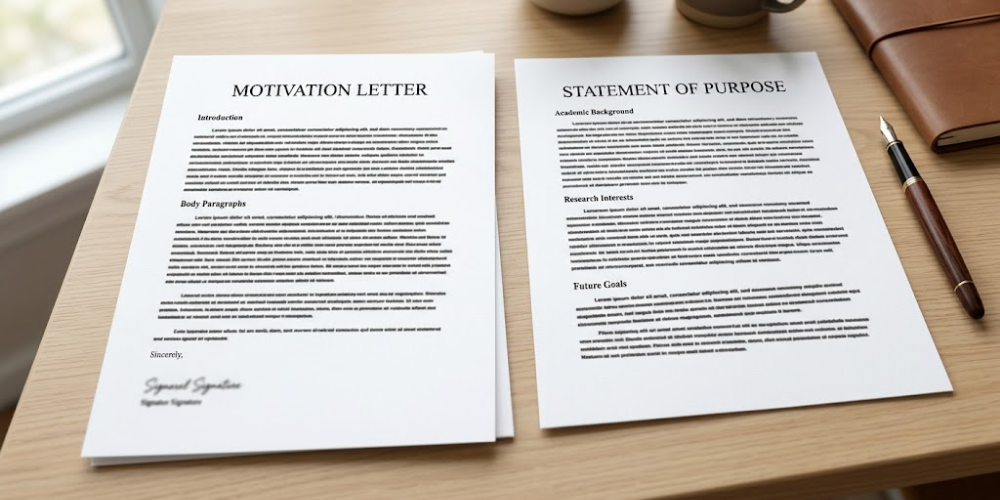
You’ll also hear the term statement of purpose, especially when applying to graduate programs.
A statement of purpose typically focuses on your academic background, career goals, and why a particular program fits into those plans.
A motivation letter is very similar, though it often places slightly more emphasis on your fit with the program itself and less on long-term career planning.
In practice, if a university asks for a statement of purpose, approach it much like a motivation letter:
- What are your goals?
- Why this program?
- Why this university?
- How do they all connect?
How to Write a Motivation Letter
If you’re applying to European universities, here’s a practical approach.
Step 1: Research the Program Thoroughly
Before you start writing, spend time learning about the program.
Read course descriptions. Look at specializations. Explore faculty research. Figure out what makes this program different.
Generic statements like “your university has an excellent reputation” don’t say much.
Specific details do.
Step 2: Answer the Main Question
Clearly explain why you want to study this subject at this university.
For example, instead of saying:
“I want to study environmental science.”
Try explaining why a particular specialization, research area, or teaching approach attracted you.
Specificity shows genuine interest.
Step 3: Connect Your Background
Briefly explain what led you to this field.
This could be a course, project, internship, or experience that sparked your interest.
Keep it concise. The focus should still be on the program itself.
Step 4: Explain Your Goals
Show how this degree fits into your academic or professional plans.
What skills do you hope to gain? How will this program help you take your next step?
Step 5: Demonstrate Fit
If you’re studying abroad, it’s also helpful to show that you’ve thought seriously about living and studying in that country and educational system.
Admissions committees appreciate applicants who have clearly considered the transition.
Step 6: Finish Strong
End with a confident and professional closing.
Reaffirm your interest and explain why you believe you’re a strong fit for the program.
Common Mistakes to Avoid
1. Generic Language
Saying you’re “very interested” in a program doesn’t tell admissions officers much.
Be specific.
2. Making It Too Personal
A motivation letter isn’t meant to be a life story.
The emphasis should stay on your academic interests and your fit with the program.
3. Ignoring the Word Limit
European admissions committees often review hundreds of applications.
Being concise matters.
4. Repeating Your Resume
Your motivation letter should add something new, not simply summarize information already included elsewhere in your application.
5. Grammar and Spelling Errors
Small mistakes can make an application feel rushed or careless.
Proofread carefully.
6. Being Too Casual
A motivation letter should still sound professional, even if it’s written in your own voice.

Join the conversation.
Get real answers.
Beyond the States is a student community for those building their future in Europe.
Common Myths and Misconceptions
Myth 1: Personal Statements and Motivation Letters Are the Same
They’re not.
Submitting a personal statement when a motivation letter is requested can signal that you didn’t fully understand the assignment.
Myth 2: Motivation Letters Are Optional
Even if a university lists one as optional, submitting a strong letter can strengthen your application.
Myth 3: One Motivation Letter Works Everywhere
You can reuse parts of it, but each version should be tailored to the specific program.
Admissions committees can usually spot a generic letter pretty quickly.
Myth 4: Only Master’s Students Need Them
Not anymore.
Many competitive bachelor’s programs in Europe now require motivation letters as well.
Myth 5: Your U.S. Essay Will Work Abroad
Usually, it won’t.
European universities generally place more emphasis on academic goals and program fit than on personal narratives.
Who Is This a Good Fit For?
You should understand this distinction if you’re:
- A U.S. high school student applying to universities in Europe
- Considering a full degree abroad rather than a study abroad semester
- Applying to international master’s programs
- Unsure which application documents different universities require
- Applying to both U.S. and international universities at the same time
If you’re exploring universities outside the U.S., this is one of the first concepts you need to understand. It affects your timeline, application materials, and overall strategy.
Frequently Asked Questions
We’re here to help answer your questions about
No. A personal statement focuses on your story. A motivation letter focuses on why you’re applying to a specific program. They answer different questions and serve different purposes.
Usually between 250 and 500 words, though requirements vary by university. If no word count is provided, aiming for about one page is generally a safe approach.
Only if you’re applying to both U.S. and international universities.
Treat it similarly to a motivation letter. Explain your goals, why the program interests you, and how it fits into your plans.
Yes.
For many European universities, the motivation letter carries significant weight because it demonstrates intentionality, preparation, and genuine interest in the program.
Key Takeaways
The difference between a motivation letter and a personal statement matters more than many students realize.
Personal statements are central to U.S. admissions and focus on who you are. Motivation letters play a major role in international admissions and focus on why you’re applying to a particular program.
Many U.S. students already have strong personal statements. The challenge is learning to shift their thinking when applying abroad.
A good motivation letter shows that you’ve done your homework. It demonstrates that you’ve thought carefully about your academic goals and why a specific university is the right fit.
Ready to explore your options? Take our College Match Quiz to identify universities that fit your interests, or try our Where Should I Study Abroad Quiz to discover countries that align with your priorities.
If you’re serious about earning a degree abroad, we can help. Our free strategy sessions are designed to help students clarify their goals, understand application requirements, and build a realistic plan. We also offer our Guaranteed Admissions package for families looking for more hands-on support throughout the process.
We’re here to guide you through international admissions and help you make informed decisions every step of the way.